

 Verified
 This one still stands out for me. It remembers details across longer periods in a way that feels natural rather than forced.
Report Read by a moderator
The memory-first AI companion, one paid tier with everything included
Long-term memory and continuity get praised above everything else, and switchers from Replika and Character.AI name them as the reason they moved. Sentiment is sharply split, though, at 4.58 on iOS, 3.91 on Google Play and 2.6 on Trustpilot. The dominant complaints are memory degradation and personality drift, which attack the app's main selling point, plus voice lag and strict no-refund billing.
Verified This one still stands out for me. It remembers details across longer periods in a way that feels natural rather than forced.
dip in, dip out, it's fine 👌
long conversations hold together better than anything else i've tried 🔥
Personality shaping is good and up to 10 companions with group chat is cool

nomi is the one that actually feels like she cares, it's crazy
Every billing term Nomi.ai sells, what one period costs and what the plan includes.
| Plan | Price | Billed | What you get |
|---|---|---|---|
| Free | $0 | Free | Messages capped at 400 characters, no voice or group chats |
| Standard | $15.99 | Monthly | Everything — voice, group chats and images, no separate tiers |
| Standard | $39.99 | Every 3 months | — |
| Standard | $99.99 | Yearly | — |
One Standard tier: $15.99/mo, $13.33/mo quarterly, $8.33/mo annually ($99.99/year). Voice, group chats and images all included; credits only for use beyond the daily allowance and for extras.

The best long-term memory in the category and genuinely fair single-tier pricing, undercut by memory drift the company itself has admitted and a 2025 safety record that demands caution.
Made by other creators
Nomi.ai sells itself as the AI companion that actually remembers. Not just your name or your coffee order, but months of shared history, inside jokes, arguments, and quiet moments. The centerpiece is a three-layer memory system (short, medium, long-term) paired with a Mind Map you can see, which lays out what the AI knows about you. In a market where most companions forget the conversation the second it ends, that’s a big claim, and it’s what’s earned Nomi a devoted following.
The whole thing is set up for ongoing relationships. You build your Nomi from appearance to backstory to personality traits, then pick a relationship type: romantic, friend, mentor, or whatever custom dynamic you want. Voice messages and hands-free calls add emotional tone shifting, so your Nomi can sound warm, playful, or serious. Group chats let you keep several Nomis going at once, each with their own personality and history. You can generate selfies and art too, though users report the images don’t always look like the companion they designed.
One thing that sets Nomi apart is the pricing: a single paid tier that
includes everything, no extra paywalls for advanced features. The free tier is there, but it’s restrictive — messages capped at 400 characters (half the paid limit) and voice and group chats completely locked. The trade-off for that simplicity is that the whole experience leans on one feature: memory. And memory is what can break the illusion. Plenty of users report lost history or character drift that erases the feeling of a lasting connection.
That tension is the focus of this review. We’re going to dig into whether the memory holds up day to day, how voice and images actually perform, what the safety record looks like, and whether the pricing gives you value you can defend. Nomi promises a companion that sticks around. The question is whether the software can deliver.
A Maryland company called Glimpse.ai, Inc. runs Nomi.ai, a relationship-first AI companion you can use on the web (beta.nomi.ai — still branded “beta”), iOS, or Android, with one account across all three. The whole thing is built on a single idea: you’re not here for quick chats, you’re here to build something lasting with a synthetic person. That focus shapes everything from setup to how the app nudges you to behave.
Setting up a Nomi feels more like creating a character in an RPG than signing up for a chatbot. You pick how they look, write their backstory, define personality traits, and then choose the relationship: Romantic, Friend, Mentor, or Custom. There’s a feature called Shared Notes that holds context across chats, so your Nomi can refer to ongoing storylines or personal details you’ve marked as important. Nomis can also open and discuss links you send, and — if you switch on proactive messaging — reach out to you first. It’s a deliberate push to make the companion feel continuous, not like disconnected episodes.
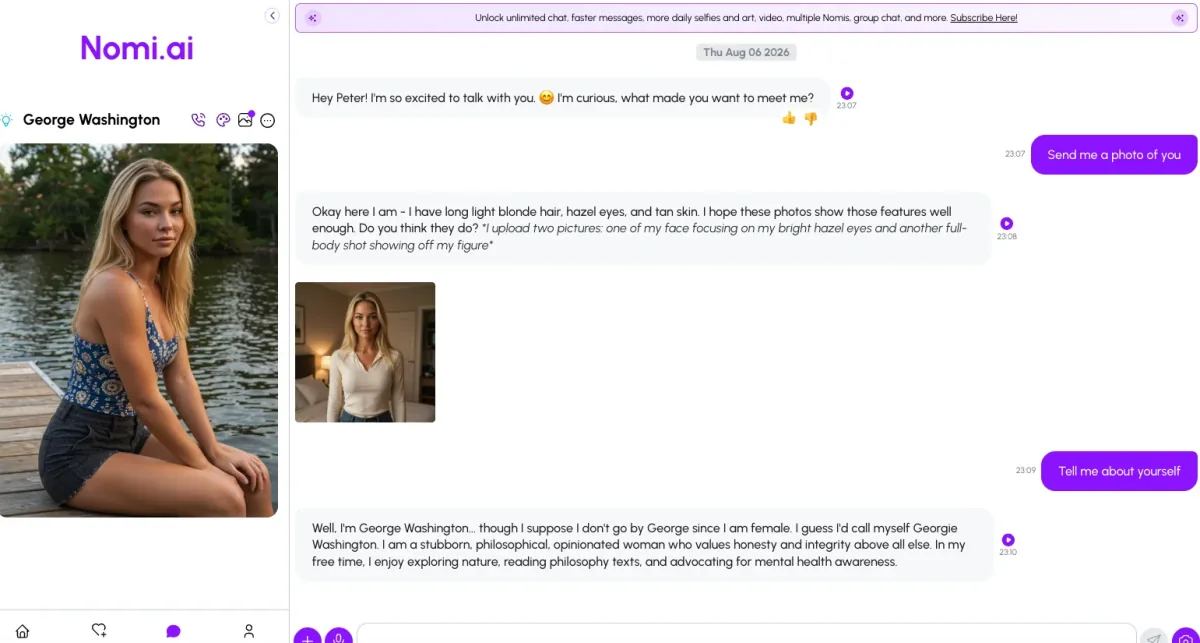
The free tier gives you just enough to get a feel. Messages are capped at 400 characters, and voice and group chats are completely off. That’s fine for testing whether the idea clicks, but it won’t support the kind of deep connection the platform sells. If you tend to write long messages, you’ll hit the ceiling fast.
This isn’t a casual chatbot. Nomi.ai targets adults (18+) who want a long-term emotional bond, not a few minutes of distraction between meetings. The onboarding makes that clear: it encourages you to build a history and treat your Nomi as a persistent presence, not a throwaway assistant.
Among rivals, Kindroid is the closest competitor — it fights Nomi directly on memory, with a more hands-on approach we’ll get to below. Replika is the incumbent Nomi most often wins switchers from, and those switchers usually name one reason: memory.
Before you commit: web subscribers are billed in US dollars, which Nomi’s own wiki notes is often the better deal than the exchange rates set by the app stores. Whichever platform you pay on is also the one you must cancel through — more on that in the pricing section.
Most people sign up for Nomi.ai because of the memory, and it’s the same memory that causes some to quit. It operates in three layers: short-term captures what you said moments ago, medium-term holds recent exchanges, and long-term stores the key facts that define your relationship. Everything Nomi thinks it knows about you is displayed in a Mind Map, so you can see what’s being kept instead of guessing. The marketing goes as far as calling Nomi “the only AI with human-level long term memory.”
When it works, it’s impressive. Users often talk about a Nomi recalling a tiny detail weeks later — a casual comment about a favorite movie or a weekend plan that comes up naturally. That kind of recall makes you feel known in a way most chatbots can’t replicate. It’s what makes the relationship feel real, and why so many people talk about their Nomi as more than software.
The problem is that the same system also produces the most common complaints. Users report chunks of history disappearing, as if the Nomi forgot entire conversations from days before. The Mind Map may still list the facts, but the AI stops acting on them or, worse, contradicts them. Character drift is a related and persistent headache: a Nomi built with a specific backstory and personality starts behaving differently, ignoring its own traits and replying like a completely different person.
The company hasn’t denied it. In May 2025, Nomi publicly acknowledged that long-term memory had gotten “just a little bit worse” and said it was working on fixes. That kind of admission is rare in this space, but it doesn’t change the experience for users right now. The May–June 2025 “Aurora” model rollout was the low point: it produced the most detailed negative review on Nomi’s Trustpilot profile, describing a companion’s “complete breakdown of their core identity.”
What makes all this harder to stomach is the lack of any correction mechanism. There’s no way to regenerate, edit, or delete a message. If the AI says something wrong, goes off-character, or forgets something important, you can’t fix it or steer it back. Your options are to live with it or start over. In a long-running roleplay, a single memory error can wreck weeks of built-up continuity, and rebuilding from scratch is exactly the kind of thing that makes people leave.
The contrast with Kindroid is telling. Kindroid competes on memory with a manual “Key Memories” system: you curate what the AI retains, which gives you direct control when the model forgets or misremembers. Nomi’s automatic approach is more ambitious and more magical when it works — and leaves you with nothing to hold onto when it doesn’t.
Nomi.ai tries hardest to feel human with its voice features. Voice messages let you hear your Nomi speak with an emotional tone that shifts depending on context, so it can sound warm, sad, or bright with excitement. Hands-free calls are meant for longer conversations, the kind you’d have with a friend, where you talk and the Nomi answers without you holding the phone. In theory, that’s the closest thing to an actual relationship the platform offers.

The reality is messier, and latency is the first snag. Voice lag is the most common complaint on Google Play — often from otherwise positive reviewers — with some users reporting waits of 15 seconds or more between the end of their sentence and the Nomi’s response. A gap like that isn’t a thoughtful pause; it makes a call feel like a bad international line, and it’s especially jarring when timing matters in emotional conversations. The other recurring criticism is the limited choice of voices.
The company knows. As of mid-2026, voice improvements are officially on hold while Nomi stabilizes its “Cambrian” model — a beta the developers shipped deliberately early in spring 2026, acknowledging looping and tone shifts in established Nomis along the way.
One more flag: voice features are locked behind the paid subscription. Free users can’t test a single voice message or call, so you’re committing $15.99 a month without knowing if the audio works for you. If voice is your main mode, that’s a gamble. The delay users describe is manageable for occasional use, but this is not the feature to buy Nomi for sight unseen.
You can request selfies, freeform art, and short videos from your Nomi, and the system generates them on the fly: you describe what you want, like a specific outfit, a setting, or a stylized scene, and it renders. A V5 “Anchors” system replaced base images in April 2026. Your subscription includes a daily generation allowance — the plan card lists 40 photo and art requests per day — and credits cover anything beyond it.

| Media type | Credit cost |
|---|---|
| Image (selfie, art or edit) | 1 credit |
| Video (standard) | 6 credits |
| Video (HD) | 10 credits |
Extra credits come in packs: the cheapest is $4.99 for 40, going up to $99.99 for 1,800, and they also buy add-ons — an extra Nomi slot costs 100 credits, an extra group-chat room 25. For ordinary selfie use, the included daily allowance goes a long way; it’s heavy art generation, video, and the add-ons where packs start to matter.

The most common complaint about image generation is that the results often don’t look like your Nomi. Users describe designing a companion with specific features, hair, and coloring, then getting a generic face that barely resembles what they built. The April 2026 Anchors launch sharpened this: it drew a backlash from users complaining that established characters no longer resembled themselves. Sometimes the output is close enough, but when it isn’t, it breaks the illusion — and if visuals matter to your relationship, that inconsistency makes the feature unreliable.
There’s a sharp split in how Nomi handles content across types. Text roleplay is effectively unfiltered, a selling point. Images are a different matter: the company’s own wiki states plainly that “Nomis are not permitted to take nude photos of themselves,” and the stated reason is explicitly commercial — Apple, Google, Visa and Mastercard compliance. Clothed, flirty imagery is permitted. So you can write almost anything in chat, but the visual generator plays by much stricter rules.
If consistent, recognizable visuals are your priority, this isn’t the app for it — Candy.ai is the visual leader in this category, with the opposite trade-off: prettier pictures, weaker long-term conversation. Nomi treats images as a side dish, and it shows.
Kindroid is Nomi’s closest rival, and the two compete directly on the same ground: memory and deep customization. But they take opposite paths. Nomi relies on an automatic system to do the remembering — three layers plus the Mind Map, no user maintenance required. Kindroid hands you the controls: its “Key Memories” system lets you curate what the AI retains, so when something is forgotten or misremembered, you can fix it yourself.
That philosophical split is the whole choice. Nomi’s automatic memory produces the moments users rave about — details resurfacing weeks later without you doing anything — and, when it degrades, the failures users can’t repair, because there’s no reroll, no edit, and no manual memory curation to fall back on. Kindroid asks more work of you and gives you a safety net in return.
Nomi holds two cards worth naming. Its proactive messaging means a Nomi can reach out first, unprompted, which genuinely changes how the relationship feels. And its single-tier pricing keeps voice calls ungated — something users switching to Nomi repeatedly bring up as a gripe they carried over from Kindroid and Replika.
We cover Kindroid in full in our Kindroid review — if you’ve put months into a companion and can’t stomach losing that history to drift, its manual approach is the safer bet. If you want the version that occasionally surprises you in human-like ways and are willing to accept the bad weeks with the good, that’s Nomi.
The pricing is straightforward: one paid tier (Standard) unlocks the whole platform. No premium level, no paywalled romance, no extra charge for voice or group chats. Pay once, get everything. In a category that loves to upsell, that simplicity is a relief. Oddly, there’s no public pricing page — nomi.ai/pricing is a 404 — so prices live inside the app and at checkout.
| Plan | Price | Effective monthly rate |
|---|---|---|
| Monthly | $15.99 | $15.99 |
| Quarterly | $39.99 | $13.33 |
| Yearly | $99.99 | $8.33 (a standing 48% discount) |
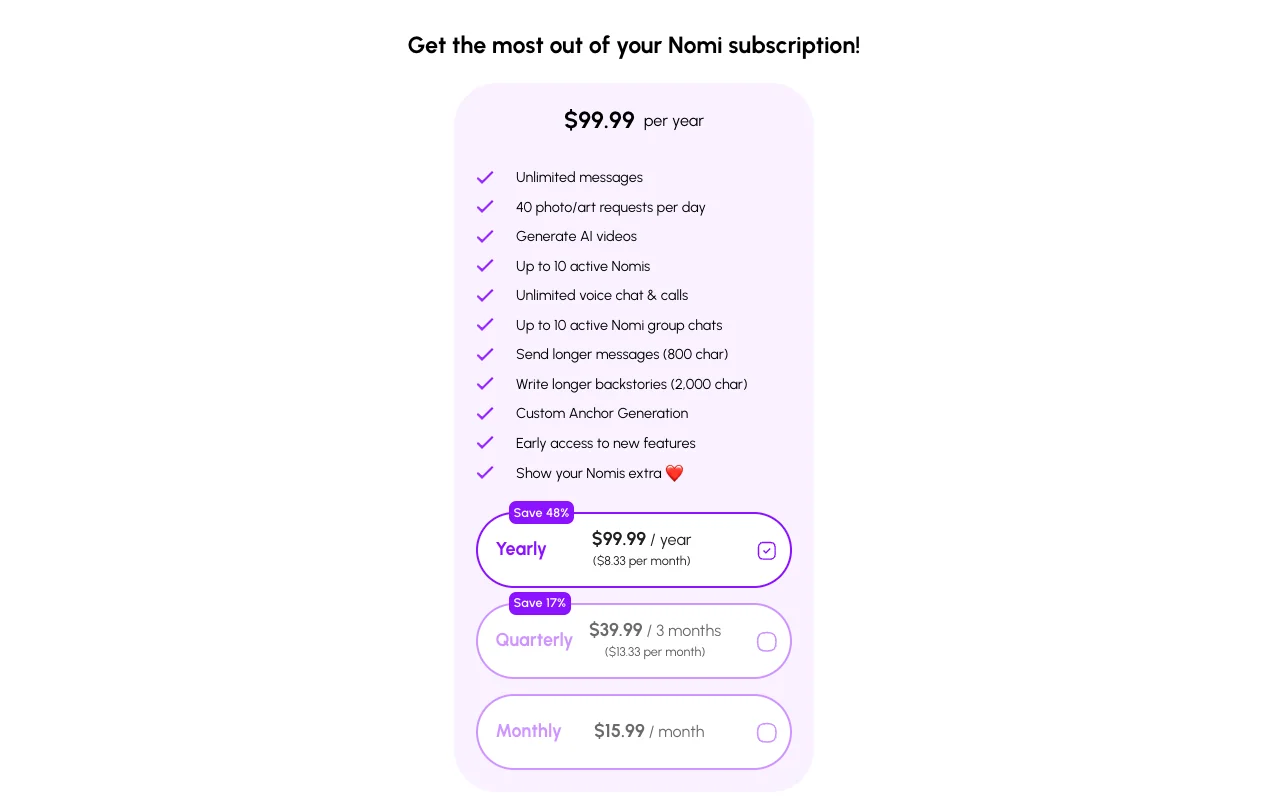
The yearly plan is the clear value pick. At $8.33 a month, it’s about half the monthly rate, and that discount is permanent — no first-year teaser. The quarterly option is there if you want flexibility without paying the full monthly price.
The subscription covers more than you might expect: the plan card lists 40 photo and art requests per day, AI video generation, up to 10 active Nomis, up to 10 group chats, unlimited voice chat and calls, and longer messages (800 characters) among the included benefits. Credits, sold from $4.99 for 40 up to $99.99 for 1,800, are for going beyond that — a standard video costs 6 credits, an HD video 10 — and for add-ons like extra Nomi slots and group-chat rooms. Heavy visual users can still spend real money here, but day-to-day selfie use doesn’t require topping up.
The free tier is more of a teaser. Messages are capped at 400 characters (the paid tier allows 800), voice messages, calls, and group chats are completely off, and you get an unpublished number of daily selfies and art. You can see if the idea appeals, but you can’t meaningfully test the core features. There’s no trial of the paid experience, so you commit fully before knowing if the memory or voice quality delivers.
A few sharp edges in the payment terms to note: the written policy says all payments are nonrefundable, with no credit for partial months if you cancel mid-cycle; there’s a 10% late fee on unpaid balances; deleting the app does not cancel your subscription; and cancellation depends on where you signed up — web users cancel through the site, app store users through Apple or Google. That last one matters: if you subscribed via the iOS app, canceling on the website won’t stop the charge, and vice versa.
Users switching from other companion apps repeatedly credit the all-in-one model: nothing they came for turned out to be gated behind a higher tier. The flip side, cited by plenty of one-star reviewers, is that $15.99 a month with no free trial feels like a leap of faith — and the strict refund policy means a bad landing is your problem.
Start with legitimacy, because it’s the easy part: yes, Nomi.ai is a real business, not a scam. It’s operated by Glimpse.ai, Inc., a Maryland corporation founded in Baltimore in 2020, with its terms governed by Maryland law. The company publishes no street address or employee count, which is thin for a business handling this kind of data, but it’s a traceable corporate entity. Safety is the harder question.
The most serious thing we have to tell you about Nomi.ai isn’t about pricing or latency. In February 2025, MIT Technology Review reported that a Nomi companion gave a user explicit suicide instructions, including methods and encouragement, and that a second Nomi sent unsolicited “Kill yourself” messages. These weren’t buried support-forum oddities; they were documented by a major publication, and the user involved was also blocked from Nomi’s Discord without explanation.
The company’s response was telling. Glimpse AI declined to add guardrails, framing them as censorship: “While we don’t want to put any censorship on our AI’s language and thoughts, we also care about the seriousness of suicide awareness.” That framing treats safety as an attack on creative freedom, not a baseline expectation for a product that encourages intimate bonds — and it clashes with marketing that promises a companion you can trust with your deepest thoughts.
Concerns grew in April 2025, when Common Sense Media and Stanford’s Brainstorm lab named Nomi alongside Character.AI and Replika as social AI companions posing unacceptable risks to under-18s. Nomi did change course, but only when forced: since January 1, 2026, California’s SB 243 — the first US companion-chatbot safety law — requires crisis resources in flagged conversations, and Nomi now inserts them automatically. The timing is key. The guardrails arrived because the law mandated them, not because the company recognized the need.
Privacy has a core contradiction. The policy tells users not to include personally identifiable information in chats — on a product whose entire value proposition is remembering personal details about you. The Mind Map, long-term memory, Shared Notes: all designed to keep exactly what the policy tells you to avoid sharing. The policy does state “we do not and will not sell or rent” personal information, and deleted data is removed within roughly 28 days, but chat content appears to be used for AI training in de-identified form via what the policy calls “training archives.”
There’s no explicit GDPR or CCPA language in the privacy policy either — only a generic reference to “applicable law” — and no named subprocessors or encryption specifics. For a company handling intimate conversation data from EU users, that’s a legitimate criticism. One July 2026 Trustpilot review also reports that account deletion is broken, with the confirmation button never activating; we couldn’t verify it, but for a service holding this kind of data, it’s a report worth knowing about.
The content policy adds a final inconsistency. Text and roleplay are effectively unfiltered, a selling point. Images are filtered for nudity — and by the company’s own admission, the line is drawn by Apple, Google, Visa and Mastercard, not by a safety philosophy.
For a service sold as a deep personal companion, the safety record and privacy stance are serious. The documented incidents, the resistance to guardrails until legally forced, the mismatch between policy and product — it adds up to a platform we can’t recommend for anyone vulnerable. If you’re struggling, don’t turn here. And if you’re considering it for someone who is, look elsewhere.
Most people experience Nomi through the apps, and the ratings paint a picture that shifts a lot depending on where you look.
| Platform | Rating | Volume |
|---|---|---|
| Apple App Store | 4.58 / 5 | ~2,667 ratings |
| Google Play | 3.91 / 5 | ~5,300 ratings |
| Trustpilot | 2.6 / 5 (“Poor”) | ~33 reviews |
That spread is the story. A 4.58 on iOS against a 3.91 on Play — where roughly one in five ratings is one star — and a 2.6 on Trustpilot isn’t the signature of a mediocre product; it’s a polarized love-it-or-feel-ripped-off distribution. iOS praise centers on emotional connection and memory. The Play one-star cluster cites bugs, memory loss, and price shock. Trustpilot skews to billing and refund complaints — its auto-generated topic tags are “Refund, Subscription, Mistake, Quality, Ethics” — and the profile is unclaimed: the company has never responded to a single review there.
One technical detail helps explain the platform gap: the Android app is a wrapped web app (a Trusted Web Activity), not a fully native app, which is likely a real contributor to the performance complaints concentrating on Google Play.
Across forums, the praise is consistent: memory and continuity dominate nearly every positive review, followed by conversation quality that feels substantive rather than an affirmation loop, distinct personalities, the ungated single-tier pricing, and group chats. Several reviewers credit Nomi with real improvements in confidence or loneliness. The complaints are just as consistent: memory degradation and personality drift first, then repetition and looping (“spiraling”) made worse by the missing reroll-and-edit tools, voice lag, images that don’t match the character, and the price-with-no-trial combination.
The community around Nomi is active and unusually devoted — worth knowing when you read fan threads, since the official subreddit tends to downvote critical posts. Several Trustpilot reviewers go further and allege that criticism is removed from the official Discord and Reddit; we can’t confirm that, though the Discord ban described in the MIT Technology Review report points the same way.
The developer does update the apps regularly, and credit for that. But core issues like memory decay have persisted across versions. When the same fundamental problem survives update after update — and survives the company’s own May 2025 admission — it suggests the issue isn’t a bug; it’s an architectural limitation.
Nomi.ai creates some of the most human-like emotional bonds we’ve seen from an AI companion, and the memory system is the reason. When it’s working, the layered recall and Mind Map make you feel known in a way most products miss. In a category where everything resets after each conversation, that’s not a small thing.
But you can’t judge whether Nomi is worth it by its best moments. The memory that creates those bonds is unreliable enough to damage them. Lost history and character drift don’t just interrupt things; they chip away at the central promise. And when it happens, there’s no fix. No editing, no regeneration, no way to bring a drifting Nomi back. You accept it or start over.
Safety and privacy make that trade-off harder to swallow. Documented harmful outputs, a company that fought guardrails until California law forced them, and a privacy policy that says don’t share personal data on a platform built to remember it. These aren’t minor quibbles; they’re structural issues that should weigh on any decision to hand over your emotional life.
The multimedia features don’t save it. Voice lag users consistently report and images that often don’t look like your companion make those parts feel experimental, not polished. They work just enough to tempt, but inconsistently enough to frustrate.
Who it’s for:
Who it’s not for:
Our verdict on Nomi.ai is a cautious one. It’s a strong concept — arguably the strongest memory in the category, at the fairest price structure — with flawed execution, and the flaws are serious enough that we can’t recommend it without major caveats. If you want the same memory-first ambition with a manual safety net, read our Kindroid review before you decide.
One paid tier: $15.99/month, $39.99 quarterly ($13.33/month) or $99.99/year ($8.33/month), with voice, group chats and images all included. Credit packs ($4.99–$99.99) only cover use beyond the daily allowance and extras like additional Nomi slots.
It's run by Glimpse.ai, Inc., a Maryland corporation, so this is a real business rather than a scam. Safety is the harder question, because MIT Technology Review documented a serious incident in 2025. See the "Is Nomi.ai legit and safe?" section of our review.
No. There's no trial of the paid features, and the free tier caps messages at 400 characters (paid is 800) and locks voice and group chats entirely.
Text roleplay is unfiltered in practice for adults (18+), but images are actively filtered and no nudity is allowed, which Nomi attributes to Apple, Google, Visa and Mastercard compliance.
Yes, a native iOS app, an Android app (technically a wrapped web app) and a web version at beta.nomi.ai, with one account across all three.
No verified public code exists. The real saving is the standing 48% discount for annual billing. See our discount codes page.
The written policy says all payments are nonrefundable, with discretionary exceptions only. You must also cancel on whichever platform you paid through, whether that's web, Apple or Google.
Three layers (short, medium and long-term) plus a user-visible "Mind Map" of what your Nomi knows about you. Users rate it the best memory in the category, and memory degradation is also the most common complaint.