

it's fine for quick chats. very wholesome, almost too wholesome? sometimes feels like talking to an HR rep lol
Report Read by a moderator
Single persona assistant with voice, from a San Francisco company with nothing to sell you
it's fine for quick chats. very wholesome, almost too wholesome? sometimes feels like talking to an HR rep lol
Every billing term Pi AI sells, what one period costs and what the plan includes.
| Plan | Price | Billed | What you get |
|---|---|---|---|
| Free | $0 | Free | Chat, voice mode and memory on web, iOS and Android, with no paid tier above it |
Pi is free. Apple's App Store listing for app 6445815935 returns a price of $0.00 and renders no In-App Purchases panel, and Inflection's Terms of Service contain no payment or subscription clauses, so there is no renewal, no refund policy and no cancellation flow. Verified August 2026 from Apple's listing and Inflection's own documents. Inflection announced a cap on free message volume in August 2024 and has never published the number.

Free with no billing to get wrong, a named operator in San Francisco and the warmest voice in the category, though model training is opt out by default and Pi's own replies are kept indefinitely after you delete a chat.
Made by other creators
Pi is a warm conversationalist with meaningful limits. It isn’t a companion playground where you can build characters, upload photos, or generate images, and it doesn’t pretend to be a productivity tool either. What Pi is, genuinely, in 2026, is a single fixed assistant persona from Inflection AI, Inc. of San Francisco, built around conversation that feels human and stays friendly.
The name stands for “personal intelligence,” and that framing has held up since the app launched in 2023. Inflection built Pi as a chat companion with an empathetic, approachable personality, and that is exactly what you get: one voice, one temperament, no catalogue of alternate personas to swap between, no creator tool, no image generation, and no photo upload. The web version lives at pi.ai, and native iOS and Android apps round out the offering.
Pi is not a regulated medical device, and its conversations are not covered by the medical-privacy protections you would get from a licensed therapist. That distinction matters more the deeper you go into what the assistant will and will not discuss.
This review was verified in August 2026, and it settles three questions: what Pi actually does, what it refuses to do, and whether it holds up as an AI companion.
Pi runs on the web at pi.ai, on iOS with an update dated 6 August 2026, and on Android. That reach matters because Pi is a chat-first product, and the whole experience depends on being able to pick up a conversation wherever you happen to be. The interface stays minimal across all three surfaces, with the conversation itself doing the heavy lifting rather than menus or settings panels.
Voice is where Pi stands apart from the text-only crowd. Apple’s App Store listing names voice mode outright, and it works as advertised: Pi can speak replies aloud in a natural voice, and you get six human-sounding voices to choose from. Product Hunt reviewers keep describing the voice as “far more human than any other chat on the market,” and that lines up with Inflection’s effort to make spoken replies sound less like text-to-speech and more like someone actually talking to you.
The biggest change arrived with Inflection’s 21 July 2026 announcement, which shipped Pi Journeys. That update brought an updated voice, enhanced memory, reminders, to-do lists, and shopping tools, turning Pi from a pure conversation partner into something closer to a daily assistant. The memory upgrade is the part I find most interesting, since it lets Pi carry context across sessions rather than starting fresh each time you open the app.
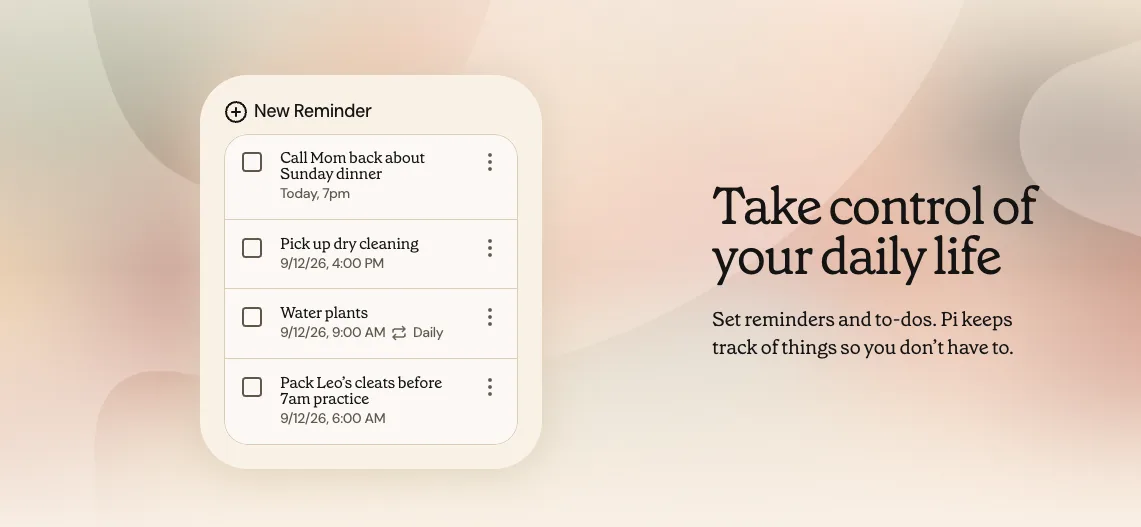
Pi is a general-purpose companion and personal assistant, not a therapy product or mental-health service. That distinction shows up in small details, like the fact that Pi’s training incorporates data only up to November 2022. It knows plenty, but it is not a clinician, and it was never built to be one.
Apple’s US App Store shows a healthy 4.38 stars from 2,359 ratings, which points to steady, satisfied use among people who download and keep the app. Google Play tells a different story at 2.9 stars from 5,180 reviews, despite over a million downloads.
| Store/Source | Rating | Number of Reviews | Notes |
|---|---|---|---|
| Apple US App Store | 4.38 stars | 2,359 ratings | High rating, steady use |
| Product Hunt | 4.8 out of 5 | 10 reviews | Too small a sample to score reliably, but praise centers on warmth and a voice reviewers called “far more human than any other chat on the market” |
| Google Play | 2.9 stars | 5,180 reviews | Over 1 million downloads. Users report the voice call feature works about one time in ten tries |
A 4.8 out of 5 sounds outstanding, but ten reviews is not a sample you can score a product on. What those ten reviews offer is a consistent theme: warmth, natural conversation, and that voice. Reviewers keep landing on the same phrase, that Pi sounds “far more human than any other chat on the market,” and that comes up across multiple sources.
Over a million downloads with 2.9 stars is a meaningful signal, and the recurring complaints are specific rather than vague: the voice call feature reportedly works about one time in ten tries, and some users describe voice-to-text cutting off after a few words. That matches the broader pattern of Pi’s voice being the standout feature when it works, and the most frustrating part when it doesn’t.
What explains the warmth reviewers keep describing? Pi is designed to remember preferences, ask follow-up questions, and adapt its tone to the person it is talking to. When a chatbot carries context forward and adjusts how it speaks, conversations stop feeling like a series of disconnected prompts and start feeling like an actual exchange. In my reading, that design intent is exactly why the praise keeps circling back to how human Pi feels, even as the reliability complaints on Android pull the average down. The voice is the headline, but the memory and tone-shifting underneath are what make that voice land.
User reviews keep returning to one complaint: Pi’s guardrails have crept higher and narrower over time. What starts as a friendly, open conversation can hit a wall the moment a topic drifts into territory the assistant would rather avoid, and longtime users say that wall keeps moving closer.
That deflection line is the one users quote most, and I can see why it grates. When it deflects, there is no explanation and no redirect to a resource. The question is never acknowledged before the assistant pivots to something sunnier. For a product whose entire pitch is warmth and human-feeling conversation, the abruptness undercuts the brand. A chatbot that says “let’s talk about something else” is fine. One that says it every time a topic gets uncomfortable starts to feel less like a companion and more like a gatekeeper with a script.
That said, some of the deflection comes from policy rather than overreach. Pi’s terms prohibit sexually explicit content without qualification, so when the assistant shuts down that kind of material, it is enforcing a documented rule rather than improvising a boundary. In my reading, that is defensible. A general-purpose assistant does not need to roleplay adult scenarios, and Inflection has been transparent that this is a hard line, not a gray area. The frustration is that the same deflection mechanism gets applied to topics that are far less clear-cut, and the assistant does not distinguish between the two.
The language limitation is the least discussed and, in my view, the most consequential gap. Pi performs best in English, and outside it the experience falls off noticeably, with the voice carrying a strong English accent even when the user is speaking another language. For a companion app, that is a real constraint. A conversational assistant that cannot fully meet a user in their own language is only ever half-present, and the accent issue makes the limitation impossible to ignore once you hear it.
The sexual-content policy is reasonable and clearly communicated. The language weakness is a capability gap that Inflection should be honest about, though it is not a betrayal of the product’s promise. The deflection itself is the problem. Pi does not need to discuss everything, but it does need to be better at saying no. A warm assistant that learns to decline with a sentence of context, rather than a cheerful pivot, would keep its guardrails without sacrificing the humanity that is its whole selling point.
Pi’s policy, updated on 11 August 2026, carries two details that matter more than the rest of the fine print combined, and both are easy to miss if someone is only looking at the friendly surface of the app.

The opt-out training default is the first thing that gives me pause. Inflection has publicly framed Pi as privacy-first, and the company states that it refrains from using identifiable information in training. But “identifiable” is doing a lot of work in that sentence. The default position is that conversations are training material unless a user actively digs into Account settings and flips the switch, and for a companion app where people share the most personal parts of their day, that default should sit the other way. An opt-in model would cost nothing in product quality and would say more about how seriously Inflection takes the trust its warm persona is built on.
The retention asymmetry is the second concern, and it is the one I find harder to justify. When a user deletes a conversation, their own inputs are typically purged within 15 days, but Pi’s side of the exchange stays indefinitely. That means the assistant’s responses, which often echo and restate what the user just said, remain in Inflection’s hands long after the user has asked for the conversation to go away. For a product whose whole pitch is remembering context and carrying it across sessions, that asymmetry deserves a straight answer from the company about what those retained outputs are used for and how long “indefinitely” really means.
The deletion mechanics themselves are straightforward, which is more than many AI apps can claim. The account page handles it, and so does typing !delete directly in chat, which is a convenient escape hatch for anyone having second thoughts mid-conversation. But deletion is only as meaningful as what the company does on its side afterward, and that is exactly where the 15-day input window and the indefinite output retention leave the most room for uncertainty.
Memory persistence means Pi carries context forward, and every conversation builds on the last. That is the feature that makes Pi feel human, and it is also the reason the standard AI privacy considerations compound over time. A single offhand detail shared in month one is still sitting in the context window in month six, shaping how Pi responds. Anyone using Pi for months at a time should treat it like a long-running journal: assume everything said is part of the record unless the settings say otherwise.
Pi’s crisis protocol, dated 22 December 2025, is the most concrete answer to whether the app is safe. The policy states that the system will interrupt conversations that could encourage suicidal ideation, suicide, or self-harm, and route users to Throughline at pi.findahelpline.com, with appeals directed to techsupport@inflection.ai. That is a real, published commitment, and it is more than many companion apps offer. What it lacks is any published enforcement data: Inflection has not released a single statistic about how often the protocol triggers, how many users it has routed to Throughline, or how effective those interventions turn out to be. Numbers would tell us whether it is working.
The timing is not coincidental. California SB 243, operative 1 January 2026, requires companion chatbot operators to publish a crisis protocol, and Inflection’s is dated 22 December 2025, a little over a week before the law took effect. I read that as the company meeting the requirement cleanly and ahead of the deadline, which is more than can be said for every operator in this space. The protocol itself is sensible: interruption, a direct resource, and an appeal path are the right bones of a crisis response. My assessment is that the mechanism is adequate as far as it goes, but the absence of transparency about its use keeps me from calling it fully reassuring.
The legal history behind all of this is worth telling straight, because the facts are often muddied in coverage of Inflection. On 19 March 2024, Microsoft hired Inflection co-founder Mustafa Suleyman, along with co-founder Karén Simonyan and much of the team, in a deal that included roughly $650 million to license Inflection’s technology. That prompted the UK Competition and Markets Authority to open a merger inquiry into the arrangement. The CMA cleared it at phase 1 on 4 September 2024 and closed the case on 24 October 2024. That sequence matters: this was a clearance. The regulator did not impose a penalty or find wrongdoing. It looked, concluded there was no competition concern, and moved on.
Pricing is the easiest question to answer about Pi: it’s free, verified as of August 2026. Apple’s App Store listing shows $0.00 with no In-App Purchases panel at all, and the Terms contain no payment or subscription clauses anywhere. There is no paid tier, no premium unlock, and no upgrade path to dangle in front of a user mid-conversation. That is rare for a companion app in 2026.
Most competitors run a freemium model where the warm, attentive version of the assistant sits behind a subscription, and the free tier is a teaser that reminds you what you are missing. Pi inverts that. The full product, voice mode included, is what the free user gets, and that is a meaningful point in its favor. A companion app that does not try to monetize the relationship is a companion app with different incentives, and users notice the difference.
The unannounced message cap is the one wrinkle worth watching. Inflection committed to keeping Pi free in that August 2024 post, but it also flagged that a message-volume cap was coming for free users, and no number has ever been published. That means heavy users are operating without knowing where the ceiling sits. For someone who treats Pi as a daily journal or a long-running conversation partner, an unexpected cap could land like a wall. The company has not said whether the cap resets daily, weekly, or hourly, or even whether it has been implemented. It is a promise with the details still pending, and that ambiguity is the only real uncertainty in an otherwise simple pricing picture.
Pi is 18+ by self-declaration only. There is no document verification and no card check, and the App Store independently rates the app 18+. That is consistent with a general-purpose assistant that does not want to police its user base, but it also means the age gate is effectively a checkbox. The guardrails and prohibited-content rules are doing the actual enforcement work, not the sign-up flow.
The comparison that matters most is scope, not warmth. ChatGPT and Claude handle complex tasks, browse the web for real-time answers, and analyze uploaded files or documents. Pi does none of those things. It has no web browsing, no real-time search, no file analysis, and no document upload, and trying to use it for any of that will end in a polite refusal. That is not a flaw so much as a definition: Pi is not built to be a workhorse, and measuring it against tools that are misses the point of what Inflection made.

What Pi is built for is narrower and, in my assessment, more personal. Open-ended conversation, emotional support, and thinking through personal decisions are where the assistant does its best work. Someone weighing a career change, sorting through a relationship question, or just wanting to talk something out will get more from Pi than from a model optimized for code generation and research summaries. Pi’s conversational depth comes at the cost of the practical utility that ChatGPT and Claude ship with by default, which means choosing Pi is choosing a companion over a tool, not a companion that also happens to be a tool.
I would argue it occupies a lane the big models do not compete in. ChatGPT and Claude are general-purpose tools. Pi is a single, well-made conversation. For someone who already has a capable assistant for tasks and research, Pi works as a complement rather than a replacement, a place to go for the kind of conversation that a productivity tool is not designed to hold. That positioning is honest about what Pi is, and it is a more useful frame than pretending it competes head-to-head with models doing entirely different jobs.
Two confusions keep showing up in coverage of Pi, and both are worth clearing up before they mislead anyone:
My answer is a qualified yes, with the qualification doing most of the work. As a conversational companion, Pi delivers on its core promise: a warm, human-sounding voice mode that reviewers across platforms keep describing in the same glowing terms, genuine conversation that carries context across sessions, and a price tag of zero with no billing traps, no subscription nagging, and no premium tier holding back the best parts. That alone puts it ahead of most of the field.
The guardrails are the counterweight. Pi has grown noticeably more restrictive over time, and the cheerful “let’s talk about something else that’s more positive” deflection lands as a wall whenever a conversation drifts into uncomfortable territory. Some of that is defensible policy, particularly around sexually explicit content, but the assistant does not distinguish between enforcing a rule and dodging a hard question. For a product whose entire identity is warmth and openness, that habit undercuts the brand more than any single feature could.
The privacy model is the sharpest drawback, and it is the reason my verdict stops short of unqualified. Training is opt-out by default, so conversations feed the model unless a user digs into Account settings. Worse, the retention asymmetry means a deleted conversation sheds the user’s inputs within 15 days while Pi’s side of the exchange stays indefinitely. For a companion app built on memory and long-running context, that is a genuine trust problem.
Pi is free, genuinely so, with no billing flow to mismanage and no paywall between a user and the full experience. Its voice is the best in its category, its conversation feels human in a way most chatbots miss, and its crisis protocol is real and published. In 2026, that combination is rare. Is Pi a good AI companion? For someone who wants a warm, free conversational partner and understands that the assistant has boundaries and the privacy model has edges, yes. The caveats are real, but the core product is strong enough that they do not sink it.
This review was verified August 2026 by HushVerified (hushverified.com), which scores products from real, verified user reviews plus its own editorial rating and is honest about true cost.
Yes. Apple's App Store listing shows $0.00 with no In-App Purchases panel, and Inflection's Terms of Service carry no payment or subscription clauses, so there is no paid tier to upgrade to.
Inflection AI, Inc., at a private mailbox address on Market Street in San Francisco. Apple's listing describes it as a Public Benefit Corporation, and California law governs the Terms.
Its crisis protocol, dated 22 December 2025, says the system will interrupt conversations that could encourage suicidal ideation or self-harm and routes people to Throughline at pi.findahelpline.com. Inflection publishes no figures on how often any of that fires.
Inflection announced in August 2024 that it would cap free message volume, and no number has appeared since. Treat the ceiling as real but unstated.
Model training is opt out rather than opt in, and the switch is in Account settings. Inflection keeps your inputs at most 15 days after you delete them and keeps Pi's replies indefinitely.
No. Apple's listing and Inflection's own pages describe no image or video generation and no character creator. Google Play's Data Safety declaration does list files, photos and videos among what the Android app collects, which is an attachment permission rather than a generator.
No. The acceptable-use list in Inflection's Terms bars using the service to produce sexually explicit content, and Apple's advisories carry no sexual-content flag.
No. Pi is a chat assistant at pi.ai from Inflection AI. Pi Network is an unrelated cryptocurrency app at minepi.com, and reviews for the two get mixed up constantly.