

Genuinely great value. Started using it for roleplay
Report Read by a moderator
One wallet that buys GPT, Claude and Gemini in the same place, with an age floor of 13
Genuinely great value. Started using it for roleplay
Every billing term Poe sells, what one period costs and what the plan includes.
| Plan | Price | Billed | What you get |
|---|---|---|---|
| Free | $0 | Free | A daily points allowance that resets every 24 hours and is never published |
| Basic | $4.99 | Monthly | 10,000 points a day, and access to more models than the free tier |
| Basic | $49.99 | Yearly | The same access charged once for the year |
| Plus | $19.99 | Monthly | 660,000 points a month, on the same benefit list as Basic |
| Plus | $199.99 | Yearly | The same access charged once for the year |
Poe publishes its plan ladder without a login but not its dollar prices. Its own subscription page lists five tiers labelled only by points volume, and served us Danish kroner under a footnote insisting prices are in US dollars. The only USD figures, and the only two tier names, come from Apple's in-app purchase list: Basic at $4.99 a month or $49.99 a year, Plus at $19.99 or $199.99. Poe's own about page corroborates the entry price. Verified August 2026. Add-on points cost $30 per million, they do not roll over, and they expire a year after purchase.

The one genuinely mainstream product in this batch, with a named operator and two independently confirmed prices, held back by a points economy you cannot price before you buy and a refund policy page that loads empty.
Made by other creators
Poe, run by Quora, Inc., makes a simple promise: one account and one points wallet that buys text, image, video, and audio generations from models made by OpenAI, Anthropic, Google, and others. Alongside those official models sits a directory of more than 1 million user-made bots, all reachable from the web, iOS, and Android. The platform has been sold as a subscription since roughly February 2023 at around $19.99 a month, and group chat arrived on 17 November 2025, with TechCrunch reporting support for up to 200 people across 200+ models.
This Poe review checks each part of it against the actual terms and pricing, not the marketing page.
The Poe Quora AI chatbot is a multi-model platform owned by Quora, which raised $75 million from Andreessen Horowitz in 2023 partly to scale the service. That bet has paid off in revenue terms: Quora’s annual take from Poe reportedly grew from about $30 million in 2024 to $65 million in 2026.
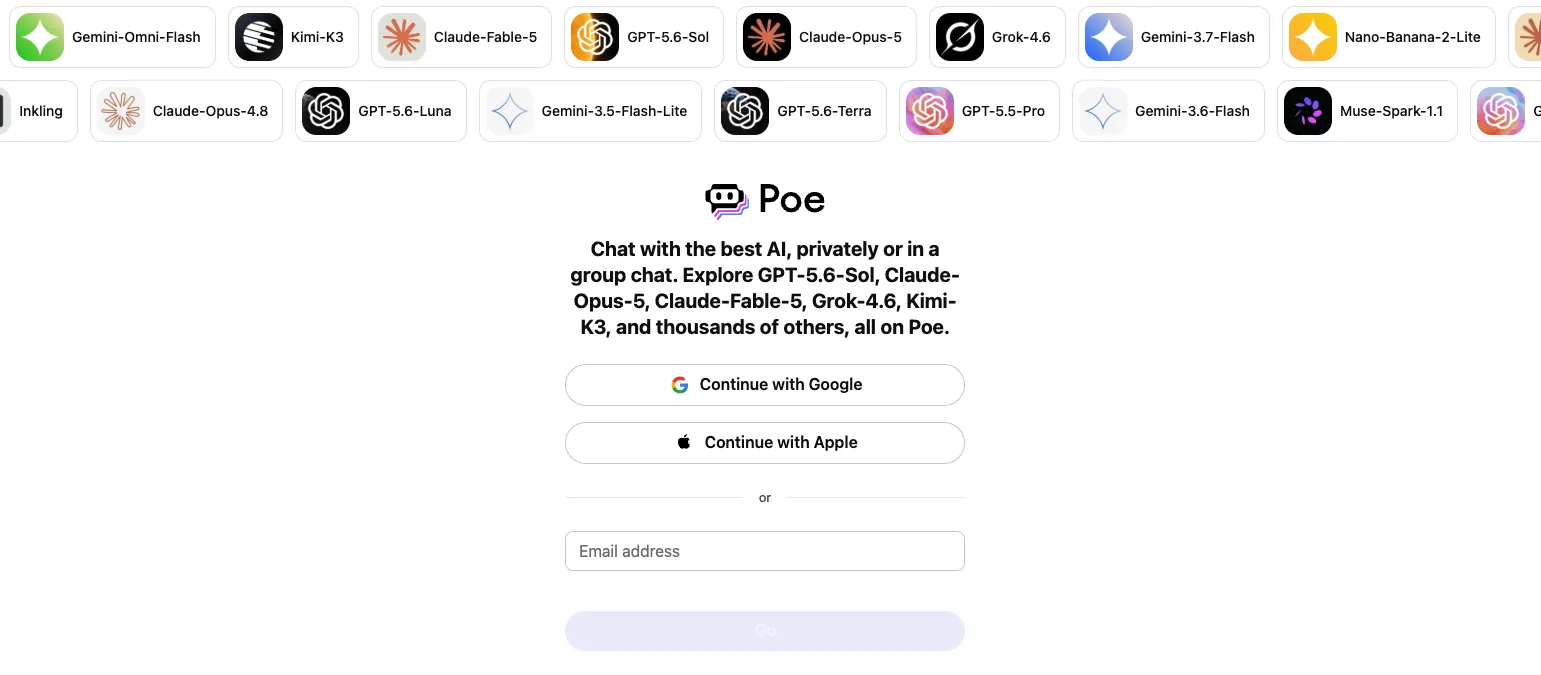
That funding paid for aggregation. Poe pulls official models from OpenAI, Anthropic, Google, xAI, Meta, Mistral, and DeepSeek into a single login, alongside dedicated image, video, and audio generators. One account opens all of them. That is the platform’s core pitch: pick the model that fits the task instead of juggling subscriptions.
The pitch gets murkier around what Poe declines to call itself. It does not market the service as a companion storefront. Logged out, the Explore tab shows no roleplay or companion category at all. Yet a public creator profile read in August 2026 listed ten user-made bots, mostly character roleplay and some flirty. The bots are there. The platform just does not organize its catalog around them.
The adult-adjacent presence also has hard limits. No undress, face swap, or nudify tool exists on Poe. Its Usage Guidelines ban sexual content involving minors and nonconsensual content, then leave most other adult material to each model maker’s policy. That means the rules shift depending on which model a user picks, and Poe publishes no map of where each one draws the line.
Every account carries one points wallet, and every message, image, video, or audio generation draws from that same balance, no matter whether the model comes from OpenAI, Anthropic, Google, or a user-made bot. There is no separate currency per provider, so the points a user spends on a Claude reply are the same points that pay for a video generation thirty minutes later.
Before sending anything, each bot’s Info button shows that model’s exact per-message point cost. The price appears in points rather than dollars, which makes the economy easy to read at a glance but also easy to lose track of across a long session.
The cost bands vary widely by model type:
Point allowances reset on a schedule. Free users get daily points that reset every 24 hours, while paid plans draw from monthly allowances. Poe publishes no figure for the free daily allowance, so a new user only discovers their allotment by watching the counter drain.
Add-on points sell for $30 per 1 million, with no transaction fees attached. Those points never roll over, expire one year after purchase, and are non-refundable. Because Poe is built around a points economy, those terms define what a subscription actually costs in practice.
The math gets uncomfortable at Poe’s own add-on rate. The $19.99/month Plus plan includes 660,000 points per month. At the add-on price of $30 per million, those points are worth exactly $19.80. That leaves 19 cents of the subscription price covering everything else the plan promises: access to models, features, and whatever else Plus unlocks. Users paying for Plus are, in effect, paying nearly full price for the points alone.
In March 2026, the free tier’s daily points dropped from around 3,000 to roughly 300, a cut of about 90 percent that Poe never announced. Three independent sources corroborated the change, and the platform’s help center no longer states an exact free-tier figure. A user who relied on the old daily allowance to test models or run a few long conversations now finds the counter draining after roughly 15 to 30 short messages.
For paid subscribers, the points arrive as a monthly allowance that resets on a schedule. Add-on purchases sit in the same wallet as that allowance but do not extend or replace it. The base monthly points still reset on their usual cycle, while add-on points run on their own separate one-year clock, expiring whether or not they have been touched.
Someone who buys a large add-on pack to cover a heavy month cannot stretch it into the next billing cycle. The allowance refreshes, the add-on balance quietly ages toward expiry, and neither influences the other.
Apple’s App Store listing, checked in August 2026, shows exactly two published tiers:

| Tier | Monthly | Annual |
|---|---|---|
| Basic | $4.99 | $49.99 |
| Plus | $19.99 | $199.99 |
Those figures line up with Poe’s own plans page, which advertises a SAVE 17% discount for annual billing. The math holds: $199.99 divided by 12 comes to $16.67 a month, and $49.99 divided by 12 comes to $4.17, both 17% under the monthly rates.
The plans page does not name these tiers. It lists five options purely by points volume, with no labels attached, and the three tiers above Plus have no verified USD price anywhere on Poe’s own pages or on Apple’s listing. A user who wants to know what the higher tiers cost has to dig through resellers or guess.
Third-party subscription resellers fill that gap with their own numbers, advertising Poe around $10.99 a month, roughly 45% off the official $19.99 Plus rate. Those routes carry real risk. They aren’t verified by Poe, so there is no guarantee of how the account is provisioned, whether it stays active, or what happens when the reseller’s arrangement with the platform changes.
Poe’s full pricing picture is harder to pin down than the subscription page suggests. Poe’s plans page labels five tiers by points volume, but only two of them carry a published price on any official page: the $4.99 Starter tier and the $19.99 Premium tier, both confirmed through Apple’s App Store listing. The remaining three tiers exist on the plans page, yet neither Poe nor Apple states what they cost in USD.
Third-party trackers fill in the allowances that official pages leave vague. They list the $4.99 tier at 10,000 compute points per day, a daily allowance rather than a monthly one, and the $19.99 tier at 660,000 points per month. Poe’s own pages describe the same tiers without being nearly as explicit about the exact numbers, so anyone comparing plans side by side has to rely on those outside sources for the specifics.
Annual billing softens the monthly cost, at least on the two priced tiers. Poe advertises SAVE 17% for paying yearly, and the math holds against Apple’s annual figures: $49.99 a year works out to about $4.17 a month for the Starter tier, and $199.99 a year comes to $16.67 a month for Premium, both 17% under their monthly rates.
The three higher tiers remain unconfirmed. Third-party sites list them at $49.99, $99.99, and $249.99 per month, but Poe and Apple do not confirm those figures anywhere official. Anyone considering those plans should treat the numbers as unverified and expect the actual cost to surface only at checkout.
On 28 July 2026, the $19.99 plan’s monthly points allowance was cut from 1,000,000 to 660,000, a 34% reduction, while the sticker price stayed exactly where it was. That makes the headline plan about 51% more expensive per point than it was the day before, with no announcement attached and the other four tiers left untouched.
Most paid users end up on one tier: the $19.99 Plus plan. That is where the platform concentrates nearly all of its useful features, and it is the only paid tier with both a verified price and a concrete list of what it unlocks.
Group chat sits outside the paywall entirely. It launched on 17 November 2025 and is available to everyone on Poe, with TechCrunch reporting support for up to 200 people across 200+ models. It is one of the few headline features that costs nothing to use.
The paid tier also supports the bot directory. Bot creators earn per-message pricing paid in USD, charged to users in points, plus up to $20 for each new subscriber they bring in. That revenue share keeps the directory of more than 1 million user-made bots growing, because it gives creators a direct financial reason to keep publishing.
Comparing Poe’s free and premium tiers comes down to one question: how much mileage does a daily points allowance buy against a monthly pool of 660,000? The free tier and the $19.99 Plus plan sit at opposite ends of that scale, and the gap shows up in nearly every row of the table below.
| Free | Plus ($19.99/month) | |
|---|---|---|
| Points allowance | Roughly 300 points per day since the March 2026 cut; Poe publishes no official figure, but it was around 3,000 before | 660,000 points per month |
| Model access | Lighter models only | All premium models, including GPT-5.5, Claude-Opus-4.7, Gemini-3.5-Flash, Nano-Banana-Pro, and Veo-3.1 |
| Limits | Lower input sizes and shorter chat history | Each bot’s maximum input size and full chat history |
| Extras | None | Faster response times, ad-free browsing, advanced bot creation, and Poe Apps |
The free tier’s daily points reset every 24 hours and never roll over, so a user who doesn’t spend the full allowance loses it. The Plus plan’s monthly pool works the same way across billing cycles, and any add-on points bought on top expire after a year regardless of use.
The $4.99 Basic tier sits between the two but gets little clarity from Poe itself. Third-party trackers list it at 10,000 compute points per day, a daily allowance rather than a monthly pool, yet Poe’s own plans page never states that figure. Anyone considering Basic has to take the number on faith from outside sources, much like the free tier’s unpublished daily allotment.
Poe’s pricing tiers come with subscription terms that carry a few sharp edges worth reading before paying. The Subscriber Terms page spells out exactly where the flexibility ends:

These terms are what a subscriber should read before paying, because none of them soften the points economy that drives the platform.
Poe’s App Store ratings are split. Poe holds a 4.72 out of 5 rating across 53,873 Apple App Store ratings. The five-star reviews cluster around the same idea: every major model behind one subscription, no juggling accounts. The one-star reviews attack the same economy from the other side, with the recurring complaint that “you have to spend money in order to actually use the app.”
Both camps are describing the same product. Poe is convenient at the moment of use, and expensive once the points run out. The $19.99 Plus plan’s 660,000 monthly points convert to about $19.80 in add-on value at Poe’s own rate, which means the subscription is essentially a points purchase with features attached at near-zero margin. For a heavy user who burns through frontier models and video generations, the meter drains fast. For a light user who mostly asks quick questions of lightweight models, the daily allowance might stretch further than expected.
Privacy deserves equal weight in that calculation. Poe’s terms state plainly that model providers and bot developers “may receive … the contents of your chats and photos or documents you upload,” and that developers may store those chats to train their models. That is a real cost of using the platform. Every conversation with a user-made bot is a conversation handed to that bot’s creator, with training rights attached.
Age and content protections are weaker than the rating suggests. The Terms ban under-13s while the same document warns that “Bots accessed via Poe may produce content that is not suitable for minors,” and signup asks only for an email address or phone number to verify. Apple rates the app 16+ on the storefront and 17+ via its lookup API, a discrepancy that hints at how little friction stands between a minor and the adult-adjacent bot directory. The Usage Guidelines ban sexual content involving minors and nonconsensual content. Everything else is deferred to each model maker’s policy, so the rules shift with every model a user picks and Poe publishes no map of where the lines fall.
Quora disclosed a 2018 breach affecting about 100 million Quora users, and that incident predates Poe entirely. It was never a Poe breach. It speaks to the company’s security history, not to this platform’s track record.
At HushVerified, the verdict is conditional: yes, but only if the user accepts the points meter and the model-by-model content rules going in. The subscription buys unmatched model variety and real convenience, and the 4.72 rating shows most paying users find that trade acceptable. The costs are the constant pressure of the points economy, a privacy posture that hands chat contents to third parties, and content rules that change with each model. Anyone who can live with all three gets real value. Anyone who cannot should treat Poe’s convenience as the expensive part of the deal, because that is exactly what it is.
Basic is $4.99 a month or $49.99 a year, and Plus is $19.99 a month or $199.99 a year. Those are Apple's figures, and Poe's own about page confirms the $4.99 entry price. Its own pricing page shows no dollars.
There is a free tier that grants points daily and resets them every 24 hours. Poe describes the mechanism but has never published the number, so how much you get is something you discover by using it.
Points are the single currency for every model on the platform. Add-on points cost $30 per million, they do not roll over between periods, and pre-purchased points expire one year from purchase.
Quora, Inc., a California company, named in the terms of service, as Apple's seller of record and as the Google Play developer. Disputes go to binding individual arbitration for US and Canadian users.
Its subscriber terms say fees are non-refundable other than as set out in its refund policy, and the refund policy page loads empty. We could not read the document those terms depend on.
Thirteen, per its terms, and there is no age gate on the way in. The same terms say bots may produce content unsuitable for minors, and Apple rates the app 16+.
Its subscription page names GPT-5.5, Claude-Opus-4.7, Gemini-3.3-Flash, Nano-Banana-Pro and Veo-3.1 among the models a subscription reaches, alongside a directory of user-created bots.
No code is published. Annual billing is the standing saving, and Poe's own page advertises it as 17% off.