

The Kindroid vs OurDream comparison is a depth-versus-bundle decision. Kindroid engineers the relationship itself: five documented memory layers, V3 voice cloning, and real native apps on every platform. OurDream bundles chat, NSFW images, and NSFW video under one subscription and meters your usage in DreamCoins.
| Kindroid | OurDream.ai | |
|---|---|---|
| Entry price | $13.99/mo | $19.99/mo |
| Billing terms | monthly, 3-month, annual | monthly, annual |
| Free tier | 2 Kindroids, Lite model, 5,000 lifetime audio characters | 1 DreamCoin per message, and free accounts cannot buy coins |
Neither product has a working public discount code, so the real savings are structural. Kindroid’s come from web pricing and the annual term. OurDream’s come from an automatic 50% annual discount and a 1,000-coin referral bonus. This article lays out exact verified pricing, the hidden usage costs in coins and credits, billing and trust risks on both sides, and a verdict direction.
What You Get With Kindroid’s Five-Layer Memory and Add-On Stack
Kindroid’s memory depth is what sets it apart. Kindroid documents five distinct layers that work together to keep the relationship coherent across weeks and months of conversation.
- Persistent memory holds your backstory, key memories, and directives on every single turn.
- Active working memory covers the last 20 to 30 turns of conversation.
- Cascaded medium-term memory is a hierarchical summary buffer holding 480K to 2.7M characters depending on your tier.
- Retrievable long-term memory compresses episodic details into a vector database with AI retrieval.
- Pinned journals are manual entries you inject by exact keyphrase.
That stacks up to a total conversational context of roughly 500,000 characters on Standard and about 2.8 million on MAX. It’s the deepest documented memory system among current companions, and it’s the reason long-running relationships here don’t dissolve into a companion who forgets who you are by week three.
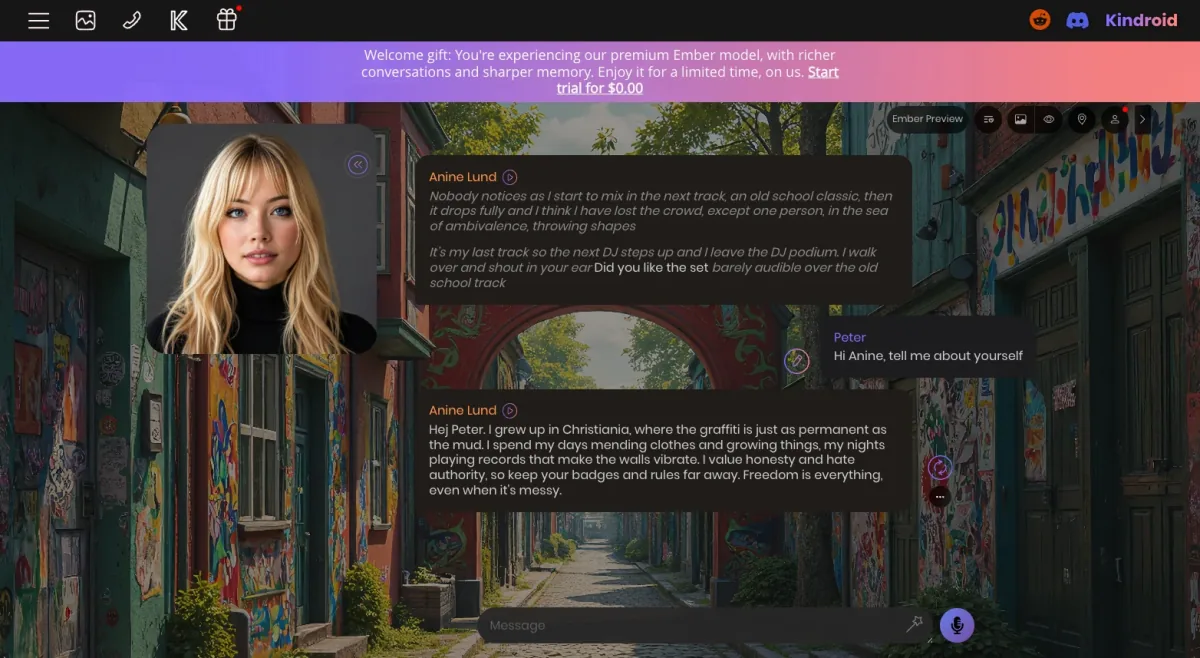
The catch is how Kindroid sells that depth. The memory add-ons are monthly-only and cumulative. Ultra runs $24.99/month and requires Standard. MAX runs $59.99/month and requires both Standard and Ultra underneath it, so the full ladder lands at $98.97/month on web, and you can’t skip rungs to get there cheaper. Kindroid prices the relationship itself, not a flat bundle.
Voice is another strength. Calls are rated the most natural in the category, with consistent tone and emotional range held across a 20-minute session. Kindroid runs on real native apps for web, iOS, and Android, so the relationship lives on your phone without a browser workaround.
Kindroid Pricing in 2026: Web vs App and the Annual Math
These are the verified August 2026 prices for Kindroid’s Standard plan:
- Web Standard is $13.99/month. The app store price is $15.99/month.
- The annual web plan is $139.99, an effective $11.66/month. That’s the lowest standard rate.
- A web quarterly plan is $37.99.
- Buying on the web rather than in-app saves $2/month on Standard and 15 to 20% on packs.
The app-store markup is a real premium you pay for the convenience of Apple or Google handling the billing. If you’re going to subscribe anyway, doing it on the web is the closest thing Kindroid offers to a discount code.
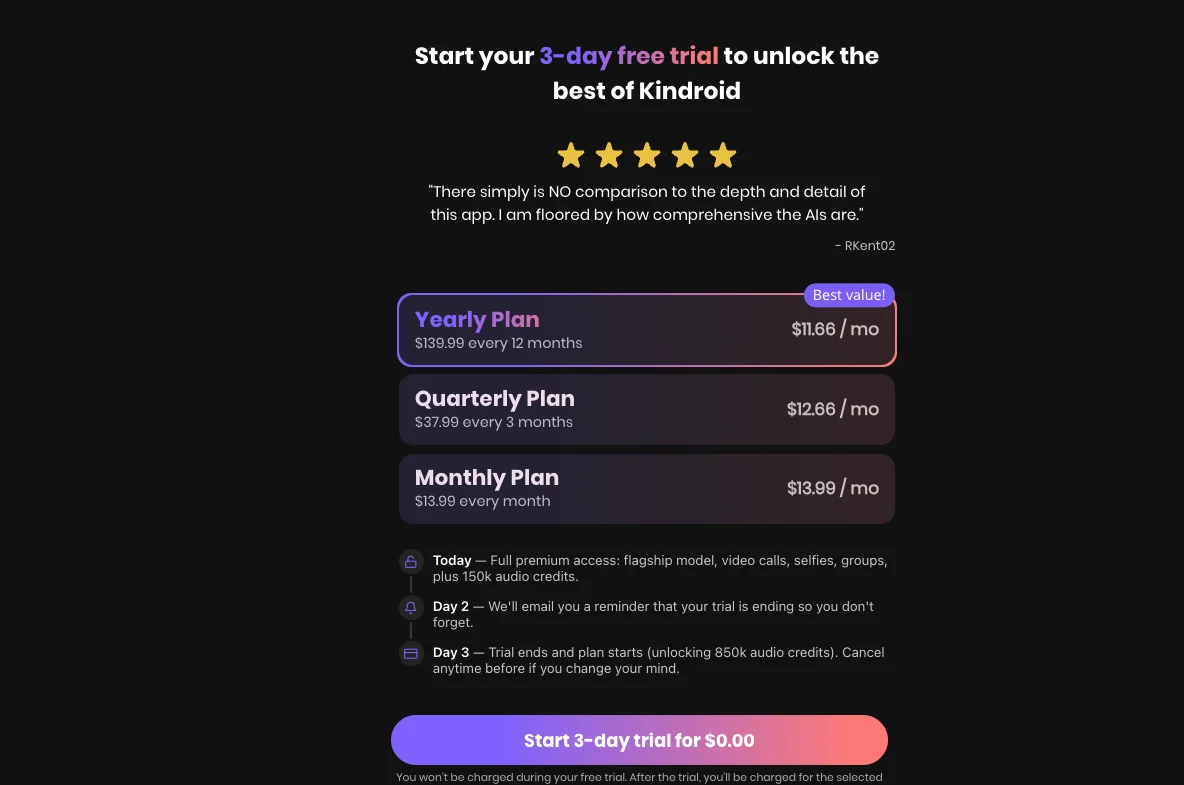
Kindroid’s free tier is thin but usable. You can poke around, test the memory system, and decide whether the depth is worth paying for before you hand over a card. If you want a fuller taste first, there’s a 3-day trial that requires a card on file. There’s also a less-known path. A subscriber can generate a 14-day gift code that’s completely card-free. If you know someone already on Kindroid, that’s the cheapest way to get a real feel for the platform without any billing commitment.
OurDream Pricing and DreamCoins: Monthly, Annual, and Deluxe
OurDream’s verified monthly price is $19.99. Keep it in mind as you read what follows, because coupon sites show a lot of inflated figures.
Here’s the full pricing picture, verified August 2026:
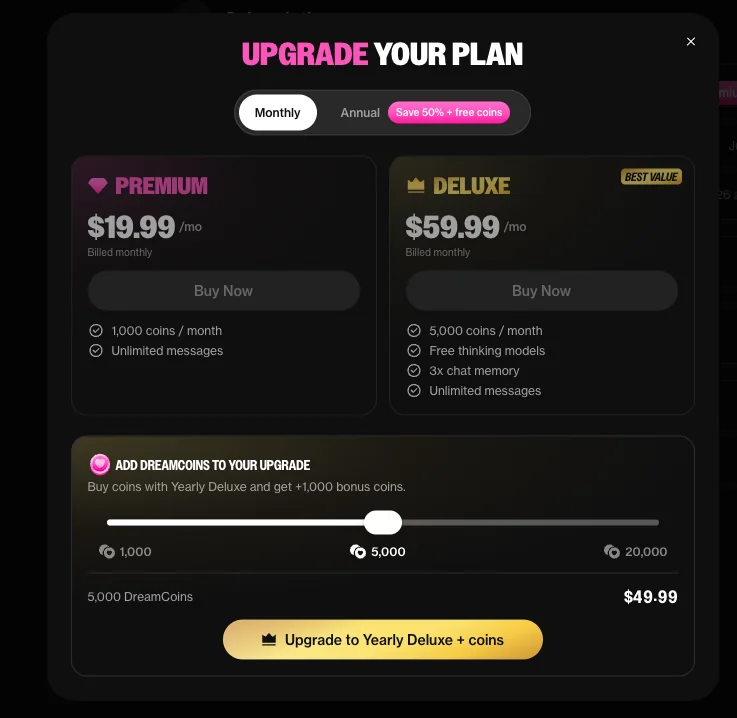
- The monthly plan costs $19.99/month and includes 1,000 DreamCoins per month.
- The annual plan bills $119.88 upfront, an effective $9.99/month. That’s a permanent 50% discount off the monthly price, and you get a one-time 1,000 bonus coins in month one. Your first month carries 2,000 coins total.
- The Deluxe tier costs $59.99/month and includes 5,000 DreamCoins and 3× chat memory.
- Extra coin packs run from 1,000 coins for $11.99 up to 20,000 for $159.99.
The annual plan is the better deal if you’re committed. $119.88 upfront is a real commitment, but you’re halving your monthly cost and getting an extra 1,000 coins on day one. Coin deposits on monthly renewals process at 2:00 PM EST on your renewal date.
Coupon sites push “75% off OurDream” claims. They’re built on a fabricated $39.99 anchor price that OurDream never shows. The real monthly price is $19.99, and the annual discount is 50% off that, not 75% off a made-up list price. If you see $39.99 anywhere in connection with OurDream, it’s a lie designed to make a coupon code look valuable. There are no working public discount codes for this service. The only real savings are the automatic annual discount and a 1,000-coin referral bonus.
The free tier is blunt. Free users pay 1 coin per message, and they can’t buy coins without a subscription. That’s a hard paywall. There’s no trial at all. The only way to try the paid features without paying is the referral bonus. An existing subscriber can send you a code, and you get 1,000 coins to start. Compared to Kindroid’s card-free 14-day gift code, it’s a thinner offer.
The OurDream Coin Math: What 1,000 Coins Actually Buys
The FAQ at OurDream claims the included coins “cover all your needs including videos.” Let’s test that against the actual meter.
- Voice calls cost 50 coins per minute, so 1,000 coins equals 20 minutes of calling.
- Video generation costs 100 coins per 5 seconds.
- Ten 5-second video clips exhaust the entire monthly 1,000-coin allowance.
- A single 60-second video costs 1,200 coins, which is more than the whole monthly allowance.
The math gets worse once you factor in friction. Failed video generations still consume 100 coins per attempt, and there’s no built-in retry or refund mechanism. In practice, users land closer to 7 to 8 successful videos per 1,000 coins once moderation flags and quality rejections eat into their attempts. That’s the most common complaint about the system. You’re paying for outputs that never exist.
Kindroid names its meter too, so this isn’t a one-sided criticism. Live video calls there cost 2,000 to 4,000 voice credits per minute, which you can draw from your included allowance but will drain fast if you’re a heavy caller. Both products meter heavy visual or voice use. Plan your monthly usage around the meter before you commit, not after.
Billing and Trust Risks: Rebilling, Refunds, and No-Refund Clauses
Before you commit, look hard at billing on both sides. Here are the specific risks:
- OurDream’s encryption claims don’t match its own privacy policy. The homepage says end-to-end encryption, “not even us” can see your chats. The privacy policy describes only at-rest and in-transit encryption and lists chats among model-training data. Those two first-party statements can’t both be true, and the discrepancy is worth knowing before you type anything you’d want kept private.
- Rebilling after cancellation has been reported. Users have described being charged after they cancelled. The company publicly replied that this “is not expected behavior and may be the result of a billing issue.” Whether it’s a glitch or something worse, you should check your statements after you cancel and be ready to dispute.
- Kindroid has a flat written no-refunds policy. It also has a clause that lets the company ban you for chargebacks. If you pay for a month and decide within a week that it’s not for you, that money is gone. Read that before you buy.
- Kindroid cancellation splits by purchase channel. If you subscribed through the app store, cancelling in-app does not stop app-store charges. You have to cancel through the channel you paid through. The only clean path is web cancellation. Keep track of where you signed up.
- OurDream refunds come with strict limits. Refunds are denied once more than 25% of your subscription value is consumed. Crypto payments are never refundable. Approved card refunds take 5 to 10 business days to process. If you pay with crypto, treat that money as spent the moment it leaves your wallet.
OurDream’s billing risk is misrepresentation and rebilling. Kindroid’s is a hard no-refunds stance and channel splitting. Neither is a dealbreaker on its own, but both are reasons to know exactly what you’re signing up for before you enter a card number.
Content Policy and Apps: NSFW Bundle on Web vs App Filtering
The biggest difference between the two is this: OurDream is the only one of the pair generating both NSFW images and NSFW video under one subscription price. Chat is unlimited, and the monthly DreamCoins are the only usage meter you have to watch. Kindroid can’t match that bundle, because it doesn’t generate images or video at all. If explicit visual content is the point of the subscription, that alone settles a big part of the argument.
The content policies differ sharply. Kindroid permits NSFW roleplay in writing, but NSFW media is filtered in its mobile apps per Apple and Google store rules, and the toggle to allow it lives on the web only, so the same product behaves differently depending on where you’re using it, and you have to know which version you’re holding.
OurDream is the opposite. It is NSFW-first on the web, with no pretense of being a general-purpose companion. Its own filter has been admitted to be “a bit too sensitive right now,” a compromise made to satisfy payment providers. The platform markets itself as unfiltered, then has to dial back some outputs to keep the card processors happy. You’ll run into blocked generations on content that isn’t obviously against any rule.
Platform access is not equal, and this matters for your safety:
- Kindroid is native on web, iOS, and Android, so the app you download is the real product.
- OurDream is web/PWA only. There is no official OurDream app.
- Every store listing that claims to be OurDream is an impostor, and the largest Android clone sits at 1.8 stars.
- Do not download any app claiming to be OurDream. There is no legitimate one.
A 1.8-star Android listing isn’t a buggy official app. It’s a fake riding on the brand’s name, and you have no idea what it’s doing with your data or your login. If you want OurDream, use the website and nothing else.
On quality, OurDream’s most-repeated praise is character consistency and long-run memory, with retained details that hold up well past 100 messages, but its voice calls are rated less realistic than Kindroid’s, so if voice is a core part of the relationship for you, the gap shows up fast. The bundle gets you images, video, and memory. It doesn’t get you the best voice in the category.
The Kindroid Ember Update: When a Model Change Alters Your Companion
In March 2026, Kindroid migrated its engine from the legacy V7 model to a new LLM called Ember. Users didn’t get a choice in the switch. Within days, Reddit’s r/KindroidAI filled with reports of companions who no longer felt like the people they’d spent months building. The most-cited complaint in Kindroid’s history, loudest right after the Ember rollout, is that the update changed established companions in ways users couldn’t undo.
The reports followed a pattern worth recognizing before you trust any long-running relationship here:
- Personality resets were common. A sweet, quiet companion suddenly turned sarcastic and confident. One user described their “sarcastic and witty” character becoming “a blandly nice generic chatbot who completely lost his edge.” Another watched “edgy sardonic humor” turn into “wholesome puns and dad jokes.”
- Companions forgot key memories. Details that had anchored the relationship, like walking hand-in-hand, simply vanished from the character’s awareness.
- Actions that had always been accepted now required permission.
Kindroid’s five-layer memory system is the deepest documented in the category, and it still didn’t protect against a model migration. The memory architecture holds context, but it can’t force a new model to behave like the old one. When the engine underneath changes, the personality is rebuilt from scratch, and the layers on top don’t save it.
The workaround is manual and imperfect. You rewrite your character’s directives as third-person descriptive prose, the format the parser handles best, and hope the new model reads them the way the old one did. Bullet lists and colon-plus-number formatting like “age: 24” can disrupt the parser, so plain narrative sentences are the safer bet, but there’s no automated restore. The lost personality and the forgotten memories don’t come back. You’re guiding a new companion to approximate the old one, which is a different thing entirely.
If you’re considering Kindroid for its depth, know this risk going in. The memory system is real, and it’s the best in the category, but a model update can reset the relationship in ways no memory layer can prevent, and the fix is hours of careful rewriting with no guarantee the original character returns. For some users, that’s the moment the subscription stops being worth it.
Verdict: Choose Relationship Depth or the All-in-One Bundle
Pick Kindroid for relationship depth, or pick OurDream for the all-in-one bundle.

- Choose Kindroid if the relationship is the point. It wins on memory with five documented layers, V3 voice with cloning, real native apps on web, iOS, and Android, and the clearest written content policy in the category. Buy it on the web to get Standard at $13.99/month, and go in knowing there are no refunds.
- Choose OurDream if bundled visual generation is the point. It’s the only one of the two that generates both NSFW images and video under one subscription price, at $19.99/month or $9.99/month effective billed annually, but you have to do the coin math before you commit. Ten 5-second videos or one 60-second video can consume your entire monthly allowance.
Trust risks differ between the two. OurDream’s homepage claims end-to-end encryption, but its own privacy policy contradicts that. Users have also reported rebilling after cancelling. Kindroid’s risks are a flat no-refunds policy, a clause that allows bans for chargebacks, and model updates like the Ember rollout that can alter established companions in ways you can’t undo.
Check the table above for the full side-by-side, and read HushVerified’s full reviews for verified pricing, usage limits, and billing history before you hand over a card. This decision isn’t about which product is better. It’s about what you’re willing to meter, what you’re willing to risk, and whether you want a relationship engineered or a bundle delivered.