

We get asked a lot which one is better, Kindroid or Promptchan. The honest answer is that they aren’t really competitors at all. They’re built for different jobs, and you should pick based on what you want to do, not on which spec sheet looks stronger.
| Kindroid | Promptchan | |
|---|---|---|
| Entry price | $13.99/mo | $14.99/mo |
| Billing terms | monthly, 3-month, annual | monthly |
| Free tier | 2 Kindroids, Lite model, 5,000 lifetime audio characters | A daily gem allowance, image creation and chat |
Kindroid is a companion product through and through. It’s built around persistent characters that stay with you, with five documented memory layers so the same person remembers your history across conversations. Voice calls include cloning, so your companion sounds consistent. There are live video calls, and group chats let multiple characters share a room together. The whole design aims at one thing: an ongoing relationship that develops over months.
Promptchan describes itself as an uncensored AI platform. It has an image generator, a video generator, and AI companions, but the chat is there to feed the generation. Billing is gem-metered around output, which tells you exactly where the platform’s priorities sit. You’re not building a long-term bond. You’re producing explicit imagery at volume.
So the routing question is simple: do you want an ongoing relationship, or explicit imagery at scale? A companion and a generator serve different needs, and comparing them feature-for-feature misses the point.
What Kindroid Actually Is: An AI Companion Built for Continuity
Kindroid’s defining feature is a single persistent character backed by five documented memory layers. That’s the product’s whole identity, and it’s what answers the question people really have when they compare Kindroid with Promptchan as an AI companion. The person you talk to today is the same person you talked to last week. The system is built so that continuity holds up across long, rambling conversations, and editable memory keeps long stories coherent. If a plot thread drifts or a detail gets lost, you can nudge it back into place rather than starting over.
That continuity goes beyond text. Voice calls support cloning, so the voice on the call matches the character you’ve been chatting with. Live video calls work natively without third-party bridges. Group chats let multiple characters share one room, and that’s where the memory system shows its value, because each participant needs to stay consistent while the conversation bounces between them.
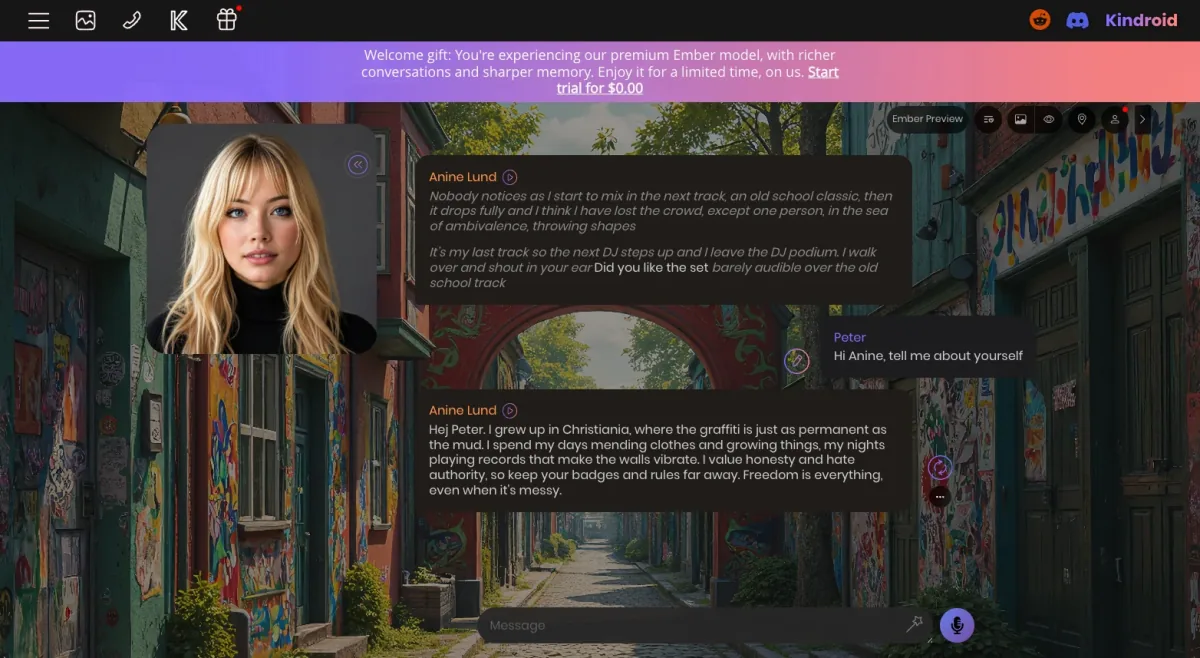
The moderation boundary is unusually transparent, and it’s worth understanding before you sign up. Kindroid explicitly permits NSFW text roleplay in writing, with three hard red lines that define what it won’t touch. NSFW media is filtered in the mobile apps, though, because Apple and Google store rules leave no room for negotiation. The toggle that turns that media on exists only on the web. If you’re an app-first user, that’s a real constraint to plan around.
Kindroid runs on genuine iOS and Android apps that are its own builds, not mobile browser shortcuts dressed up as native software. Both apps are real, maintained, and tied into the same character and memory backend as the web version. For a product whose whole pitch is an ongoing relationship, that matters, because the companion should feel the same whether you’re on your phone or at a desk.
What Promptchan Actually Is: An Uncensored Generator First
Promptchan is not an AI companion in the way Kindroid is. Its entire premise is uncensored image and video generation, and the chat feature exists to serve the generator rather than build a long-term companion. The characters you talk to are there to feed the generator, not to remember your birthday six months from now. When you open the platform, the creation tools are the first thing you see. Chat is a side room.
The generation controls carry the real depth. You get styles, poses, quality tiers, and negative prompts to steer output away from what you don’t want. There’s a community gallery where other users post their results, and each one carries a prompt you can clone and tweak for your own run. That turns the gallery into a shared library of starting points rather than a place to scroll for inspiration.
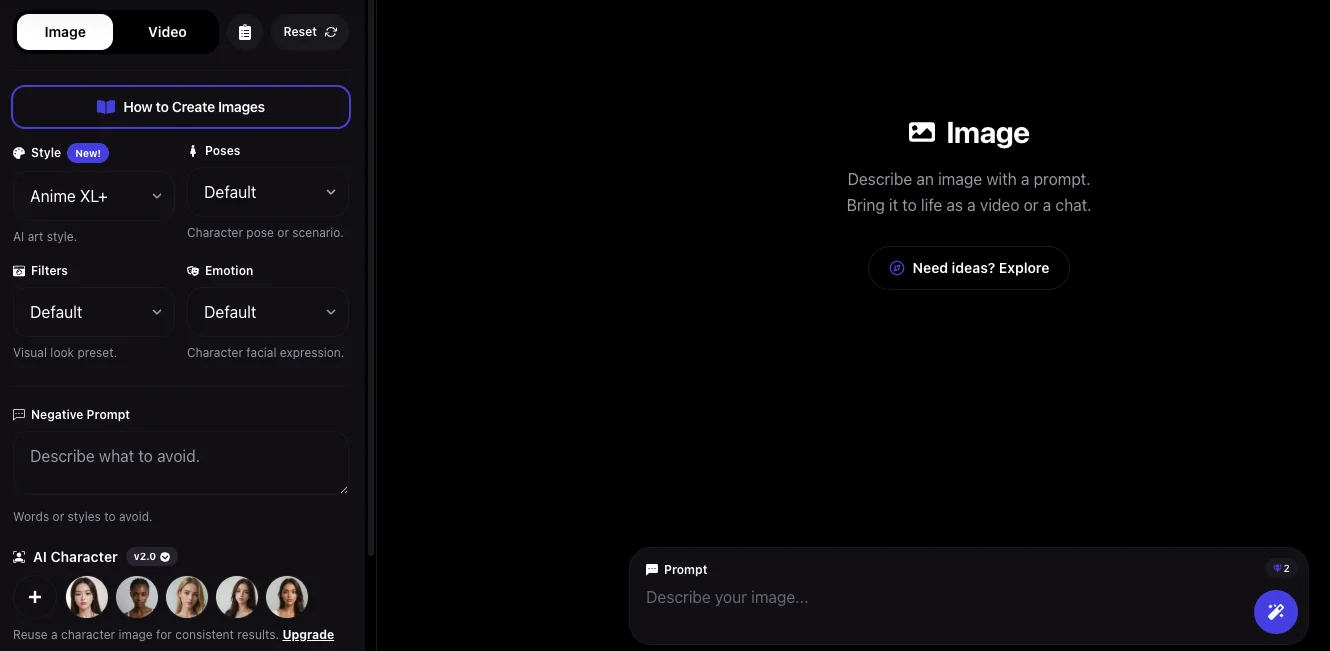
Several of the more capable features sit behind the Pro plan. Full-length video generation, custom character creation, and voice calling all require it. The free tier and lower paid plans will get you images, but if your goal is video or a character built from scratch, you’re looking at Pro.
Promptchan has a genuine iOS app and a full web platform, but no official Android app. That matters, because circulating “MOD APK” builds claim to fill the gap, and they’re a malware risk. If you’re on Android and someone offers you a cracked version of Promptchan, treat it as a trap, because that’s what it is.
If you came here hoping Promptchan is a companion like Kindroid, it isn’t. It’s a generator with a chat wrapper, built for output at volume. Choose it for what it actually does, not for what the marketing tab might suggest.
Kindroid vs Promptchan Price: Flat Monthly vs Gem-Metered Plans
When you compare Kindroid vs Promptchan on price, you’re looking at two completely different billing philosophies. Kindroid charges a flat monthly fee for the whole product, while Promptchan meters everything around gem output. One tells you exactly what you’ll pay before you commit, the other asks you to estimate how much you’ll actually use.
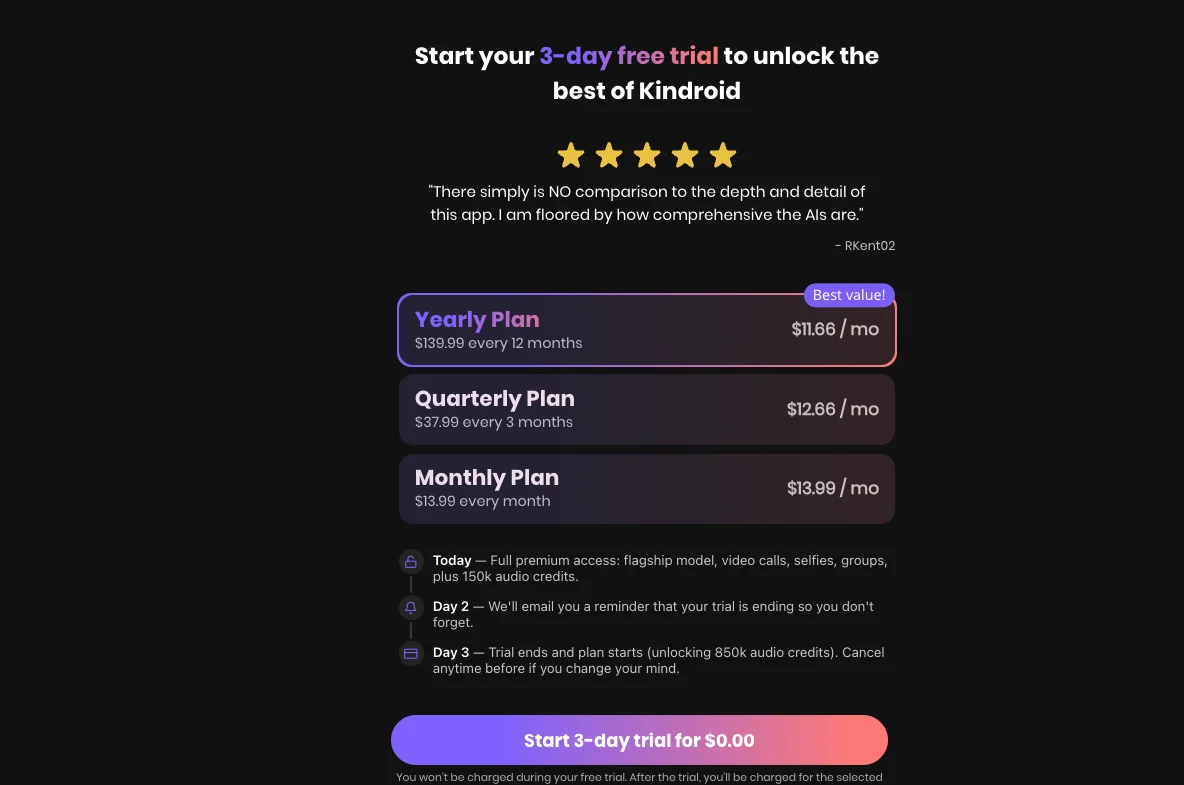
- Kindroid is $13.99 per month on web, or $15.99 per month through an app store. The annual plan is $139.99, which works out to $11.66 per month. On web, the optional add-ons Ultra ($24.99/month) and MAX ($59.99/month) are cumulative, so the top of the ladder reaches $98.97 per month on web.
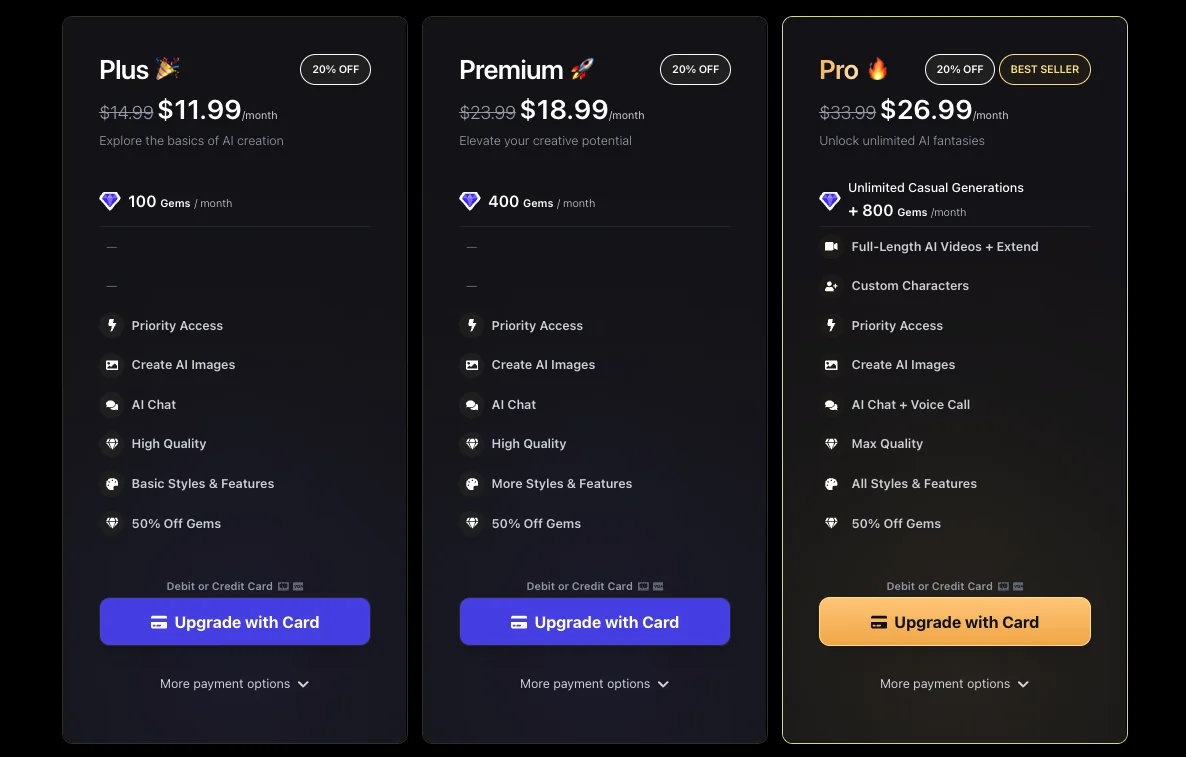
- Promptchan has no annual or multi-month option. Its plans are Plus $14.99/month for 100 gems, Premium $23.99/month for 400 gems, and Pro $33.99/month for 800 gems plus unlimited ‘Casual’-quality generations.
- Buying Kindroid on web saves $2 per month versus app-store pricing and 15 - 20% on packs. Promptchan subscribers get a 50% discount on gem top-ups.
- A site-wide 20% checkout promotion in August 2026 lowered Promptchan’s Plus to $11.99, Premium to $18.99, and Pro to $26.99.
Kindroid’s real cost stays predictable. Promptchan’s can creep upward through gem usage the moment you want anything beyond the baseline. Both platforms offer ways to trim the bill, but only one lets you know the total before you ever start generating.
Free Tiers and Trials: What You Get Before Paying
Trying each one before paying shows how different they really are. Kindroid’s free tier is thin, while Promptchan’s is a genuine free tier, just one with limits you’ll want to know about before you lean on it.

- Kindroid’s free tier is thin: a 3-day card-required trial, or a 14-day gift code from a subscriber if you know one and want to avoid entering a card.
- Promptchan has a genuine free tier with a daily allowance, but the exact gem count is unpublished. Treat it as a way to test the generator, not a long-term plan.
- Neither product has any working public discount code. Any code you find online is likely expired or fake.
- Kindroid’s real savings come from buying on the web and choosing the annual term. Promptchan’s real savings come from checkout promotions, not a lower annual rate.
That difference flips the usual advice. With Kindroid, the discount is structural. Pay on the web instead of through an app store, or commit to the annual term, and the price drops without coupon hunting. With Promptchan, there’s no annual rate to chase, so the only real deals are the occasional checkout promotions, like the 20% site-wide discount that showed up in August 2026.
Kindroid’s trial is a short window to feel out whether a persistent companion clicks with you. Promptchan’s daily allowance is a way to sample the generator’s output quality. One is for testing a relationship, the other for testing generation output. When you’re weighing Promptchan or Kindroid, ask which of those you’re actually trying to evaluate.
Where You Can Actually Run Each App
Where you can run each app says a lot about which audience each company is chasing. Kindroid has real native apps on iOS and Android, plus full web access, and all three are its own. There’s no mobile-browser shortcut dressed up as a native build here. The apps are maintained, tied into the same character and memory backend as the web version, and treated as first-class citizens.
Promptchan is a different story. It has a web platform and a real iOS app, but there is no official Android app, and that absence is deliberate. No app store listing exists for it at all, which is a direct consequence of the NSFW content policies that gate what Apple and Google will host. The web platform is fully mobile-responsive, so Android users can install it as a PWA and get something close to an app experience, but it’s not the same as a native build.
That gap creates a real hazard, and we want to be blunt about it. If you’re on Android and someone offers you a Promptchan APK, it is a MOD build and a malware risk. There is no official Android app to download. The cracked versions circulating online are how people end up with their accounts drained or their devices compromised, so treat any APK as a trap rather than a workaround.
On iOS, Promptchan’s app was completely rebuilt in v10.0.0 on 31 July 2026. That means the complaints you’ll still see about the old app, the crashes, the clunky interface, and the missing features all predate the rewrite. If you’re judging Promptchan on app quality, make sure the review is about the new build and not the old one. The platform gap comes down to a simple question: if you’re an Android user looking for a native app, Kindroid is the only one of the two that offers one.
Content Rules: Explicit Text vs Uncensored Media
Kindroid explicitly permits NSFW text roleplay in writing with three hard red lines: hate speech, violent imagery, and anything involving real people are banned. That’s the whole boundary, stated plainly, and it’s worth knowing before you start because it shapes what the product allows. Everything else in text is fair game, and the platform says so rather than hiding behind vague terms of service.
- Hate speech gets you banned.
- Violent imagery gets you banned.
- Anything involving real people gets you banned.
Those are the only walls, and they’re sensible. Within them, private chats are unfiltered. You can take a scene anywhere, with the AI following your lead rather than initiating on its own. That freedom stops at the edge of your private conversation, though. Public posts, shared images, and community content are instantly flagged and held to strict guidelines. Kindroid runs a walled-garden dynamic: anything goes in the room, and the hallway outside is heavily policed.
Promptchan’s entire premise is uncensored image and video generation, so explicit imagery is the default for verified adult users, not a toggle they have to hunt for. NSFW isn’t an afterthought bolted onto a mainstream product. It’s the core feature. Explicit photorealistic, anime, and hentai output all work out of the box, and adult roleplay in Story Mode and chat sits on the same pipeline. There are fewer restrictions here than almost anything else in the space.
That contrast sits at the center of the uncensored ai image generator vs ai companion question. If your goal is explicit imagery, you are Promptchan’s audience, and no amount of Kindroid’s text freedom changes that, because Kindroid won’t generate the media in the first place. If your goal is an ongoing relationship with a character who remembers you, you’re Kindroid’s audience, because Promptchan’s chat exists to feed its generators, not to build continuity.
There’s one last platform constraint to keep in mind. Kindroid’s NSFW media is filtered in its mobile apps, because Apple and Google store rules don’t leave room for negotiation. The toggle that lets that media through exists only on the web. So even though Kindroid permits explicit text everywhere, a phone-first user can’t access NSFW media at all. Promptchan doesn’t have that problem, which is exactly why it has no Android app at all, but that’s a platform story for another section.
What Each Tool Does Well and Where It Falls Short
People often frame the Kindroid vs Promptchan 2026 conversation as a head-to-head, but that misses what each tool is actually built for. Both have real strengths, and both have real weaknesses. The key is knowing which trade-offs you’re willing to live with.
Kindroid: Built for Depth, With Some Growing Pains
Kindroid’s strongest card is the memory system. It’s the deepest documented memory architecture in the category, with five explicit layers that let a character hold onto context across long, winding conversations. It’s the thing that makes a months-long relationship feel real rather than like you’re talking to a fresh stranger every session. Paired with that is the voice system. V3 is strong on its own, and cloning takes it further, so the voice on a call matches the character you’ve been texting. Add real native iOS and Android apps, and you’ve got a product that feels complete on every front.
The moderation policy deserves a mention too, because it’s rare to see one stated this plainly. Kindroid tells you exactly what’s allowed and what isn’t, with three hard red lines, and then stays out of your way within them. That transparency is a genuine strength in a category where most companies bury the rules in legalese.
But Kindroid has real counterweights, and the loudest one is model updates. When the underlying model changes, established companions can shift in ways users didn’t ask for. The complaints were loudest after the March 2026 Ember rollout, and they’re worth taking seriously. If you’ve spent months building a character a certain way, a silent update that changes how they respond is a genuine frustration, not a minor annoyance.
Then there’s the pricing structure. The optional add-ons are cumulative, so the ladder climbs to $98.97 per month on web if you stack Ultra and MAX on top of the base plan. That’s a real commitment, and it’s easy to underestimate. And the refund policy is flat: no refunds, period. Worse, there’s a clause reserving the right to ban accounts that file chargebacks. That’s a hard stance, and it means you’re betting on the product working for you from day one.
Promptchan: Powerful Generation, With Trust Issues
Promptchan’s strengths all sit on the generation side. You get styles, poses, quality tiers, and negative prompts to steer output, which gives you real control over the final image rather than leaving the result to chance. The community gallery is the hidden strength here: every posted image carries a prompt you can clone and tweak for your own run, which turns the gallery into a shared library of starting points. And on Pro, you get full-length video with extend, which is a capability most competitors don’t offer at all.
The counterweights are where we’d want to be careful if we were new users. There are recurring reports of purchased gems not being credited, and that’s the kind of problem that erodes trust fast, because it hits you right at the payment layer. There are also reports of features being removed without warning, which makes the platform feel less stable than its marketing suggests.
The refund policy adds another complication. Promptchan has a written 30-day guarantee, but it’s conditional on no significant use, which gives the company a lot of room to interpret what “significant” means. And if you paid with crypto, that’s non-refundable regardless. So the practical protection is weaker than the headline suggests.
Both products are honest about their trade-offs in their own way. Kindroid tells you exactly what it costs and exactly what it will and won’t do, then asks you to trust it for the long run. Promptchan gives you powerful tools and a generous free tier, but asks you to trust the billing. Which trust you’re willing to extend depends entirely on which job you’re hiring the tool to do.
The Verdict: Kindroid for Companionship, Promptchan for Images
After working through both platforms, our bottom line is this: if you want an ongoing companion, Kindroid is the choice. If you want uncensored image and video output, Promptchan is the choice.
The Kindroid or promptchan for companionship question is really about memory and continuity. Kindroid’s persistent characters, five documented memory layers, voice cloning, live video calls, and group chats all point in one direction: a relationship that develops over time. The person you talk to in March is the same person you talk to in September, and the system is built so that continuity holds. If that’s what you’re after, no amount of Promptchan’s generation power changes the answer, because Promptchan’s chat exists to feed its generators, not to build a relationship.
The promptchan or kindroid for image generation question points the other way. Promptchan’s generation controls, prompt cloning from the community gallery, and Pro-only features like full-length video and custom characters make it the clear choice for anyone whose goal is explicit imagery at volume. Kindroid won’t generate NSFW media in its mobile apps at all, and its text freedom doesn’t help you if what you actually want is the image. If output is the job, Promptchan is the tool.
If you’re genuinely torn between the two, we have one deciding question for you: will you still want the same character next month? If the answer is yes, you’re describing a relationship, and that’s Kindroid’s territory. If the answer is no, you’re describing a session, and that’s Promptchan’s.
The table above shows the side-by-side comparison so you can see the trade-offs at a glance. Before you hand over a card to either platform, read the full HushVerified reviews for both products. The pricing quirks, the refund policies, and the platform gaps are all worth knowing before you commit. The choice between these two isn’t about which one is better. It’s about which one does the job you’re hiring it for.