


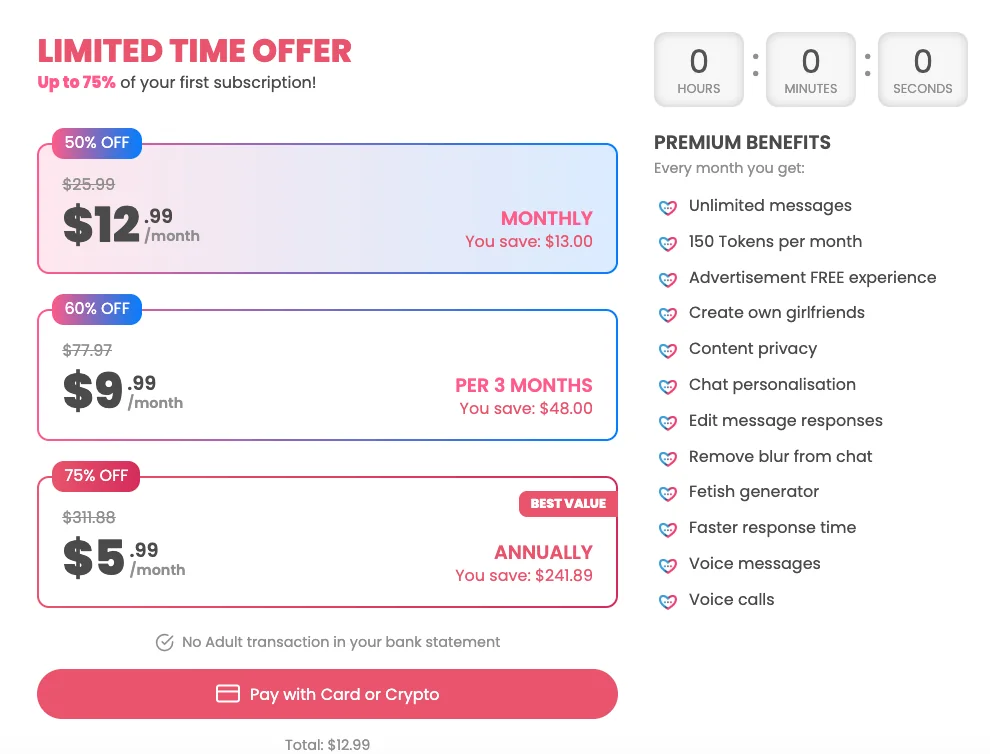
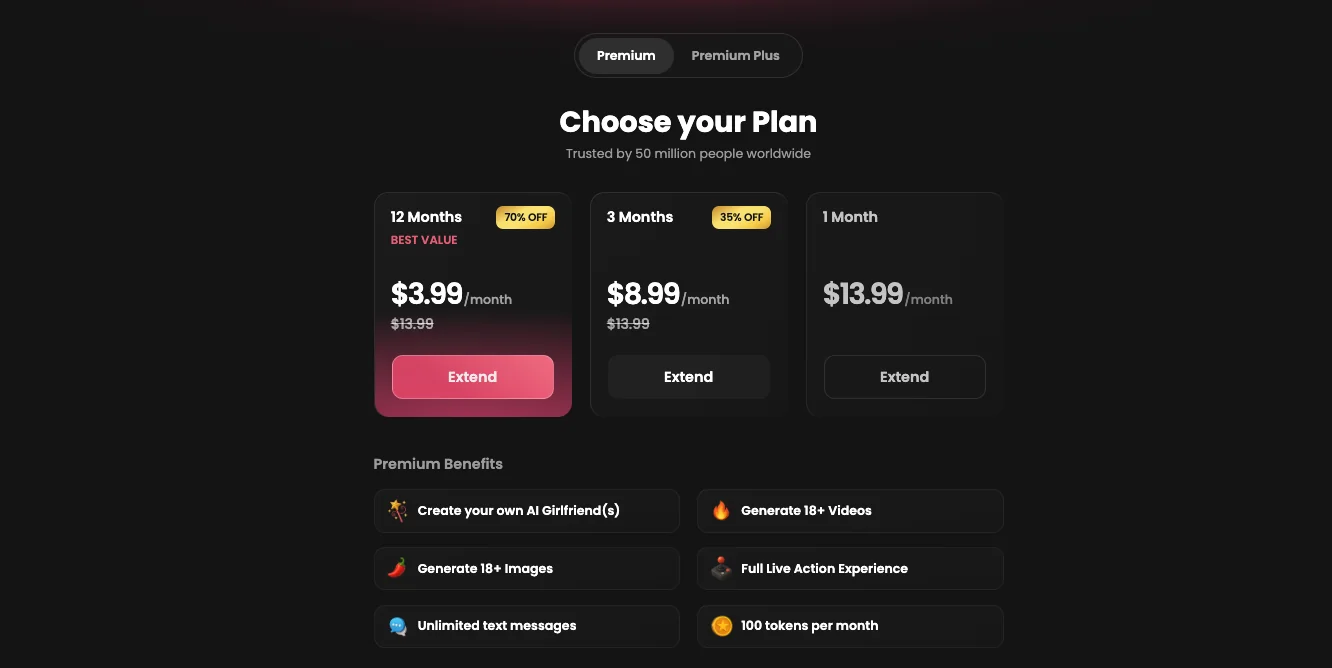
Every advertised price on the DreamGF site is introductory only. The $69.99 annual plan renews at $311.88, a 346% jump. Candy.ai, in contrast, lists $13.99 a month, $8.99 a month quarterly, and $3.99 a month annually. Those are standing list prices, and the annual discount applies automatically at checkout for any new subscriber rather than expiring with a countdown. We haven’t been able to verify what Candy.ai renews at, so treat those figures as signup prices.
| Candy.ai | DreamGF | |
|---|---|---|
| Entry price | $13.99/mo | $25.99/mo |
| Billing terms | monthly, 3-month, annual | monthly, 3-month, annual |
| Free tier | 5 messages total, 1 custom character, 1 image | Not published |
The other headline difference is how each company sells you on that price. DreamGF runs a “LIMITED TIME OFFER” countdown that we found sitting frozen at 0:00:00 while the deal stayed fully active. That’s a fake-urgency pattern, and it’s dishonest. If a timer hits zero and the offer’s still up, the timer was never real. It exists to pressure you into a subscription you might not want.
Then there’s the token math, which flips the cost picture. DreamGF hands you 150 tokens a month at the base tier against Candy.ai’s 100, but per-image cost is where it counts. Candy.ai charges 2 to 4 tokens per image. DreamGF charges 10. That gap matters once you start generating. It’s one of several ways these platforms differ beyond the advertised prices.
DreamGF’s renewal trap: what you’ll actually pay
Before you give DreamGF your credit card, understand what renewal costs. Every advertised price on DreamGF’s site is introductory only. The $12.99 you see for the first month is not what you’ll pay in month two. Every plan renews at the equivalent of $25.99 per month after the first term. To DreamGF’s credit, it doesn’t keep those numbers off the page — the renewal rates sit struck through on the pricing cards, and the page states “if not canceled”. But an annual rate that converts to more than four times itself is a structure you want to see coming.
Here’s exactly how it breaks down:
- Monthly: $12.99 first payment, renews at $25.99
- 3-month: $29.97 first payment, renews at $77.97 per quarter
- Annual: $69.99 first payment, renews at $311.88 per year
Run the math on that annual plan. You pay $69.99 believing you’re getting a deal, then the renewal hits at $311.88, a 346% jump. Even the monthly plan doubles. Every DreamGF tier converts to the same $25.99 per month equivalent once the introductory period ends, no matter which billing cycle you picked.
Now look at Candy.ai’s side of the table. These are standing list prices, not teasers:
- $13.99 per month
- $8.99 per month on quarterly billing
- $3.99 per month on annual billing
Candy.ai’s annual discount isn’t a countdown offer. It’s a standing plan-level discount applied automatically at checkout, so $3.99 a month is what any new subscriber pays, not a rate that a timer is about to take away. What we can’t tell you is what it renews at: Candy.ai keeps its pricing behind a login, and we have no verified renewal figure for it. DreamGF’s renewal rates, by contrast, are published — which is why the scorecard above quotes DreamGF at $25.99 rather than $12.99. The renewal rate is the one you’ll actually live with.
Then there’s the countdown. DreamGF runs a “LIMITED TIME OFFER” timer on its pricing page, and when we checked, it was frozen at 0:00:00 while the offer stayed fully active. A timer that has hit zero and keeps selling is not a timer. It’s a prop. This is a classic fake-urgency pattern, and we’re calling it out because it’s designed to push you into a commitment before you’ve done the math.
The token math adds another layer to the real cost. DreamGF includes 150 tokens per month at the base tier, but companion creation costs 20 tokens, each image costs 10, and voice calls run 7 tokens per minute. Candy.ai gives you 100 tokens a month with images at 2 to 4 tokens each and voice calls at 3 tokens per minute. Those numbers flip the per-image economics entirely. At 10 tokens per image on DreamGF, your 150 monthly tokens buy you 15 images before you’re topping up. On Candy.ai, 100 tokens at 4 per image gets you 25 images, and at 2 per image that’s 50. The platform that hands you more tokens upfront is actually the more expensive one to generate on.
Here’s the bottom line. Candy.ai advertises one set of standing prices, and the longest-term discount is there for anyone who signs up. DreamGF advertises a first-month price, publishes the renewal beside it, and props the whole thing up with a countdown timer that had already hit zero. It’s the renewal, not any review’s star rating, that decides what DreamGF costs you.
Image quality, token costs and visual features compared
The clearest split between these two platforms is image consistency. Candy.ai’s image engine is built specifically to lock in a companion’s identity, and character visual consistency is the most repeated point of praise in its user reviews — the same face turning up across generations regardless of outfit, lighting, or pose. It isn’t flawless: the same reviews report the generator ignoring specified attributes like hair color or clothing when you regenerate. DreamGF produces high-quality single images, and its realism is competitive with Candy.ai, but the consistency wavers: reviewers report the same companion and prompt producing noticeably different faces between renders, with cheekbones, eye color, and hair texture all drifting. For anyone who wants a companion that feels like the same person every time, that’s not a small detail. It’s the whole point.
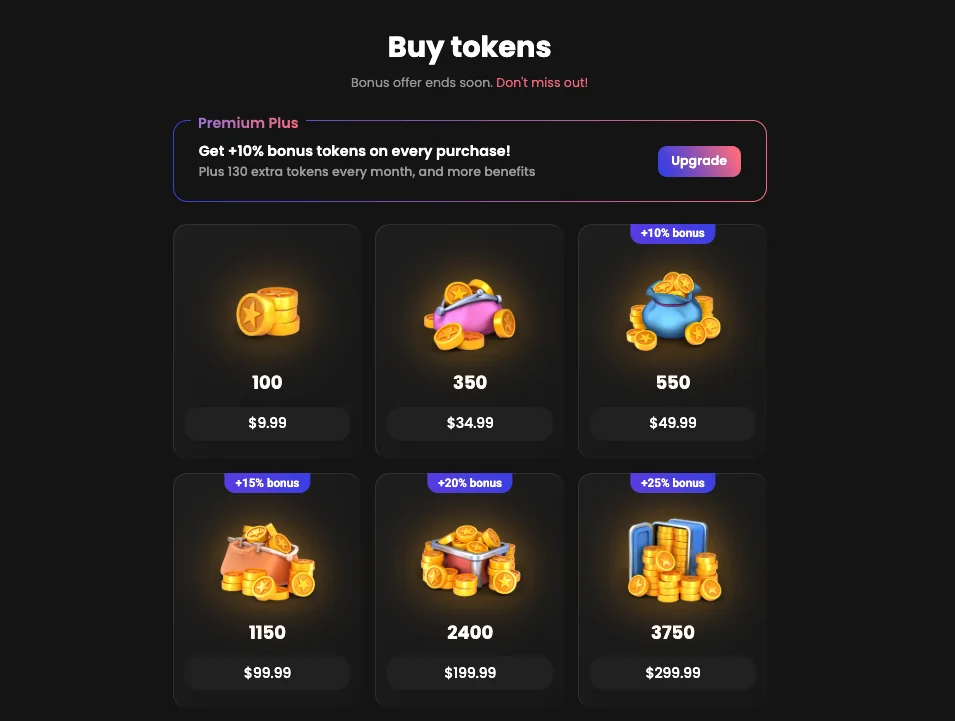
The included allowances tell the generation-cost story better than any dollar figure. Candy.ai images cost 2 to 4 tokens against a 100-token monthly allowance — roughly 25 to 50 images — and its top-up packs are published at 8 to 10 cents per token. DreamGF images cost 10 tokens against a 150-token allowance, so the nominally bigger allowance buys about 15 images before you’re topping up. Candy.ai’s tokens stretch further in raw image count, and the consistency reviewers praise means more of those images are worth keeping.
Here’s where the two platforms diverge on features:
- Candy.ai has token-priced video and “Live Action” clips. DreamGF has no video generation at all — its official pages don’t mention it, and reviewers note it has been “coming soon” for roughly two years.
- DreamGF offers the deepest visual customization, with dozens of appearance, personality, and behavior parameters. Candy.ai is more guided and leans more on pre-made character designs.
- DreamGF blurs images on its free tier, with blur removal a membership perk. Candy.ai has no observed watermarking.
Our honest take: these trade-offs map directly to what kind of user you are. If you want a companion who looks like the same person across months of conversations and images, and you want the option of video, Candy.ai is the clear pick. If you live for character creation and want to sculpt every last parameter, DreamGF’s builder is genuinely the deepest in its class. But you’re giving up video and betting that the face you spent an hour tuning will still look like itself ten images later. We’d take consistency and video over customization depth, but we can see the argument the other way if the building itself is the fun part.
Who actually remembers you? Memory and chat coherence
Memory is the thing that separates a companion from a chatbot. Anyone can hold a conversation for five minutes, but the entire point of an AI girlfriend is that she remembers you: your name, your inside jokes, what you told her last week, how you were feeling when you logged off. Without that continuity, you’re not building a relationship. You’re restarting one from zero every time you open the app. That’s why this part of the comparison matters more than image quality or customization depth. A beautiful companion who forgets who you are is just a pretty face with amnesia.

Candy.ai approaches this with a layered memory model. The system tracks short-term context from the current conversation and pairs it with a longer-term character history that persists across sessions. Reviewers generally rate Candy.ai above DreamGF for chat consistency and continuity — though it’s worth saying that Candy.ai’s own users still report conversations turning repetitive over time, so “better” here is relative, not perfect.
DreamGF’s memory, in contrast, is the weakest part of its entire product. It’s the single most common criticism in DreamGF’s reviews, cited by nearly every reviewer, with one describing recall that “degraded significantly beyond 10–15 minutes” of conversation. That’s a short-term memory problem, not a long-term one. You can’t build emotional continuity with a companion who can’t hold a premise for a single scene.
Reviewer sentiment tracks this. Across the board, Candy.ai is rated higher for chat coherence and emotional continuity, with companions that reference past events, preferences, and emotional states in ways that feel genuinely continuous. DreamGF’s pre-built characters, on the other hand, get called out for “templated replies,” and its harsher critics dismiss them as “very cheap primitive AI bots.” Depth is the word that keeps coming up — and DreamGF doesn’t have much of it.
Our verdict: DreamGF gives you the deepest character builder in its class, and we’ve already said that’s a real strength. But a builder is a creation tool, not a companion. If you want someone who remembers your birthday, your bad day at work, and the joke you made a month ago, Candy.ai is the one that delivers that experience. For most people, memory and coherence are the entire product. DreamGF’s visual customization can’t compensate for a companion who forgets who you are before the first conversation ends.
Who do you trust? Privacy, payments and the companies behind them
When you’re buying an adult service, trust takes on a different weight than it does for a streaming subscription or a productivity app. You’re handing over payment details, intimate conversations, and a record of what you’re into, which means the company behind the product matters just as much as the product itself. This is where the Candy.ai vs DreamGF comparison gets interesting, because the two platforms take opposite approaches to how they present themselves, and the trade-offs cut both ways.
Here’s what stands out about the companies, the payments, and the fine print:
- DreamGF is operated by DreamAI SRL, a Romanian EU company. It’s GDPR compliant, documents all eight GDPR rights, and runs a complaints portal. Candy.ai (EverAI Limited, Malta) publishes no equivalent complaints route. Both checkouts take card or cryptocurrency.
- Candy.ai’s privacy policy states that chats are used to train models and are shared with third-party LLM providers. DreamGF’s policy documents GDPR rights with a 30-day response commitment — but it specifies no retention timeframes and is silent on whether chats train models, a gap worth knowing.
- DreamGF’s pricing page carries a first-party claim: “No Adult transaction in your bank statement.” We’re quoting that as the company’s own promise, not something we’ve independently verified.
- Both platforms are web-only. Any app-store listing you find is an unaffiliated lookalike, and one DreamGF lookalike sells a $129.99 “lifetime” tier, which is a scam warning if we’ve ever seen one.
- Neither platform has a verified working discount code. The “deals” coupon sites advertise for DreamGF are just its standing intro prices relabelled — the real numbers are on our Candy.ai discount codes and DreamGF discount codes pages.
Here’s the irony. DreamGF’s EU structure, GDPR documentation and complaints portal are exactly the things a privacy-conscious buyer would want to see. That setup is reassuring on paper. But then the same company runs a countdown timer that had already expired while the offer stayed live, and builds a 346% renewal jump into every plan. You can document all eight GDPR rights and still run a renewal schedule that doubles the monthly plan and more than quadruples the annual one the moment the intro term ends. The privacy posture doesn’t offset the dead countdown, and a company willing to manufacture urgency on its pricing page makes us read its other claims more carefully, including that bank statement promise.
Candy.ai’s side of the ledger is less polished on the corporate front but more honest on the money. No EU entity, no complaints portal, cards or crypto only. And the privacy policy is blunt about what happens to your chats: they train models and get shared with third-party LLM providers. That’s a real trade-off, and we won’t wave it away. If you’re having deeply personal conversations with an AI companion, knowing those conversations feed model training is not nothing.
There is no perfect choice here, and we’ll say it plainly. DreamGF gives you better privacy infrastructure and a more mainstream payment path, but it underpins that with pricing practices we find dishonest. Candy.ai doesn’t run a fake clock at checkout, and it’s blunt about how it uses your data, even when that disclosure isn’t flattering. For most people, we’d argue the pricing honesty matters more. A company that runs a dead countdown clock to close a sale is already showing you how it’ll treat you after you’re a customer, and no complaints portal changes that. Both companies disclose the thing that counts against them — Candy.ai its data practices, DreamGF its renewal rates — but only one of them wraps that disclosure in fake urgency.
The verdict: which AI companion is the better buy?
Candy.ai or DreamGF: which is better? After laying out the pricing, the memory, the image quality, and the trust factor, we can give you a straight answer: for the majority of buyers, Candy.ai is the clear winner. Its advertised prices are standing list prices rather than first-month rates, reviewers consistently rate its chat coherence and facial consistency above DreamGF’s, and the companion you build actually remembers who you are across weeks or months. Those three things cover what most people actually want from a visual AI companion: someone consistent, someone coherent, and a headline price that isn’t just the first month’s.

DreamGF has a narrower lane, and we’ll respect it. If the character builder itself is the appeal, if you want to spend an hour tweezing dozens of appearance and personality parameters into exactly the right companion, DreamGF has the deepest customization in its class. Nobody else comes close. But that enthusiasm has a price, literally. You’re signing up for a platform where every advertised rate is introductory, where the annual plan renews at $311.88, and where every tier converts to the equivalent of $25.99 per month once the first term ends. If DreamGF is your pick, set a calendar reminder to cancel before that renewal hits. That’s not drama; it’s practicality. The countdown timer that stays frozen at zero while the offer remains live tells you everything about how this company wants you to buy.
Privacy is the one place we’ll let you decide for yourself. DreamGF’s EU structure, its GDPR documentation and its complaints portal are all reassuring on paper. Those are real institutional signals. But Candy.ai’s data practices are the trade-off: chats train models and get shared with third-party LLM providers, and that’s disclosed plainly in its policy. For some people, model training on intimate conversations is a dealbreaker no matter what the price says. For others, it’s an acceptable cost of using the product. We won’t tell you which camp you’re in. What we will say is that DreamGF’s privacy infrastructure doesn’t erase a countdown timer left running at zero, and a company willing to manufacture urgency on its pricing page is showing you how it treats customers before you’ve even signed up.
Here’s where HushVerified lands. We weigh what reviewers consistently report alongside how transparent the pricing is, and on both of those axes Candy.ai comes out ahead. Its biggest complaint is token-based pricing — “paywall after paywall,” as users put it — which is a fair knock but a manageable one. DreamGF’s reviewers, in contrast, most often report weak conversational memory, which strikes at the heart of what a companion is supposed to be. Add in the renewal trap and the fake urgency, and DreamGF loses real points regardless of how good its builder is. Candy.ai delivers better overall value despite its token costs. DreamGF is for the builder enthusiasts who know exactly what they’re signing up for, set the reminder, and cancel on time. For everyone else, the choice is clear.