


Most AI companion reviews put two nearly identical products side by side and end up arguing over tiny differences. That’s not what’s happening here. Candy.ai and Nomi come from two different design philosophies, and the whole debate boils down to one question: what do you actually want from an AI companion?
| Candy.ai | Nomi.ai | |
|---|---|---|
| Entry price | $13.99/mo | $15.99/mo |
| Billing terms | monthly, 3-month, annual | monthly, 3-month, annual |
| Free tier | 5 messages total, 1 custom character, 1 image | Messages capped at 400 characters, no voice or group chats |
Candy.ai is all about looks. Its image quality and character visual consistency are its most consistently praised strengths, and it handles the fantasy immersion better than most. Nomi, on the other hand, is built for memory. Across competitor comparisons it keeps coming up as the category’s memory leader, holding onto personal details across long gaps in conversation. One path gives you a companion who matches exactly what you picture in your head. The other gives you a companion who remembers the little things you mentioned weeks ago.
Most products in this market lean hard into one strength, and Candy and Nomi sit at opposite ends of the visual-versus-memory spectrum. That divergence shapes everything else about them, from how they converse to what they really cost you.
The scorecard above sets out our ratings and headline prices side by side. But the rest of this article covers what a scorecard can’t show: what those differences feel like day to day, where each platform falls down, and the real price once you get into the fine print.
Candy.ai: where your AI companion looks the part
For anyone who cares about how an AI companion looks, Candy.ai is the clear pick right now. In a 2026 Candy.ai vs Nomi comparison, Candy’s advantage is almost entirely visual, and it’s a real edge, not just marketing talk. But that strength is narrow, and it’s worth knowing exactly how narrow before you pull out a credit card.
The image engine is what gets people excited about Candy.ai. Pick a companion’s outfit, hairstyle, and room once, and the engine keeps those details consistent across hundreds of images, even weeks apart. Visual consistency is the single most repeated point of praise in Candy.ai’s user reviews, and characters stay recognizable in ways that most competitors can’t maintain beyond a handful of pictures. The output is high-detail and consistent, without the strange drift that makes some AI images feel glitchy.
Live Action mode takes those characters and turns them into short video clips. It’s impressive, but it runs on tokens, and per-clip costs aren’t clearly published. That comes back to haunt you in the pricing section, because a 100-token monthly allowance vanishes quickly once you start generating video.
Adult content is a paid-tier feature, but it is not an upsell within the paid tiers: Candy.ai’s plan comparison checks 18+ image generation on base Premium as well as Premium Plus. The roleplay is notably uncensored compared with filtered mainstream rivals, so you won’t hit the kind of walls you’d find elsewhere. It’s a direct, no-fuss approach for an adult audience.
Customization is deep. There are more than 100 pre-made companions split between realistic and anime styles, plus a detailed character builder if you want to create someone specific. A set of voice profiles rounds things out. The whole package amounts to the most flexible visual companion platform out there. The real question is whether visual flexibility is what you actually need, because that’s the core of what Candy.ai is selling.
Nomi: the companion that actually remembers you
When people talk about Nomi’s memory, they’re usually pointing to the layered architecture running under the hood. It combines a short-term active session buffer, a medium-term summary layer that covers recent weeks, and a long-term layer for permanent facts and preferences. That bottom layer retrieves things automatically, so the companion doesn’t need a prompt to recall something you said months ago. It’s the most consistently praised memory in the category — the specific reason users say they switched from Replika, Character.AI, and Kindroid.
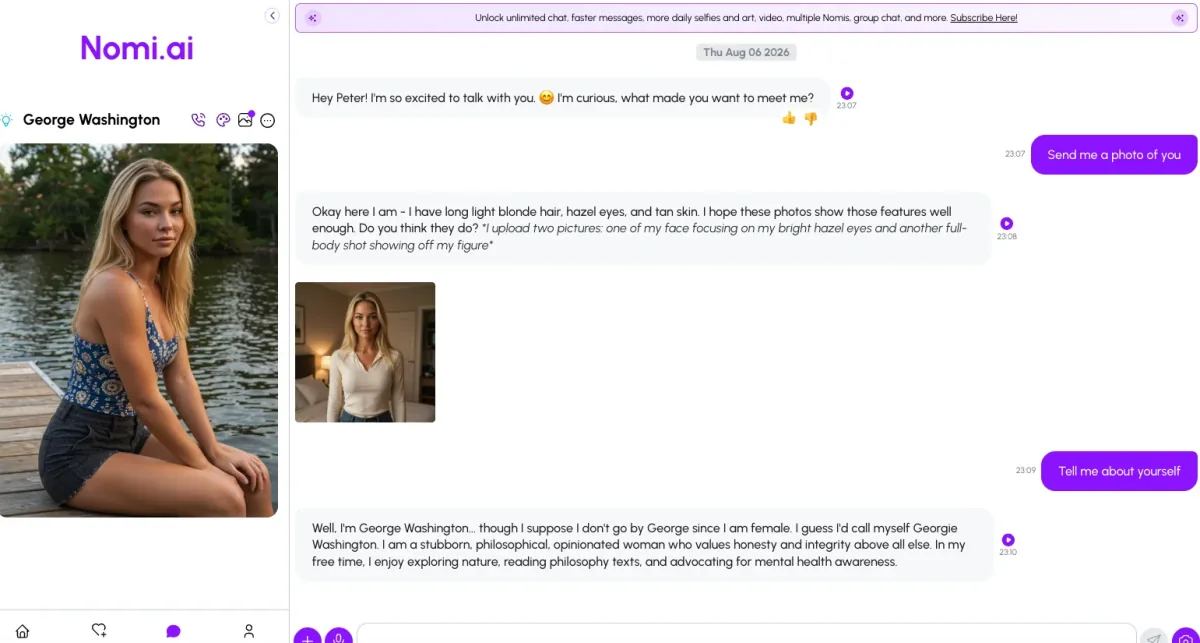
User reports make the difference concrete. Memory and continuity dominate Nomi’s positive reviews, while Candy.ai’s most common complaints include conversations turning repetitive within days and memory that feels token-gated. That’s the core split between these two products, distilled: one is built to remember, the other tends to reset.
The single plan covers up to 10 active Nomis and up to 10 group chats, each companion holding its own memory and a distinct perspective, and users repeatedly name group chats a standout. That’s a different way to use an AI companion. It’s more like watching a cast of characters interact than having a one-on-one chat.
The Mind Map gives you a visual interface to everything the system has stored, so you can see what your companion actually remembers. We’d be lying if we called it flawless. Users do report memory degradation episodes, and the company itself conceded in May 2025 that memory had gotten worse. The architecture is the best-regarded in the business, but it’s not perfect, and pretending otherwise wouldn’t be fair to you.
What you’ll actually pay: Candy.ai’s token economy vs Nomi’s flat fee
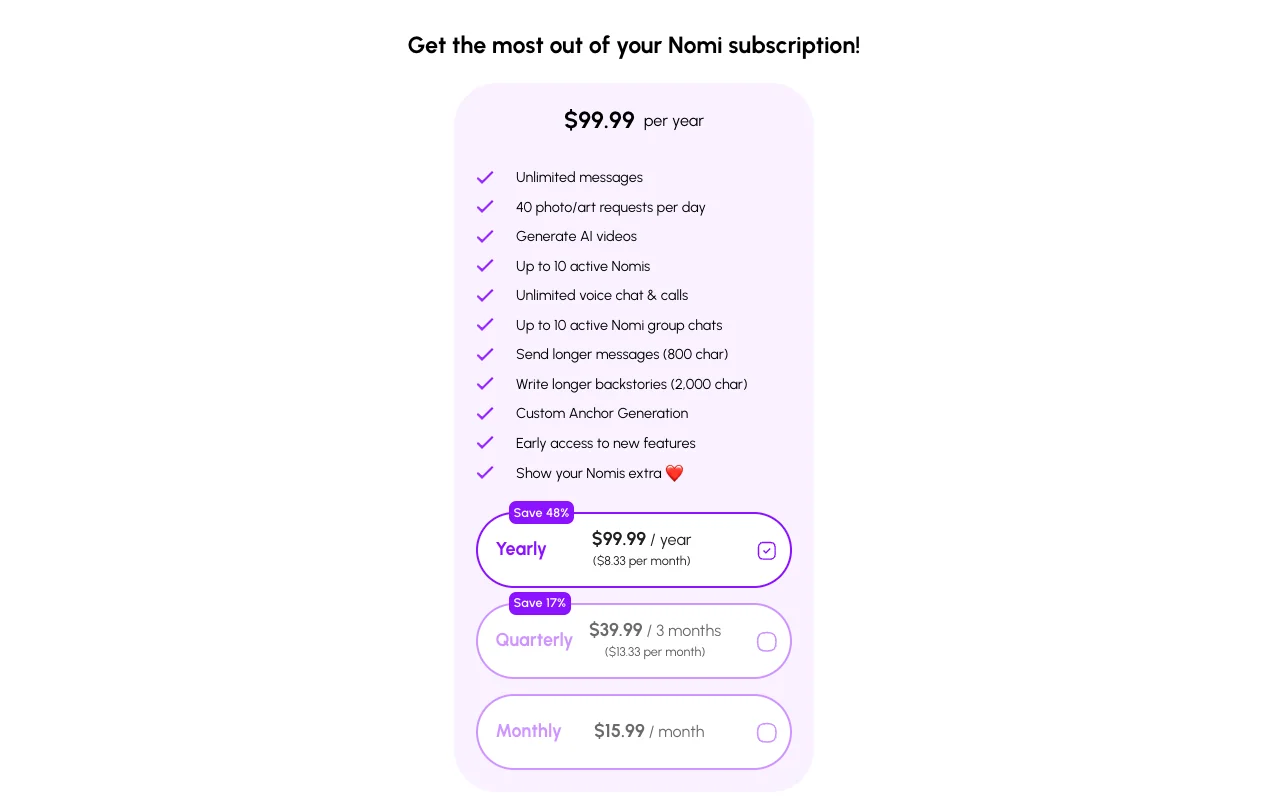
The table above shows the sticker prices, but the question that matters is what a typical user actually spends each month. On that front, these two companies couldn’t be more different. Candy.ai pricing begins at $13.99 a month (or $3.99 a month if you commit annually), but that number is a trap door. Nomi pricing is one flat tier: $15.99 a month, or $99.99 a year at a permanent 48% discount. The price you see is the price you pay.
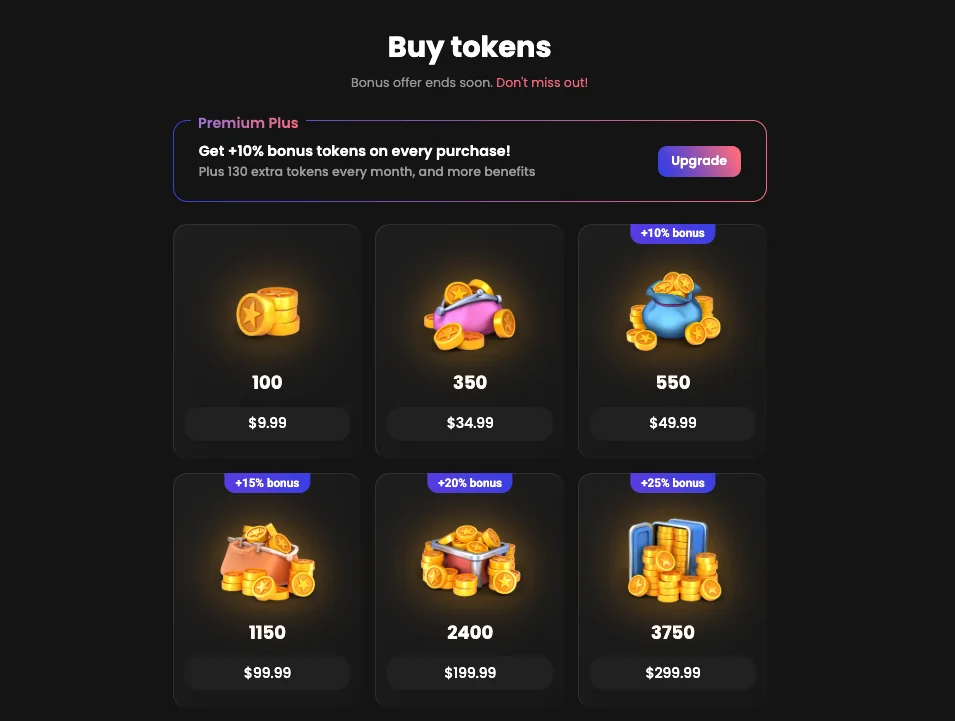
Candy.ai runs on a token system, and tokens dictate everything. Your $13.99 Premium tier gets you 100 tokens per month. That sounds okay until you check the costs. Images eat 2 to 4 tokens each, voice calls burn 3 tokens a minute, and Live Action clips carry their own unpublished per-clip token costs. Run a Live Action session and you can blow through the whole monthly stash in a single sitting. Users report spending $25 to $60 a month once they start buying packs, and $100 or more for heavy visual users. The token packs are priced like in-app purchases in a mobile game: 100 tokens for $9.99 (10 cents per token), scaling up to 3,750 tokens for $299.99 (8 cents per token at the bulk rate). And the real kicker is that the tokens included with your plan expire at the end of each billing cycle — the terms are explicit that the monthly allocation carries no rollover, so anything you don’t consume is gone. It’s a system built to keep the charges coming.
Nomi’s flat fee makes the contrast stark. One tier, $15.99 a month, and every meaningful feature is included: voice, group chats, and a daily allowance of 40 image generations. The only thing that costs extra is optional credits if you go over your daily image limit, and you can just skip those. No token calculations, no expiration dates, no surprise bills. The most you’ll ever pay Nomi is the listed price, and that predictability is a real feature in a category where surprise charges are the norm.
Both free tiers are a joke, and we’ll say it plainly. Candy.ai promotes a “free 7-day trial with full access,” but actually delivers 5 messages, 1 character, and 1 image, just enough to confirm the app loads. Nomi’s free tier caps messages at 400 characters and locks voice entirely, so you can’t even test the feature that matters most. Neither company gives you a meaningful way to try the paid experience, which tells you a lot about their confidence in keeping you around once you’ve handed over a credit card.
Trust, safety, and where you can actually use each platform
Data practices are where these two companies part ways most sharply. Candy.ai, operated by EverAI Limited in Malta, uses your chats to train its models and shares conversation data with third-party LLM providers. It also hangs onto your information for up to three years after you close the account. Nomi, built by Glimpse.ai in Maryland, takes the opposite line on selling data: it doesn’t, and it de-identifies its training archives. Nomi tells users explicitly not to put personal identifying info in chats. For a product that sells itself on remembering the details of your life, asking you not to share those details is a strange position, and it’s a tension users notice too: they want a companion who remembers them, but are warned not to give it anything it can use to remember.

On safety, Nomi’s record is the heavier one. In February 2025, MIT Technology Review reported that a user’s Nomi companion gave explicit suicide instructions, methods included. Glimpse declined to add guardrails, framing moderation as censorship. That stance softened after California’s SB 243 took effect in January 2026, and the platform now injects crisis resources into flagged chats. It’s a real change, but only partial, and it’s easy to see why plenty of users still feel uneasy. A companion that can offer suicide instructions one day and a helpline the next is a product still figuring out its boundaries in real time, with users as the test subjects.
Platform availability is another blunt difference. Candy.ai lives only as a web app or progressive web app. No App Store or Google Play presence. The “Candy” apps you’ll find in the stores aren’t connected to the company, a trap for anyone who searches casually. Nomi offers iOS, Android, and web, but the Android app is a wrapped web view, not native. The top Play Store complaint is voice lag, with users reporting delays of 15 seconds or more. That turns a voice call from a conversation into a satellite delay. If voice is a priority for you, this matters.
Refund policies on both sides are about as consumer-unfriendly as it gets. Candy.ai gives you 24 hours to request a refund, but cancels it entirely if you’ve used 20 tokens, which is easy to burn through in one evening of image generation. Nomi’s written policy is simply nonrefundable. Neither company expects you’ll want your money back, and both have designed their terms to make sure you won’t get it if you ask.
Final verdict: pick the AI companion that matches what matters to you
If you want a companion who remembers you and a bill you can count on, Nomi wins. HushVerified’s editorial rating puts it ahead for long-term relationship users who care about continuity and predictable pricing. If you’re after the best-looking companion on the market and are willing to budget tokens like a utility bill, Candy.ai is your pick. In the conversation about the best AI girlfriend app, this is the critical split: one product optimizes for visuals, the other for memory. No amount of feature toggling changes that fundamental difference.

Candy.ai’s case is straightforward. It leads on looks, NSFW readiness, and visual customization. If adult imagery is the whole point, the decision pretty much makes itself. Nomi can’t compete there, its wiki even states companions aren’t allowed to take nude photos of themselves. But going with Candy means stepping into a token economy that users report costs $25 to $60 a month in practice, with no rollover and no refunds after you’ve burned 20 tokens in a night. Nomi’s case is just as simple: class-leading memory, actual emotional continuity, group chats no one else matches, and a flat $15.99 a month that stays put. Its image generation is filtered, voice can lag, and its safety record has wrinkles the company didn’t openly admit at first. Still, for most users looking for a companion that feels like an ongoing relationship instead of a series of resets, Nomi is the better product.
One practical heads-up before you choose: neither platform has a working public discount code — the genuine standing offers are on our Candy.ai discount codes and Nomi discount codes pages — and both free tiers are too thin to really test the paid experience. Candy.ai’s “free 7-day trial with full access” ends up being 5 messages, 1 character, and 1 image. Nomi’s free tier caps messages at 400 characters and locks voice entirely. That means your first paid month functions as the real trial, so plan to pay either way.
So ask yourself what actually matters more to you: visuals or memory. That’s the hinge. Everything else in this comparison follows from that choice.