

The Kindroid vs DreamGF matchup is one of the clearest in the AI companion category because the two platforms are not competing on the same axis. Kindroid is built to remember and talk. Its five-layer memory system is the deepest documented in the category, and it ships real native iOS and Android apps. DreamGF is built to look exactly how the user wants. Its visual customization is the deepest in its class, but its most-cited complaint is weak conversation memory, the same thing Kindroid treats as its core feature.
| Kindroid | DreamGF | |
|---|---|---|
| Entry price | $13.99/mo | $25.99/mo |
| Billing terms | monthly, 3-month, annual | monthly, 3-month, annual |
| Free tier | 2 Kindroids, Lite model, 5,000 lifetime audio characters | Not published |
The price stories are just as opposite. Kindroid’s base price is $13.99/month on web ($15.99 via app stores), flat and predictable. DreamGF advertises $12.99/month but renews at $25.99. Every plan resets to that same monthly figure. The gap matters because neither platform offers refunds.
Kindroid’s Stable Pricing: $13.99 Base, Optional Add-Ons, and What You Get
There’s no introductory rate waiting to reset. Kindroid does sell one-time consumables, voice credits, selfie credits and extra slots, and it meters the included monthly audio allowance, which live video calls burn through fast. The subscription covers the core product, and everything extra is an optional add-on stacked by choice.
- On the web, Kindroid costs $13.99/month, while buying through an app store raises the monthly price to $15.99.
- The annual plan costs $139.99/year, working out to $11.66/month effective.
- Optional cumulative add-ons run Ultra at $24.99/month and MAX at $59.99/month. Stacking both on the base takes the full ladder to $98.97/month on web.
Pay the base rate, get the full platform, and only reach for Ultra or MAX if the extra memory tiers and expanded capabilities are actually wanted.
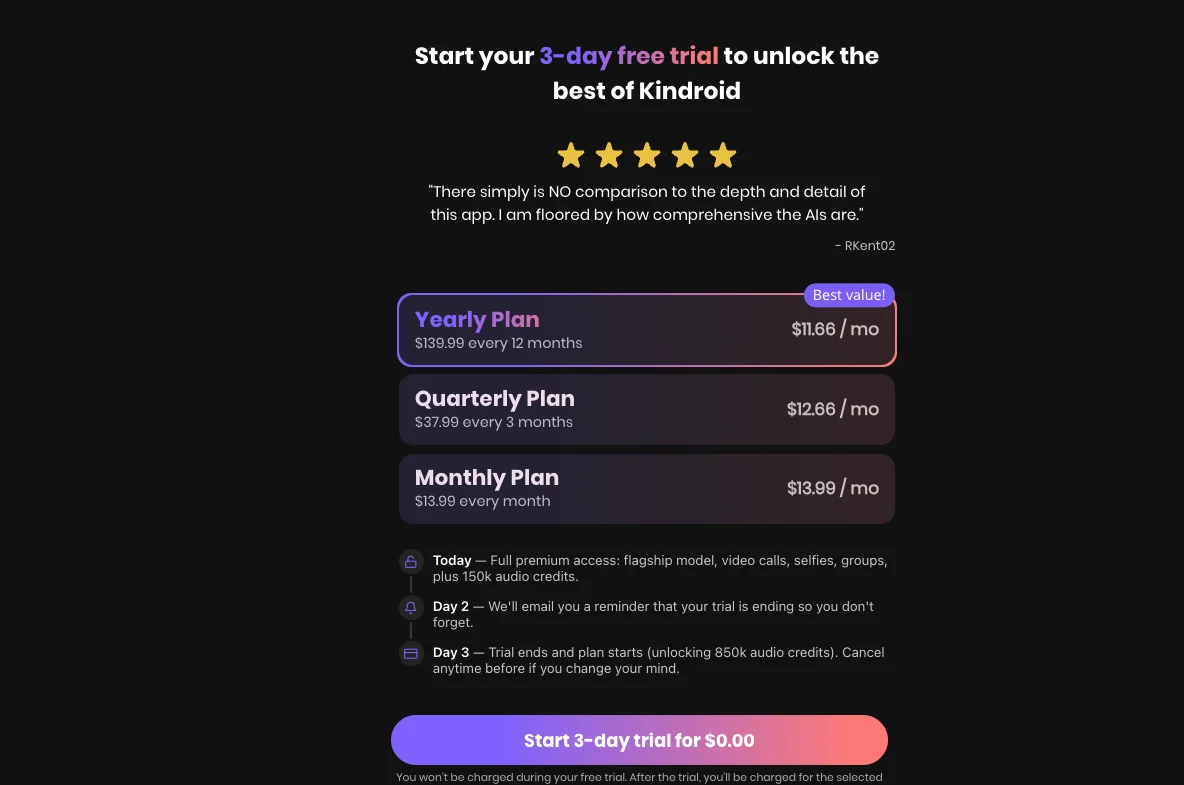
V3 voice calls ship with voice cloning, live video calls have been available since March 2026, group chats are included, and the native iOS and Android apps are genuinely Kindroid’s own. The one caveat is that live video calls run 2,000 to 4,000 voice credits per minute, which makes them expensive to use on a regular basis. But the core conversation experience, the memory system, and the voice layer are all part of the flat fee.
DreamGF’s Introductory Discounts That Jump on Renewal
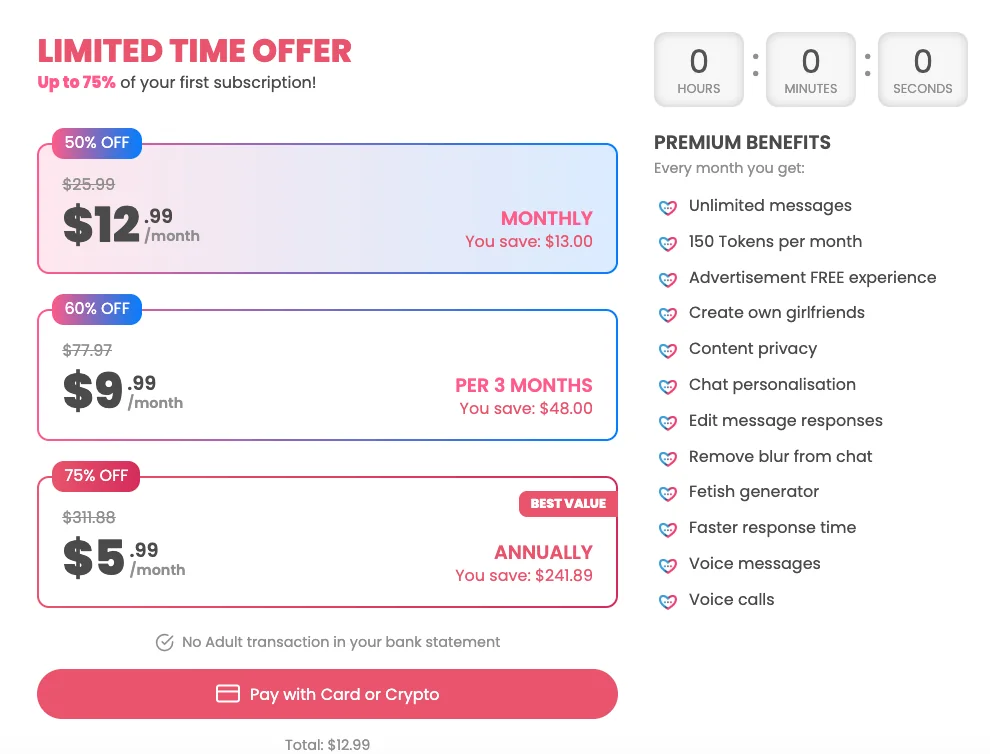
Every advertised rate on DreamGF’s site is an introductory hook. The renewal price is a different, higher number that applies from the second billing cycle onward. All three plans follow the same shape: a discounted entry, then a reset to $25.99/month equivalent.
- The monthly plan starts at $12.99 for the first payment and renews at $25.99/month.
- The 3-month plan starts at $29.97 total and renews at $77.97 per quarter. That works out to exactly $25.99/month.
- The annual plan starts at $69.99 for year one and renews at $311.88/year. A year-one annual buyer pays 4.5 times more in year two.
The annual plan is the sharpest version of the trap. A $69.99 first year sounds like a bargain next to the $12.99 monthly intro, but the second year hits at $311.88. Nothing about the product changes between year one and year two. The renewal price is the same $25.99/month no matter which plan was chosen. The only difference is how long the intro rate holds.
The site also runs a “LIMITED TIME OFFER” countdown timer that was observed frozen at 0:00:00 with the offer still live. That’s a fake-urgency pattern, not a real deadline, and it should not rush a decision. The introductory rate is a standing fixture of the pricing model, not a fleeting sale. All prices were verified in August 2026.
DreamGF’s Token Meter and True Monthly Cost
Each DreamGF membership comes with 150 tokens per month. The token meter is how the platform charges for what it does best.
- Images cost 10 tokens each.
- Voice messages cost 3 tokens.
- Voice calls run 7 tokens per minute.
Fifteen images exhaust the entire monthly allowance. A 20-minute voice call burns 140 of the 150 tokens on its own. Top-ups are available on top of the $25.99 renewal, so the true monthly cost can climb well past the advertised rate depending on how much the visual and voice features get used.
Tokens cannot buy video. DreamGF has no video generation at all, so there is nothing to spend tokens on there. On the free tier, images are paywalled entirely, which makes the token system inaccessible without a paid membership.
Kindroid’s Five-Layer Memory vs DreamGF’s Weak Recall
Memory is the axis Kindroid is built on and the exact place DreamGF comes up shortest. The Kindroid five-layer memory system is the deepest documented in the category, while DreamGF’s long-term conversation retention is its most-cited structural weakness.
Kindroid’s memory is organized into five distinct layers that work together.
- Pinned key memories are user-pinned facts that the AI treats as permanent anchor points.
- The short-term context window holds about 18,000 characters on Standard, 50,000 on Ultra and 125,000 on MAX.
- Long-term auto-generated summaries condense older conversation into evolving summaries the AI keeps pulling forward.
- Journal entries are triggered by keyphrases rather than fixed prompts, up to eight keyphrases each, with at most three recalled per message. They cap at 500 entries. It caps at 500 entries.
- Cascaded memory is the deepest tier, available to all subscribers at roughly 480,000 characters on Standard, 1.2 million on Ultra and 2.7 million on MAX.
Users consistently report companions recalling technical projects and personal details weeks later, which is the single most-cited strength in third-party reports. Those reports are second-hand rather than our own testing. Reviewers have called that persistence the strongest single argument for Kindroid in the category.
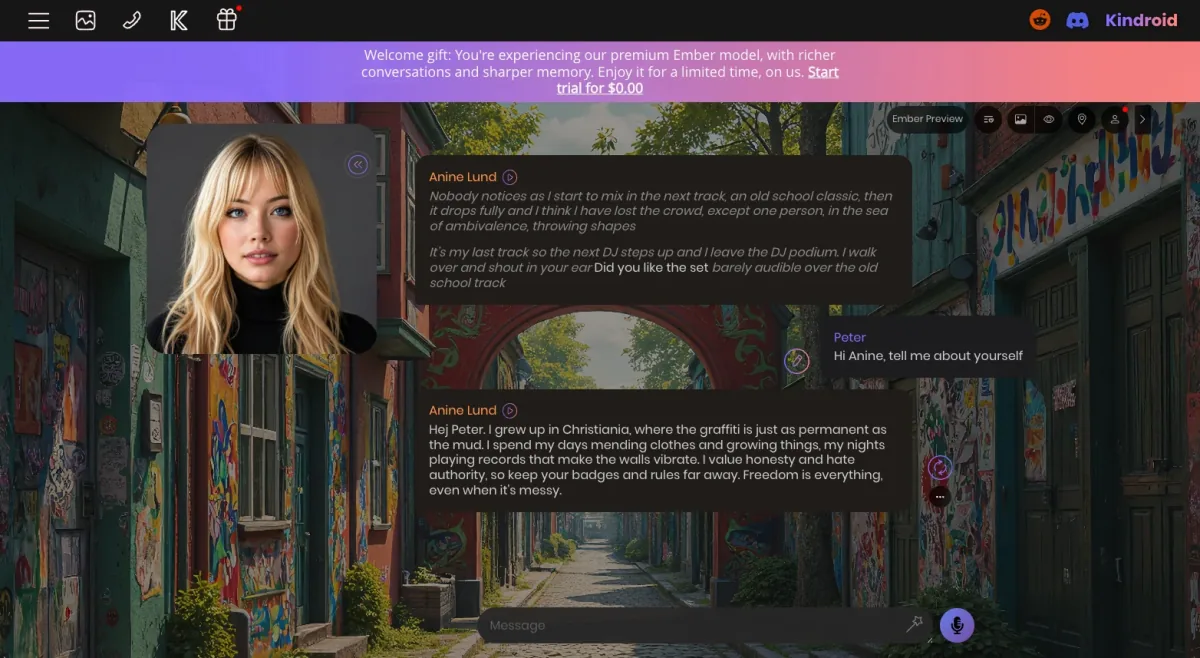
DreamGF sits at the opposite end. It references past topics adequately but does not match the best in category, and its long-term conversational recall is the platform’s most common criticism.
Kindroid’s one real complaint runs the other direction. Model updates have been known to change established companions’ personalities, and that issue was loudest after the March 2026 Ember rollout. Users who had spent months shaping a character suddenly found it responding differently after an update. It’s a genuine trade-off against the memory depth. Users migrated to Ember reported both personality flattening and memory loss, and we found no public Kindroid response or rollback.
DreamGF’s Visual Builder, Payment Options, and EU Registration
Reviewers are consistent about the DreamGF character builder. It has the deepest visual customization in its class. Face, body, clothing, ethnicity and age can all be dialed in, and reviewers who have compared the field repeatedly call it the deepest customization in its class. Most platforms give the user a handful of presets and a few sliders. DreamGF treats the character sheet like a design tool.
That depth comes with a trade-off in consistency. DreamGF image quality at its best is excellent, but the same character can look noticeably different across separate images. That is the platform’s most common visual criticism. The face the user carefully built in the character sheet may shift slightly from one generation to the next, and that instability undercuts some of the precision the builder offers. It is a known weakness, not a hidden one, and it matters most to anyone who wants a character that stays visually locked-in over many images.
On the corporate side, DreamGF is more transparent than most of the category. It is operated by a named, registered EU company, DreamAI SRL in Romania, and it documents GDPR rights and runs a complaints portal. That is stronger corporate paperwork than most AI companion platforms can show, including Kindroid, which operates as Beautifully Incorporated under US/Delaware law. DreamGF also accepts mainstream payment methods including PayPal, which removes a common friction point for users who do not want to hand a card to a niche subscription service.
The DreamGF vs Kindroid choice, then, comes down to what the user actually cares about building. If designing how she looks is the whole point, DreamGF is the clear answer. It has a visual builder and image quality that Kindroid does not match. If who she is matters more, Kindroid wins on personality depth, memory, and conversation.
Web-Only vs Native Apps and NSFW Rules
Where each platform lives is a bigger part of the decision than most buyers expect. The two services take opposite approaches to distribution, and that shapes everything from how the product feels on a phone to what content rules apply.
- DreamGF is web-only, and every app-store listing under its name is an unaffiliated lookalike, with one selling a $129.99 lifetime tier that has nothing to do with the real service.
- Kindroid’s iOS and Android apps are genuinely its own, native apps that sync with the web version.
- NSFW media is filtered in Kindroid’s mobile apps per app store rules, with the NSFW toggle available only on the web version.
- DreamGF on a phone requires the mobile browser. Log in to the official web app, not a store listing.
The app-store warning matters because DreamGF’s name surfaces a cluster of listings that are not the product. The $129.99 lifetime tier sold under its name is the clearest red flag, but any store listing claiming to be DreamGF is a third-party imitation. Kindroid’s situation is the opposite. Its apps are legitimate, but the store versions carry content restrictions that the web version does not.
Refund Policies and Free Tiers: Money Is Spent Before You Commit
DreamGF’s refund policy is literally titled “Non-Refundable Policy.” The company positions the free trial as the evaluation window. Anything paid after that is treated as final. Kindroid’s policy is a flat written no-refunds as well, and it goes a step further by reserving the right to ban accounts that dispute charges. There is no refund, no partial credit, and no grace period after the first payment clears.

Kindroid’s free tier is thin. It offers 2 companions and limited audio, with two ways to try the paid product. A 3-day trial requires a card up front, or an existing subscriber can hand over a card-free 14-day gift code. DreamGF’s homepage advertises a free trial with up to 50 bonus messages a day, while third-party testers report getting only six or seven messages, SFW, with images paywalled. That means neither free tier gives anything close to a full test of what the paid product feels like. The decision has to happen before renewal, not after discovering the product was not what the trial suggested.
How to Actually Save: Web vs App, Annual Terms, and No Discount Codes
- There is no working public discount code for either platform. Any code circulating online is either expired or never worked in the first place.
- Kindroid’s genuine savings come from buying on the web instead of in-app. That saves $2/month off the base subscription and 15-20% on packs, plus the annual term drops the effective monthly cost to $11.66.
- Kindroid must be cancelled through the same channel it was bought on, because cancelling in-app does not stop app-store charges. Buying on the web also makes cancellation simpler.
- DreamGF’s only real discount is its standing introductory pricing, which is the renewal trap restated rather than a genuine saving.

Neither platform offers a working promo code, so a shopping strategy should be built around the web purchase, the annual term, and a realistic view of DreamGF’s intro rate as a first-month number that resets, not a discount that lasts.
Kindroid or DreamGF? One Clear Choice for an Ongoing Companion
The Kindroid or DreamGF question has a clear answer for most buyers, and it comes down to what the word “companion” means. If the goal is an ongoing relationship with someone who remembers, responds in a consistent voice, and stays reachable across devices, Kindroid is the stronger product. Its five-layer memory system, native apps, voice cloning, and clearly written content policy add up to a platform built for continuity rather than novelty. That case holds as long as the purchase happens on the web version and the no-refund policy is accepted going in.
DreamGF is a different product serving a different purpose. It is the right choice only when visual character building is the whole point, and even then only with a realistic view of the renewal math. The $12.99 intro rate becomes $25.99/month from the second billing cycle, so the decision to stay has to be made before the first month ends, not after the renewal hits. For someone who primarily wants to design a character and generate images, DreamGF’s builder is unmatched. For someone who wants a conversation that feels continuous, its weak memory makes it the wrong tool.
Conversation depth and a stable monthly cost point squarely at Kindroid. The $13.99 web price is flat, predictable, and easier to plan around than DreamGF’s $12.99 entry that quietly becomes $25.99. The annual term drops Kindroid to $11.66/month effective, and nothing about that structure changes on renewal. DreamGF’s only “discount” is the intro rate itself, which is the trap restated rather than a genuine saving.
Before paying anything, check the table above for a side-by-side of every price and feature, and read the full reviews on both platforms. Neither company offers refunds, so the choice has to be made before checkout, not discovered after the first billing cycle. Decide what the companion is for, pick the platform that serves that purpose, and budget for the real recurring cost from day one.