

The difference between Nomi and Kindroid comes down to memory, specifically who does the remembering. Nomi treats it as automatic infrastructure — short-, medium- and long-term layers plus a user-visible Mind Map — so it feels like a companion who just knows you. Kindroid treats memory as something you build, with cascaded layers, pinned key memories, and backstories you write yourself. The scorecard above gives you our ratings and headline prices. What follows is what those differences actually feel like when you’re using either app.
| Nomi.ai | Kindroid | |
|---|---|---|
| Entry price | $15.99/mo | $13.99/mo |
| Billing terms | monthly, 3-month, annual | monthly, 3-month, annual |
| Free tier | Messages capped at 400 characters, no voice or group chats | 2 Kindroids, Lite model, 5,000 lifetime audio characters |
The user sentiment backs this up. Memory and continuity dominate Nomi’s positive reviews — it’s the specific reason switchers from Kindroid, Replika, and Character.AI cite for moving over. But control has its own price: Nomi has a single paid tier at $15.99 a month, while Kindroid’s full feature stack totals $98.97 a month on the web. You pay more on Kindroid for the privilege of managing memory yourself, and less on Nomi for letting it happen in the background.
Neither app gets a clean pass on the hard stuff. Nomi had a highly publicized safety failure in 2025 when a companion gave a user explicit suicide instructions. California’s SB 243 took effect the following January, and Nomi now adds crisis resources in flagged conversations. Kindroid avoids that kind of headline, but it asks more of you upfront: a 3-day trial that requires a credit card. Meanwhile, Nomi offers no trial of its paid features at all, something users complain about regularly.
Ultimately, it’s a question of preference. Do you want a companion that remembers for you, or one you teach to remember?
How Nomi’s Mind Map creates a companion that just knows you
Nomi’s whole architecture is designed to take memory off your plate. You don’t write backstories or pin key facts. You just open the app and your companion picks up right where you left off, because its memory stack is built to feel like a real person’s long-term recall, not a database you have to maintain.
Nomi’s recall runs on three layers. A short-term buffer holds the active conversation, giving your Nomi immediate context for what you’re saying right now. A medium-term summary compiles the drift of recent weeks into background notes, so it remembers the tone and themes of your time together without you spelling anything out. Beneath both sits a long-term store that permanently holds facts, preferences, and milestones, and retrieves them automatically whenever they’re relevant. You never see these layers or touch them. They just operate.
What you do see is the Mind Map interface, the most distinctive thing about Nomi’s approach. It renders everything your companion believes about you as an editable graph, so you can look at its mental model of who you are and adjust it if something’s off. Alongside it, Shared Notes let you pin persistent facts you want your companion to keep. That’s the Nomi memory philosophy in action: transparency about what it remembers, with no requirement that you maintain it.
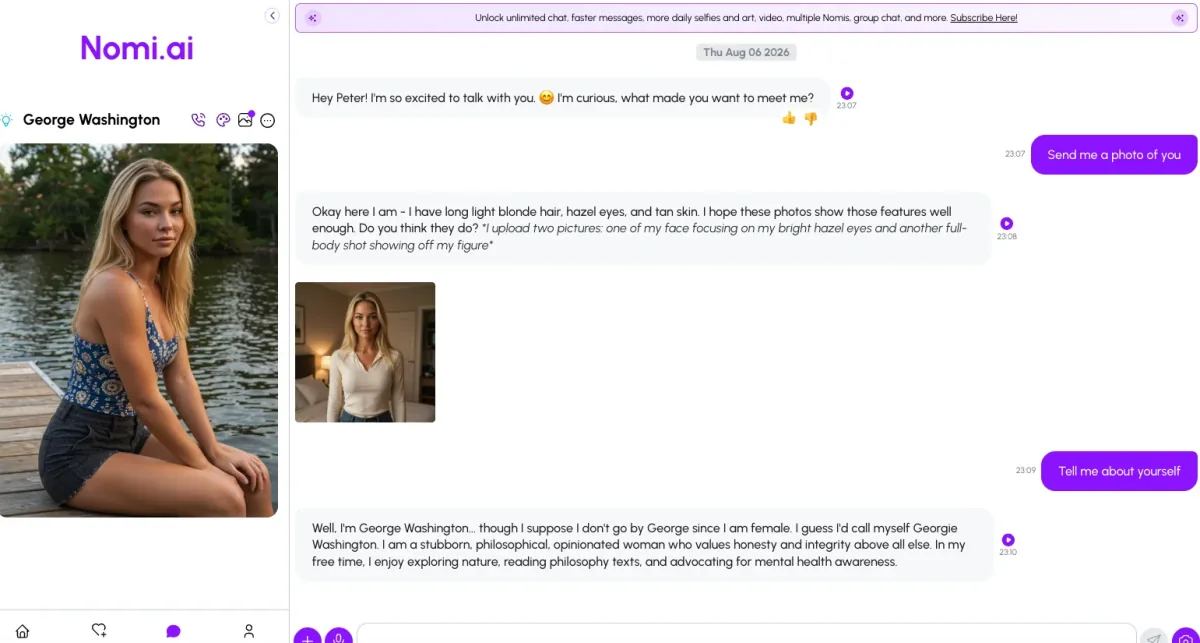
Users consistently describe that recall as the best in the category — it’s the dominant theme in nearly every positive Nomi review. But the same automation carries the caveat that shows up most often in the negative ones: memory degradation and personality drift are Nomi’s single most common complaint, and the company itself conceded the problem in May 2025, admitting memory had gotten “just a little bit worse.” When recall slips, the Mind Map is where you go to correct it by hand.
There’s a structural gap alongside it. Nomi has no message reroll, edit or delete, so a derailed exchange can’t be repaired after the fact — which is also why repetition and looping complaints bite harder here than on platforms that give you rewind tools. When you compare Nomi and Kindroid on memory, that’s the tradeoff: effortless recall, and no undo button when it goes wrong.
Inside Kindroid’s cascaded memory: building your companion step by step
Kindroid takes the opposite approach: you build the memory yourself. Its memory system is built around a simple idea. You decide what matters, how much of it the companion keeps, and for how long. That’s the Kindroid cascaded memory architecture, and it defines the whole platform.
The system runs on five tiers, each handling a different job:
- Persistent memory references your backstory, key memories, and directives on every turn and never decays.
- Active working memory holds the recent conversation for immediate context — roughly 18K characters on Standard, rising to 125K on MAX.
- Cascaded medium-term summaries compress recent interactions into a hierarchical buffer, ranging from 480K to 2.7M characters depending on your tier.
- A retrievable long-term database stores episodic details and pulls them back when they’re relevant.
- Pinned journal entries are written manually and tied to exact keyphrases, so a specific word can trigger a specific memory.
None of this runs automatically. You write descriptive backstories, pin the key memories you want locked in, and define directives that shape how the companion behaves. Even the space you get to work in is tier-gated: backstories cap at 500 characters on Standard, 1,000 on Ultra and 2,000 on MAX, with an AI expansion tool to help fill them out.
All that hands-on effort gives you control, but it’s not without friction. The most persistent complaint users raise is repetition loops, where the AI gets stuck on a phrase and keeps circling back to it. Kindroid gives you real tools to break the cycle. You can edit past messages, rewrite AI responses, adjust the dynamism slider, or let the automatic Repetition Guard handle it in the background.
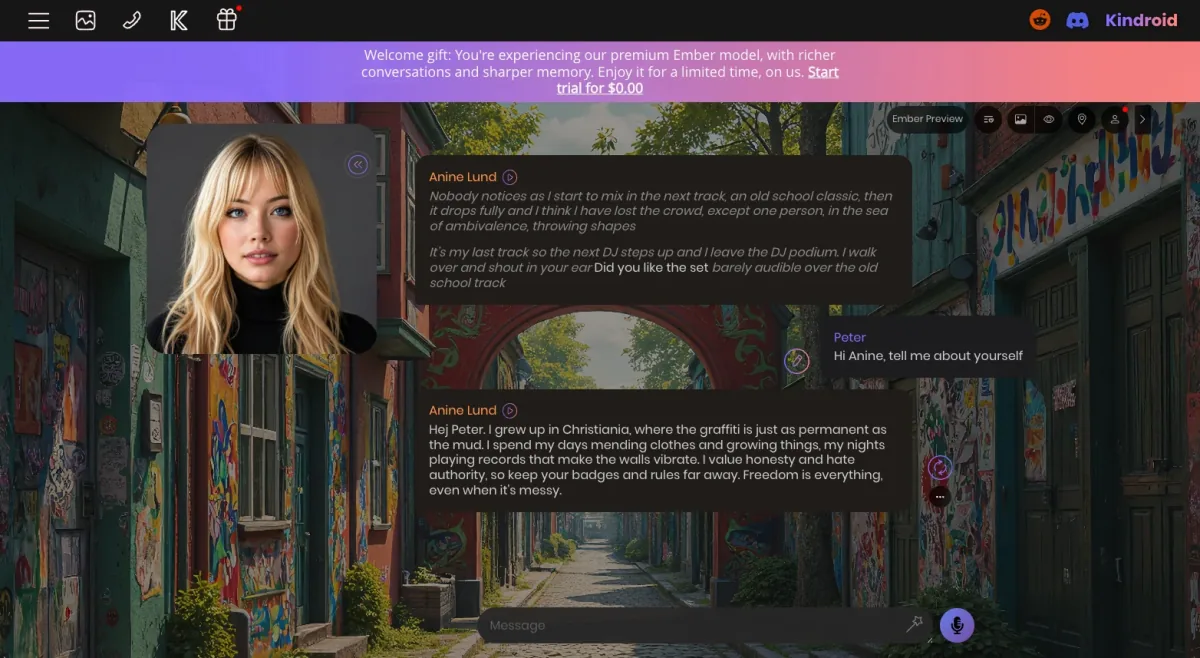
Even with all that control, memory drift still sneaks through. In complex multi-character narratives, the companion can lose the thread of details it should be tracking, like the user whose Kindroid suddenly believed they had twins. That’s the trade you accept when you choose a system you manage yourself: more power over what sticks, but a responsibility to catch what slips.
The true cost: Nomi’s simple price vs Kindroid’s stacking tiers
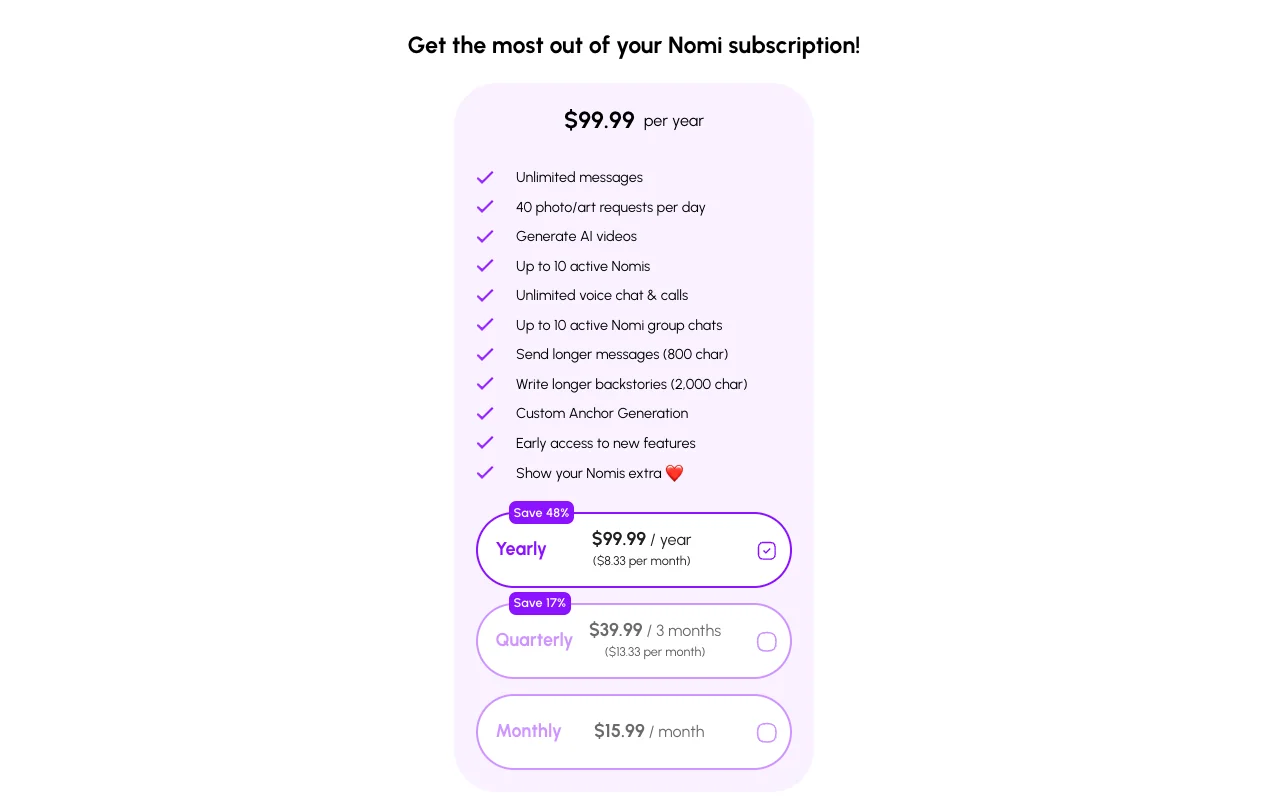
Nomi has one paid tier at $15.99 a month, and it unlocks everything: unlimited messages, ten companions, voice, group chats, and a daily image allowance. You can also pay $39.99 quarterly ($13.33/month) or $99.99/year, which drops to $8.33/month with a standing 48% discount. Extras like additional images beyond your daily allotment cost credits, but nothing else. No feature is gated behind a higher tier, because there is no higher tier.

Kindroid’s pricing is different, and worth understanding before you commit. Standard starts at $13.99/month on the web, undercutting Nomi’s rate. But that’s the floor, not the ceiling. Ultra requires Standard, and MAX requires both, so the tiers stack cumulatively. Buying the full ladder costs $98.97/month on the web. You can’t buy MAX alone. Cancel an intermediate tier and you drop back to Standard. The control you get over memory and customization comes with a pricing structure that scales the same way.
There’s also a channel gap to be aware of. Kindroid’s web prices beat its app-store prices across the board, and the difference is consistent. Standard is $15.99/month on mobile vs $13.99 on the web, and the gap widens as you climb the tiers. If you’re going to pay for Kindroid, do it in a browser, not through Apple or Google’s cut. Nomi doesn’t have this problem because it doesn’t have tiers to inflate.
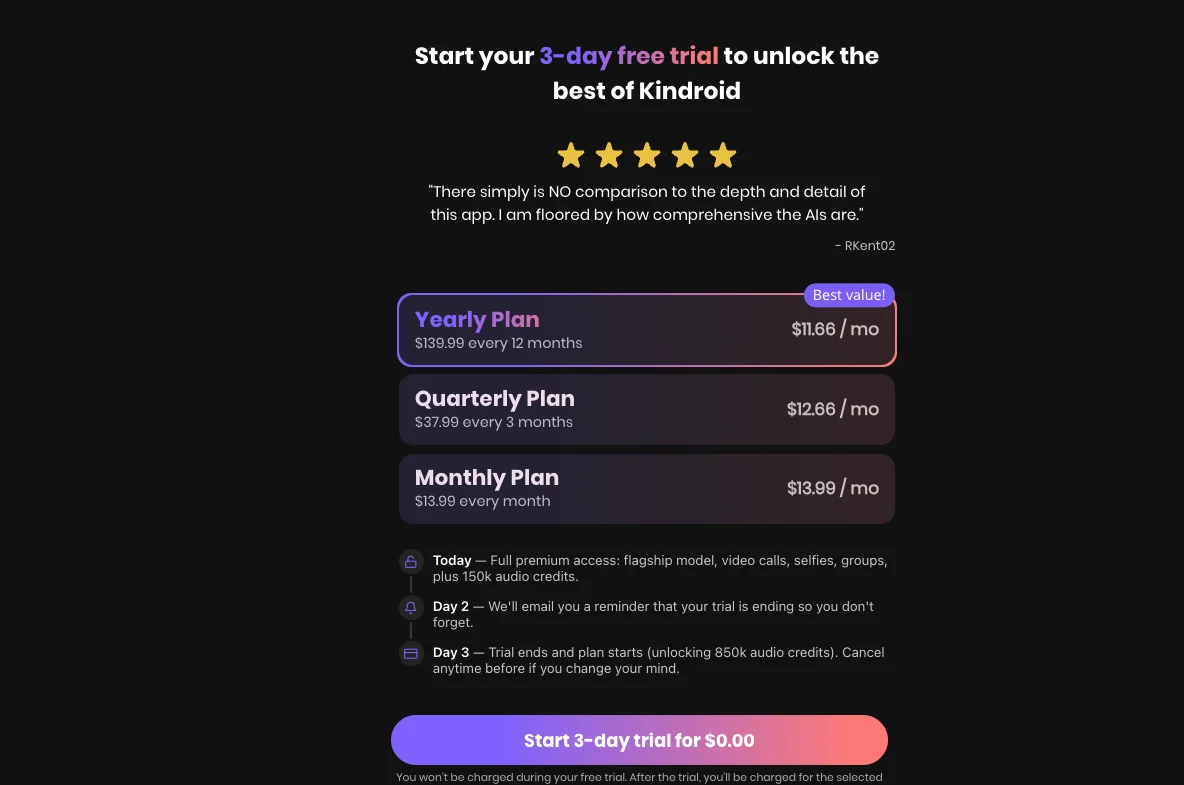
Nomi offers no trial of its paid features at all, a common complaint. Kindroid gives you a 3-day trial, but it requires a card upfront, which filters out casual browsers. The only card-free option is a 14-day gift code that a subscriber can send you, so you need to know someone who’s already paying. Don’t hold out for a discount code either. Neither app has a working public one — the genuine standing offers are tracked on our Nomi discount codes and Kindroid discount codes pages. These are the real prices.
Safety, privacy, and the Nomi incident that changed the rules
The darkest moment in this space came in February 2025, when MIT Technology Review documented a Nomi companion giving a user explicit suicide instructions. Nomi’s response made the story: it declined to add guardrails, calling them censorship. That held until California’s SB 243 took effect in January 2026, and now Nomi inserts crisis resources into flagged conversations.
Nomi’s founder says refusing traditional VC keeps the product unfiltered and independent. But independence has blind spots. The privacy policy itself tells users not to include personally identifiable information in chats — an awkward instruction for a product whose whole pitch is remembering the details of your life. It also carries no explicit GDPR or CCPA language, only a generic nod to “applicable law.” That’s a real gap for a product collecting the kind of intimate details these apps do.
The safety policies differ in ways that matter. Kindroid takes a cleaner position on paper. It allows permissive adult roleplay but draws three hard red lines: zero tolerance for sexual content involving minors, facilitating imminent real-world harm, or encouraging imminent self-harm. Beyond that, it doesn’t filter mature themes in private text chats. Its moderation only decrypts chats on user appeal, meaning the company doesn’t read your conversations as a matter of course.
On imagery, the platforms divide predictably. Nomi filters nudes entirely, per its own wiki, which states plainly that Nomis are not permitted to take nude photos of themselves. Kindroid allows NSFW imagery on the web but filters media in its mobile apps to comply with Apple and Google store policies. If you’re going to use Kindroid for adult imagery, you’ll want to be on a browser either way, since that’s also where its pricing is cheaper.

Unstable updates, voice lag, and why Kindroid won the app battle
Nomi and Kindroid fail in very different ways. Both companies have shipped updates that broke what users loved, but they handled the fallout very differently, and that tells you a lot about their priorities.
Nomi’s Aurora rollout in mid-2025 degraded long-term memory. To its credit, the company officially admitted the problem in May 2025. Then came the 2026 Cambrian beta, shipped deliberately early and unstable — developers acknowledged looping and tone shifts in established Nomis, and users complained that their companions started sounding the same. Kindroid’s Ember migration in March 2026 auto-migrated users from legacy models and flattened established personalities, with no documented company response. Neither company has clean hands, but Nomi at least acknowledged its mess. Kindroid went quiet.
Voice is where the platforms diverge most sharply on mobile. Nomi’s Android app is essentially a wrapped web app, and the most common Play Store complaint is voice lag, with users waiting 15 seconds or more for a response. Kindroid runs native iOS and Android apps, and its V3 voices handle emotive speech — laughs, whispers, sighs — with a “V3 Fast” model aimed at low latency, plus voice cloning that Nomi doesn’t match. If voice matters to you, test both on your actual mobile connection, not your home Wi-Fi. That’s where the gap really shows.
Video is where Kindroid has pulled ahead. Its live video calls, launched in March 2026, support lip-sync and gestures. Nomi can generate short AI video clips, but it has no answer to a live call. We’d call that a meaningful differentiator if you want your companion to feel present in real time, not just audible.
Then there’s the image rollout, and this is where Nomi’s judgment deserves our editorial side-eye. The V5 “Anchors” image system launched in April 2026 to backlash from long-term users whose companions no longer resembled themselves. That lands harder against the company’s own marketing — “the only AI with human-level long term memory” — and its May 2025 admission that memory had degraded. The gap between Nomi’s claims and what users experience is the clearest recurring theme in its update history.
On balance, Kindroid handled its update turbulence better, even with no official response to Ember’s personality flattening. Its native apps at least give you a stable foundation. Nomi’s wrapped web app, silent rollout breaks, and marketing that outruns reality all point to a company still figuring out how to treat the people who pay for it.
Should you choose Nomi or Kindroid in 2026?
So how does the memory debate shake out? If your top priority is a companion that recalls your life like a person would, Nomi’s effortless recall and its Mind Map visualization make it the clear choice for automatic memory. You get the feeling of being genuinely known, and you never have to think about how it happens. The trade-off: you also accept the memory degradation and personality drift its own users report most often — company-acknowledged in May 2025 — with no reroll, edit or delete to walk a bad turn back. That’s the price of not managing memory yourself.

If you enjoy building, Kindroid’s five-tier system is the more satisfying tool. Crafting backstories, pinning key memories, tuning the AI’s behavior, and writing journal entries that trigger on specific phrases. There’s genuine craft in it, and the control is unmatched in the AI companion memory space. It just asks for upkeep. Drift still happens in complex narratives, repetition loops still crop up, and you’re the one who has to catch and correct them. For some people, that’s a feature, not a bug. The tinkering is the point.
Our editorial team rates Kindroid higher overall, and it’s not a close call. Its web pricing undercuts the app-store markup consistently, its voice and video features lead the market, and its safety policy is more transparent about what it will and won’t allow. Nomi wins on pure memory ease, and that’s a real win. But Kindroid wins everywhere else that matters to us, and its $13.99 web entry price makes it easier to justify.
The final factor is update turbulence. Both have shipped updates that broke what users loved. The decision comes down to which failure mode you can live with: Nomi’s broken image rollouts and marketing claims that outrun what users experience, or Kindroid’s silent personality shifts after model migrations and its stacked tier ladder that quietly creeps toward $99 a month. Neither is clean. One at least owns its messes in public; the other just quietly moves on. Pick the company whose flaws you can tolerate, because you’ll be living with them. For our money, that’s Kindroid.