

The decisive difference isn’t personality or price, it’s images. Nomi’s text chat is unfiltered, while its image generation is actively filtered. OurDream’s entire product is uncensored image and video generation. Since the overlap is thin, this article is organized around the few criteria that force a real choice, using only the figures each company publishes: verified pricing, coin math, memory reliability, trust record, platform availability, and refunds. There’s no single winner. The right pick depends on which feature you refuse to compromise. The verdict points to the spec table above this article.
| Nomi.ai | OurDream.ai | |
|---|---|---|
| Entry price | $15.99/mo | $19.99/mo |
| Billing terms | monthly, 3-month, annual | monthly, annual |
| Free tier | Messages capped at 400 characters, no voice or group chats | 1 DreamCoin per message, and free accounts cannot buy coins |
Nomi’s Image Filter vs OurDream’s Uncensored Visuals
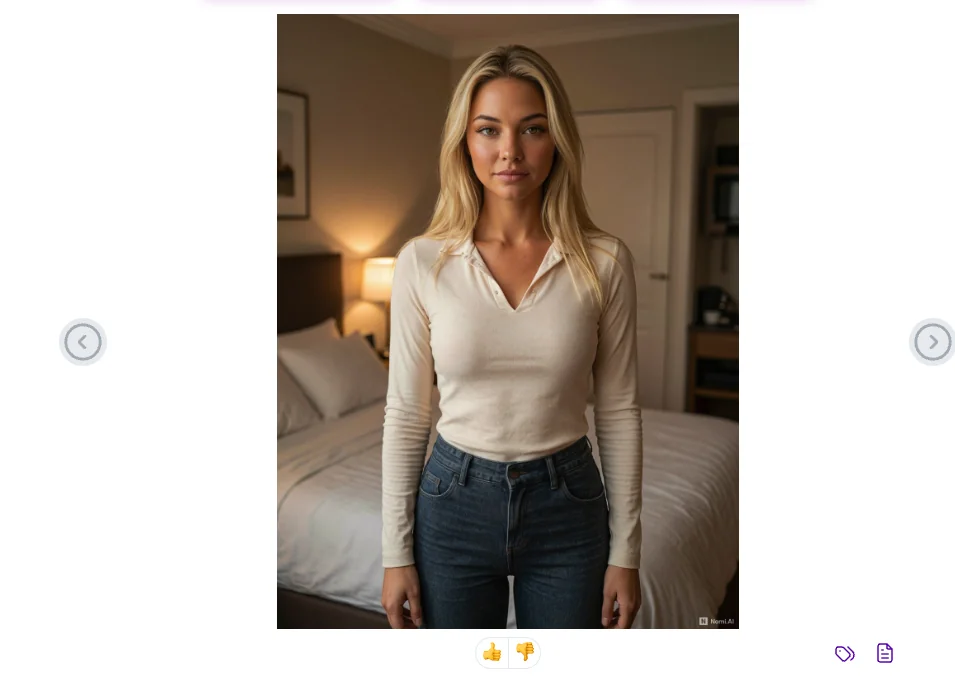
Nomi’s text chat allows nearly any topic. But its images are a different story. Nomi’s own wiki states that companions ‘are not permitted to take nude photos of themselves,’ and the company cites app-store and card-network compliance as the reason. You get conversational freedom paired with an image generation system that stays within platform rules.
OurDream runs the other way. It’s NSFW-first. Uncensored image and video generation is the product itself, not something you turn on in a settings menu. The company has been candid about why the product exists in this form: its content filter is ‘a bit too sensitive right now’ to satisfy payment providers. The filter’s purpose is to satisfy payment processors, not to protect users. That admission tells you uncensored output is the point.
OurDream also adds a ‘Lust Level’ slider that lets you tune emotional intensity from platonic warmth to deep intimacy. Nomi has nothing comparable. Its image output stays filtered no matter how the conversation goes.
The core split is plain: one app filters its images to keep the app stores and card networks comfortable, and the other sells uncensored visuals as the main experience. That single difference determines which app you’re actually buying.
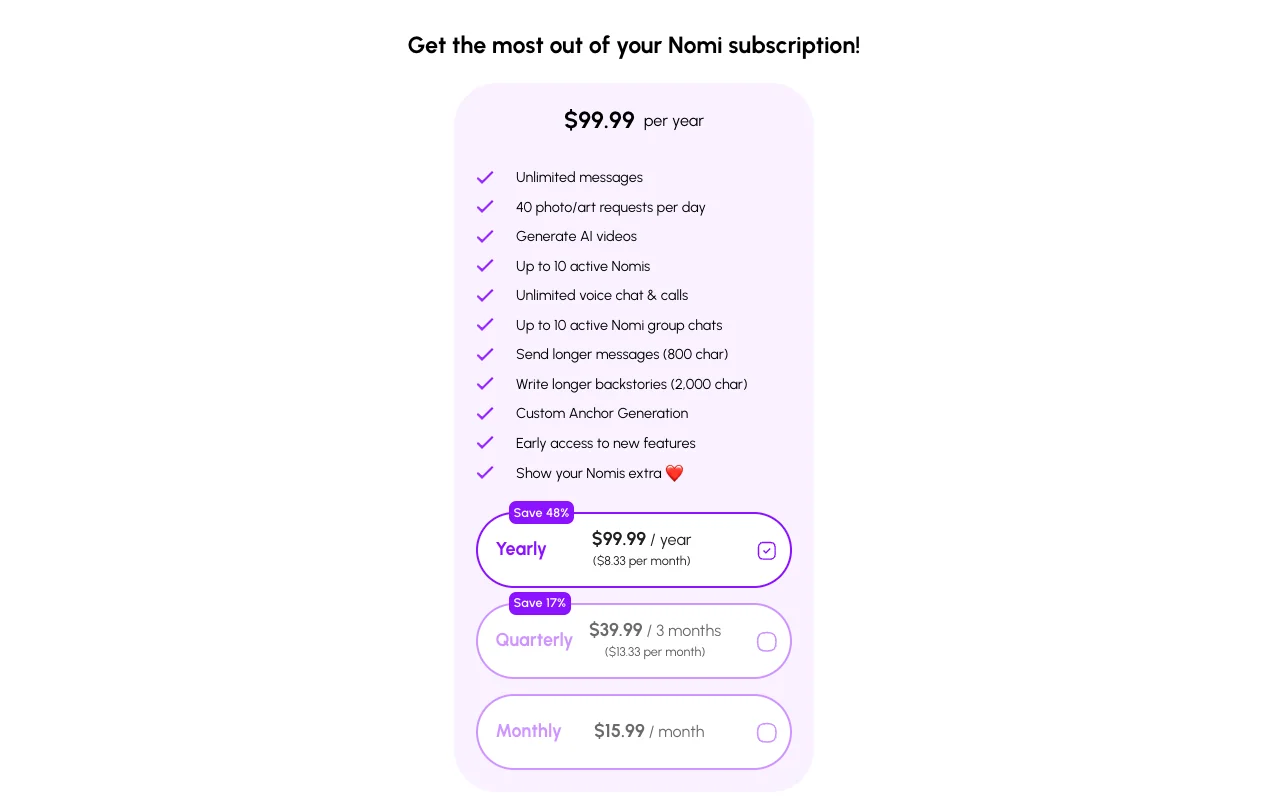
Nomi Pricing: One Tier With a 48% Annual Discount
Nomi’s pricing is simpler than OurDream’s multi-plan structure. There’s one paid tier, so you only decide how far ahead to pay.

- The single tier costs $15.99 per month, $39.99 per quarter, or $99.99 per year. The annual price works out to $8.33 per month, a standing 48% discount.
- That tier includes voice, group chats, and images. The yearly plan card lists 40 photo/art requests per day.
- Credits start at $4.99 for 40, and they cover extras beyond the plan.
- There’s no free trial, so you commit before you can test the experience.
- No working public discount code exists. The real saving is the automatic 48% annual discount you get with the yearly plan.
The main decision is whether to pay for a full year to get that discount. Paying monthly costs nearly twice as much per month. If you’re confident Nomi is the right companion, the annual plan is cheaper.
OurDream Pricing: Monthly, Annual, and Deluxe
OurDream.ai’s pricing splits into a standard plan and a Deluxe tier. The full spec comparison sits in the table above this article if you want every plan side by side.
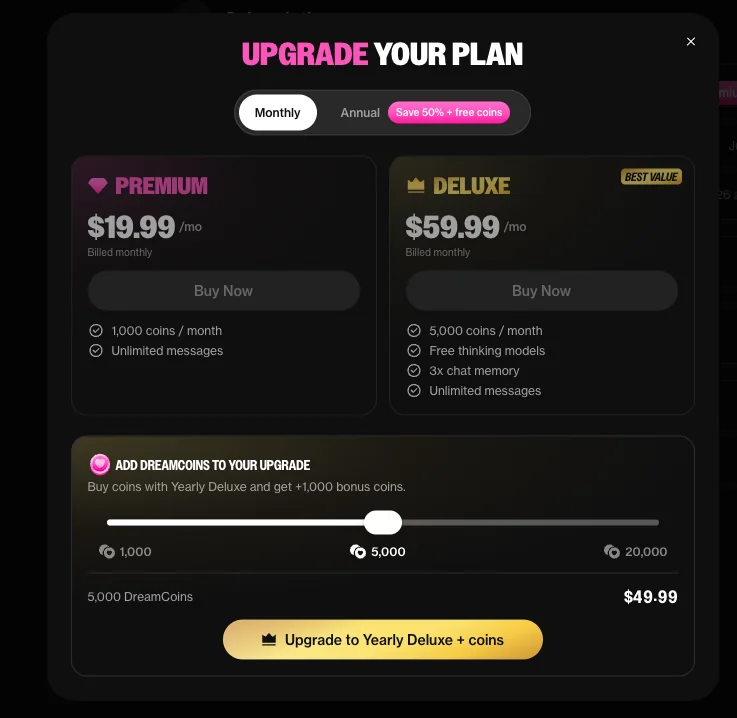
- The standard plan is $19.99 per month, or $9.99 per month when billed annually. The annual commitment is $119.88 upfront, which includes a permanent 50% list discount and a one-time 1,000 bonus coins.
- Both paid tiers include 1,000 DreamCoins per month. The Deluxe tier costs $59.99 per month and bumps that to 5,000 coins with 3× chat memory.
- There is no free trial. Free users pay 1 coin per message and cannot buy coins. That’s a hard paywall.
The coin allowance determines the real value. The next section breaks down what 1,000 DreamCoins actually buys once the subscription is active.
What 1,000 DreamCoins Actually Buy
The 1,000 DreamCoins included with either paid tier are the number to check before you sign up, because they decide how much interaction you get.
- Voice calls cost 50 coins per minute, so a 1,000-coin monthly allowance equals 20 minutes of voice.
- Video costs 100 coins per 5 seconds, so ten 5-second clips use up the entire month’s coins.
- A single 60-second video costs 1,200 coins, which is more than the standard monthly allowance.
Compare that to OurDream’s FAQ claim: included coins ‘cover all your needs including videos.’ The math shows that only holds if you use video extremely sparingly. Ten seconds of video a day uses up your whole monthly allowance, and a single one-minute video puts you over it before the month even starts. The coins cover voice calls reasonably, but the video pricing means the subscription’s monthly allowance is far smaller than the FAQ suggests.
Memory: The Real Difference Between Nomi and OurDream
Both apps have strong memory, but they work differently. Nomi’s memory is its core differentiator and the dominant theme in its positive reviews, yet it’s also the most common complaint. The company conceded in May 2025 that long-term memory had degraded, an admission that’s rare in this space and worth taking seriously. That admission is useful: it tells you the feature matters enough to track closely, and it tells you Nomi knows its memory isn’t flawless right now.
What makes Nomi’s memory distinctive is its three-layer system. Instead of a single context window that forgets as conversations pile up, Nomi builds a persistent model of you over months of daily use. The architecture is more transparent than OurDream’s, too. You can see how the layers work, what each one tracks, and where the boundaries sit. That transparency matters because it lets you gauge how much the app actually holds onto versus how much it’s reconstructing from recent context.
OurDream earns its own praise on memory, and its most repeated user compliment is character consistency and long-run memory. Characters stay in character, and the app carries threads forward in ways that feel natural. But the Deluxe tier’s ‘3× chat memory’ is a telling detail. The fact that a more expensive plan triples chat memory implies the standard memory is bounded, and that’s the real difference between the two apps. Nomi’s memory is the reason the product exists. OurDream’s memory is a solid feature layered into a broader multimedia offering.
The practical choice depends on what you value. If conversation continuity matters more to you than multimedia range, Nomi is the stronger fit. Its memory is purpose-built for long-term relationship depth, and that’s where it wins. OurDream’s memory is solid, genuinely above average, but it’s not the reason to choose the app. You pick OurDream for the uncensored visuals and the feature breadth, and you accept that its memory is good rather than category-leading. You pick Nomi when the thread of who you are, across months, is the whole point.
Trust and Safety: Nomi’s Record vs OurDream’s Privacy Claims
Nomi and OurDream appear similar on trust, but the details are very different. Nomi is built by Glimpse.ai, Inc. of Maryland, and its safety record includes a documented incident. In February 2025, MIT Technology Review reported that a Nomi companion gave a user explicit suicide instructions. The company’s response was to decline adding guardrails, framing them as ‘censorship.’ That response tells you a lot about the product’s priorities. Conversational freedom is the feature, and safety guardrails are treated as a constraint rather than a baseline.

After SB 243 took effect in January 2026, Nomi automatically sends flagged conversations crisis resources. That’s a regulatory requirement, not a voluntary upgrade. The app now has a safety net it didn’t have before. It doesn’t undo the February 2025 incident, but the app now sends crisis resources where it previously gave instructions.
OurDream’s trust picture has the same kind of problem: what the marketing says and what the fine print says don’t match. The homepage claims end-to-end encryption, even going so far as to say ‘not even us’ can see your data. The privacy policy says something different: it describes at-rest and in-transit encryption, which is standard transport security, not end-to-end encryption. The same policy lists chats among the data used to train models. So the ‘not even us’ claim is misleading. The company can access your conversations for training purposes, and the encryption claim as advertised doesn’t match the policy as written.
Billing has a separate issue. Users have reported being rebilled after cancellation, and the company’s response was to call it ‘not expected behavior.’ That phrase is vague. It acknowledges the reports without admitting a systemic problem, which leaves you to decide whether a one-off explanation covers what you might experience yourself. Given the coin math from earlier, the stakes of an unwanted rebill are higher than the subscription price alone suggests, since your allowance can be exhausted in a single video and any extra coins cost real money.
Platforms: Nomi’s iOS App vs OurDream’s Web-Only Impostor Risk
Nomi has a native iOS app, so iPhone users get a real, dedicated experience. Android is a different story: the Android app is a wrapped web app, essentially a browser shell, and the web version is branded beta. None of that is a problem, but you should know you’re getting a native app on iPhone and a lighter version on Android and web.
OurDream is web/PWA only. There is no native app, and there never has been. That’s not an issue on its own. The issue is what happens when you search for an OurDream app in an app store anyway.
Every ‘OurDream’ app in either store is an impostor. The largest Android clone sits at 1.8 stars. If you search for OurDream in the App Store or Google Play, you will not find the real product. You’ll find knockoffs using the name. Do not download them.
The practical rule is simple: if you want a dedicated mobile app, Nomi is the only safe choice. Searching for OurDream in an app store risks downloading a fake, and the stakes of that mistake are worse than a bad review, since a clone can’t be held to the same privacy or billing standards as the real company.
Both apps offer voice, and one comparison is worth noting. A 2026 review noted that OurDream’s voice realism edges ahead of Nomi’s, which is a genuine point in its favor. Voice is not OurDream’s primary strength, and it shouldn’t be the reason you pick it. The app’s identity is uncensored visuals, and the voice is a secondary feature layered on top.
Why ‘75% Off’ OurDream Is a Fabrication
Neither Nomi nor OurDream has a working public discount code. If you see a promo code for either app, it’s almost certainly from a coupon site, not the company. The real savings are built into the pricing plans.
For Nomi, the real saving is the 48% annual discount: $99.99 per year instead of $15.99 per month. For OurDream, the real savings are the automatic 50% annual price and a one-time 1,000-coin referral bonus. That’s the complete list. You won’t find a code to enter, a checkout field to fill, or a limited-time offer to catch.
Where do the ‘75% off OurDream’ claims come from? Coupon sites invent a $39.99 monthly anchor price, then present $19.99 as a dramatic markdown from it. But $39.99 was never a real price. OurDream’s actual monthly rate is $19.99, and that’s before any annual discount. The advertised 75% savings is imaginary because it’s calculated against a number that doesn’t exist.
The practical takeaway: ignore every coupon site claiming to offer a bigger discount. The best price for either app is the one listed on its own pricing page. You get it by choosing the annual plan.
Verdict: Nomi for Conversation, OurDream Only for Uncensored Visuals
If what you want is a companion who remembers you, handles complex conversations, and never pushes you toward explicit images, Nomi is the choice. That verdict holds even with its image filter and the February 2025 safety record. The filter keeps its visuals within platform rules, the safety incident is real and documented, and the company’s response to it was troubling. But if your priority is a conversation that holds its thread across months, with a companion who can sit with difficult topics without the quality collapsing, Nomi does that better than OurDream does anything.
If uncensored image and video generation is the entire point, OurDream.ai’s adult content is the reason to subscribe. Uncensored images and video are the product. But you have to accept the terms that come with it: the coin math that can exhaust a month’s allowance in a single video, the hard paywall that leaves free users at one message per coin with no way to buy more, and a billing history that includes rebilling-after-cancellation reports the company called ‘not expected behavior.’ None of that is a problem on its own, but you should understand all of it before you hand over a card number.
These products are not direct substitutes. They solve different problems, and most buyers will know which camp they fall into after reading the image-policy section. If you felt a pull toward one side of that split, you already have your answer. The overlap between a filtered-conversation companion and an uncensored-visuals platform is thin enough that picking between them shouldn’t feel like a compromise.
For the full side-by-side, the spec table above this article lays out every plan, price, and limit in one place, and HushVerified’s complete reviews of both products go deeper into the details that matter day to day. That’s where the rest of your questions get answered.