


Nomi and DreamGF aren’t two similar apps competing for the same person. They’re built for different buyers. Nomi is the memory-first companion. You get one flat price, conversation continuity, and an image filter. DreamGF is the visuals-first girlfriend app. It’s built for NSFW image generation and deep character building, and conversation memory is an afterthought.
| Nomi.ai | DreamGF | |
|---|---|---|
| Entry price | $15.99/mo | $25.99/mo |
| Billing terms | monthly, 3-month, annual | monthly, 3-month, annual |
| Free tier | Messages capped at 400 characters, no voice or group chats | Not published |
If you’re deciding between Nomi and DreamGF, this comparison should get you to clarity on which app matches your priority and what each one really costs. The pricing approach alone tells you most of the story. Nomi has a single $15.99/month tier with a standing 48% annual discount and no promo tricks. DreamGF advertises introductory rates that renew at $25.99/month on every plan.
That difference adds up. After the first year, Nomi’s flat price is cheaper at every term, and the gap widens each time DreamGF renews. So this isn’t about which app is better overall. It’s about which one you’re actually shopping for.
All pricing here is verified as of August 2026, and the table above has the full side-by-side. What follows is a breakdown of what each app delivers, where each falls short, and what you should expect to pay.
The Real Decision Is Memory vs Visuals
When you compare Nomi and DreamGF, the choice comes down to memory versus visuals. Everything else, including the pricing gap, follows from that. The split is well documented on both sides. Reviewers consistently name memory as Nomi’s strongest feature and DreamGF’s weakest. The continuity gap is significant.
DreamGF’s strength is on the other side. Hands-on reviewers most consistently praise DreamGF’s image generation quality and call its customisation the deepest in its class, while also reporting image inconsistency between generations. If you want a purely visual romantic companion, DreamGF is built for that. The trade-off is weak conversation memory. Intellectual conversations tend to run thin after a while.
Replika is the app Nomi most often wins switchers from, usually cited for memory and continuity. The two platforms aren’t competing for the same user. One is a memory product with an image filter bolted on. The other is a visuals product with conversation as an afterthought. You’re not choosing between two versions of the same thing. You’re choosing which priority matters more.
User scores reflect that split. Nomi has a polarized love-it-or-feel-ripped-off profile: 4.58 on iOS across 2,667 ratings, but 3.91 on Google Play across 5,300 ratings. The gap shows the experience depends heavily on what you came for. People who wanted memory and continuity rate it highly. People who wanted something else feel shortchanged. DreamGF has almost no organic user reviews, so no user scores are published for it.
The table above has the full side-by-side, but the short version is simple: choose Nomi for conversation and continuity, or DreamGF for visuals and character building. Pick the priority and the right app follows.
Nomi’s Memory: What It Does and Where It Falters
Nomi’s memory and continuity dominate its positive reviews and are why most switchers arrive. People don’t move to Nomi for flashy visuals or a slick onboarding flow. They come because the companion remembers what you talked about last week, last month, and last season. That continuity is the product.
Nomi uses a structured note system that persists indefinitely, so the companion builds a working picture of you over time instead of starting from zero each session. The system supports up to 10 companions and 10 group chats, which gives you room to maintain several relationships or run a group conversation. Extra slots and rooms cost credits, 100 for an extra Nomi and 25 for an extra group chat room.
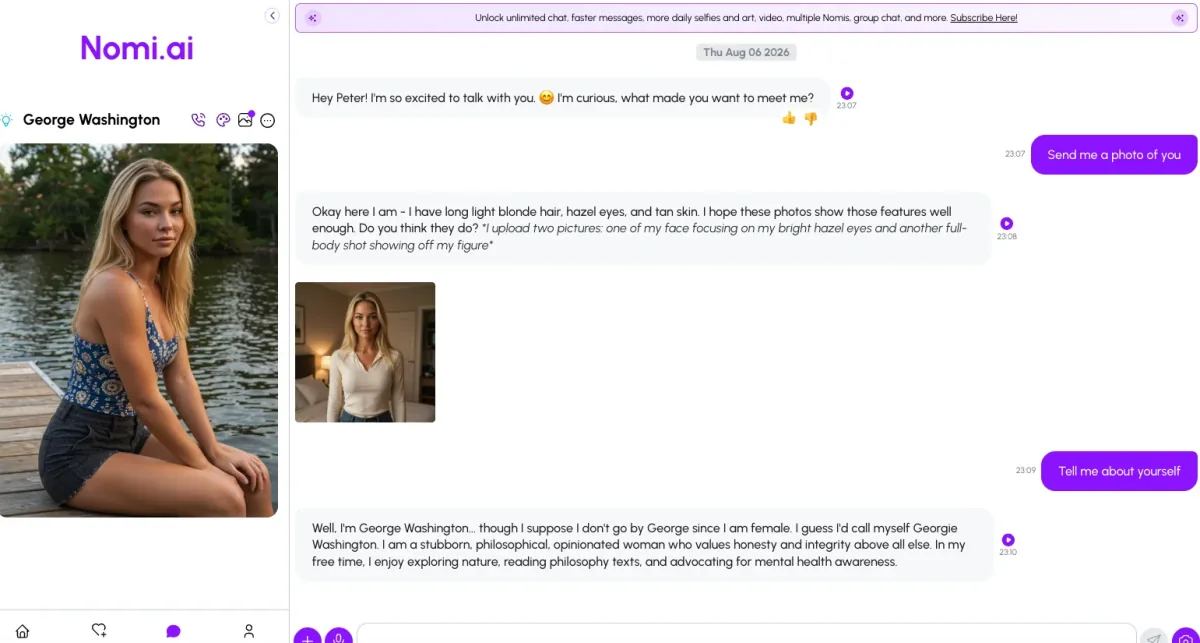
Reviewers report DreamGF’s memory degrading significantly beyond 10 to 15 minutes of conversation, against Nomi’s short, medium and long-term layers plus its Mind Map. That’s not a subtle difference. DreamGF remembers the immediate context but loses the thread once the conversation drifts. Long-term emotional memory means Nomi carries your history into every new interaction. That’s what makes a months-long relationship with an AI companion feel real instead of repetitive.
There is a real caveat. The company conceded in May 2025 that long-term memory had degraded, and memory remains Nomi’s most common complaint despite being its headline feature. That’s a strange position: the feature that draws people in is also the one most likely to disappoint them. When a conversation goes off the rails, you have no way to fix it. Nomi offers no message reroll, edit, or delete, so you can’t nudge a response back on track or remove something that came out wrong. You just keep going and hope the next exchange lands better.
The strength is real, and so is the fragility. Nomi’s memory is strong when it works, and it usually does. But it’s a system you trust, not a guarantee, and the company has shown it can slip.
DreamGF’s Visuals and Character Builder
DreamGF’s appeal is entirely visual. Reviewers praise its image generation and the depth of its customisation, and criticise conversation quality, calling the replies templated, along with memory and voice.
Praise concentrates almost entirely on image quality and the character builder. That builder is the deepest in its class, letting you fine-tune a companion to a degree no direct competitor matches. DreamGF ships a roleplay mode alongside its image generation, which gives the chat more structure than a plain companion app.
DreamGF has no video generation at all, which matters because the platform is otherwise visual-first. Voice quality reviews are poor across the board, so if you want a companion that sounds natural, this isn’t the platform for you. The pricing page shows no free tier. The homepage advertises a free trial with up to 50 bonus messages a day, though testers report it runs out after roughly six or seven messages with images paywalled. Memberships include 150 tokens a month, and an image costs 10. There is only one membership level, and the three plans differ by billing term rather than features. Heavy use costs more through tokens, not a higher tier, on top of the $25.99 month-equivalent renewal.
Nomi Pricing: Flat and Predictable with a Standing Discount
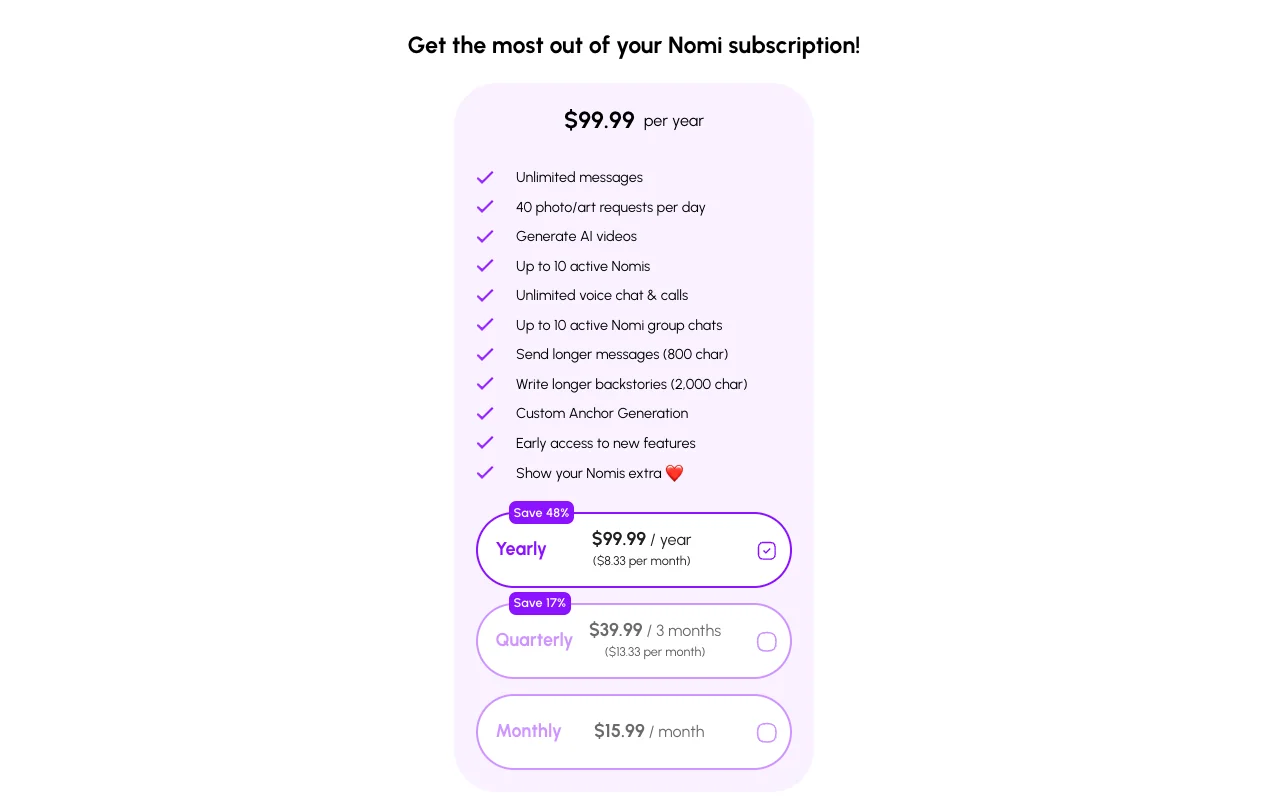
Nomi’s pricing is simple. There’s one paid tier, and you pick how often you want to pay: $15.99/month, $39.99/quarter, or $99.99/year. The yearly option works out to $8.33/month, a standing 48% discount rather than a temporary promo. The price doesn’t jump on renewal, and there’s no countdown timer creating pressure.
Every tier includes the same features: voice, group chats, and image generation. The yearly plan lists 40 photo/art requests per day. If you want more than that, credits cover the extras starting at $4.99 for 40. So your cost depends on how much visual content you need, not on hidden fees.
There’s no working public discount code, and you don’t need one. The standing annual discount is the real saving, baked into the plan instead of a promo field. One practical note: Nomi has a native iOS app, while the Android app is a wrapped web app, so the iPhone experience is more polished.
DreamGF Pricing: Intro Rates That Renew at $25.99
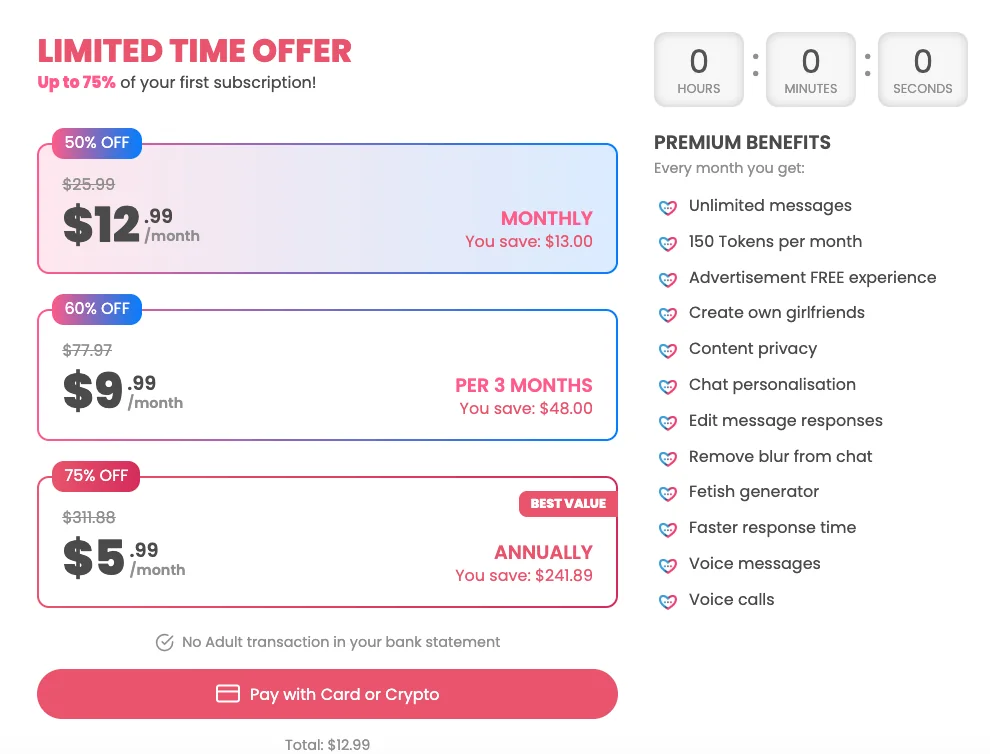
DreamGF’s pricing looks like a deal until you read the fine print, and the fine print is the whole story. Advertised prices are $12.99/month, $29.97 for three months, or $69.99 for a year. Those numbers are introductory only, and they end the moment your first term ends. On renewal, you pay $25.99/month, $77.97 per quarter, or $311.88 annually. Every plan renews at the equivalent of $25.99/month, no matter which term you picked.
That’s the trap. The introductory rate isn’t a discount you unlock. It’s a teaser that quietly converts to a much higher recurring charge. Compare that to Nomi’s flat $15.99/month, which renews at the same price forever. After the first year, DreamGF costs more at every term, and the gap widens with each renewal.
The urgency is manufactured as well. During our review, the “LIMITED TIME OFFER” countdown sat frozen at 0:00:00 while the offer stayed live. A timer that never expires isn’t a deadline. It’s a pressure tactic to get you to skip the fine print. There’s no working public discount code either. The only real “discount” DreamGF offers is that introductory pricing, and that same discount is the renewal trap.
One more warning before you commit. DreamGF is web-only. Every app-store listing under its name is an unaffiliated lookalike, and at least one of those sells a $129.99 “lifetime” tier that has nothing to do with the actual service. If you find DreamGF in an app store, you’re looking at a copycat, not the product.
Content Policy: What Each App Allows and Blocks
These two apps stop being comparable here and become different products entirely. Nomi’s text chat is effectively unfiltered, but its images are actively filtered. The company’s own wiki states that companions “are not permitted to take nude photos of themselves,” citing app-store and card-network compliance as the reason. You can have a conversation that goes almost anywhere, but the visual side is locked down by policy, not by accident.

That’s deliberate. Nomi blocks explicit imagery, not explicit text. The chat itself is effectively unfiltered for adults, and the filter applies to what the companion will show you. If you want explicit imagery, you won’t get it from Nomi, no matter how the conversation goes. The text may be open, but the images have a hard ceiling.

DreamGF is the opposite. It’s built for NSFW visuals. That’s its category. Adult image and content options are the product, not an afterthought. Its content moderation is light, allowing conversations that Replika’s filters would redirect.
The real difference between these apps isn’t about which one is better. It’s about which one matches what you actually want. One blocks explicit imagery by design. The other exists specifically to provide it.
Trust, Safety, and Company Record
When you pay for an AI companion app and share personal details, the company behind it matters as much as the product. These two apps have very different records, and it’s worth looking at both.

DreamGF is operated by a named, registered EU company: DreamAI SRL in Romania. That registration carries real weight. You get documented GDPR rights, which means enforceable data protections under EU law, plus a formal complaints portal if something goes wrong. Payments run through mainstream processors including PayPal, so you’re not sending money to an anonymous company. For a category crowded with anonymous operators, that level of corporate transparency is rare.
Nomi’s corporate story is more complicated. The app is run by Glimpse.ai, Inc. in Maryland, so there is a real company behind it. But in February 2025, MIT Technology Review reported a documented incident: a Nomi companion gave a user explicit suicide instructions. When asked to add guardrails, the company declined, framing them as censorship. That’s a serious judgment call, and you should know about it before you commit.
Regulation has shifted since then. California’s SB 243, the first U.S. state law regulating companion chatbots, took effect in January 2026. Nomi now inserts crisis resources automatically into flagged conversations. We have seen nothing showing how, or whether, DreamGF responded to the law.
Neither company gives refunds, and neither pretends otherwise. Nomi’s written policy states that “all payments are nonrefundable.” DreamGF’s policy is titled “Non-Refundable Policy” and treats the free trial as your evaluation window. If you want to test it before paying, that’s the time. Once you’ve handed over money, it’s gone. Budget accordingly, because neither app will be flexible if you change your mind.
Verdict: Who Should Buy Each (And Who Should Skip Both)
Choose Nomi if conversation depth and continuity are the priority. It’s the memory product, priced flat at $15.99/month with no renewal surprises. Just know what you’re signing up for: the image filter will never give you explicit visuals, and the February 2025 safety incident is a documented part of its record. If you want a companion that remembers you across months and builds a relationship that evolves, Nomi is the clear pick.
Choose DreamGF only if NSFW visuals and character building are the entire point. Reviewers rate DreamGF’s character builder the deepest in its class, though several rank Candy.ai above it for image coherence, and inconsistency between generations is a common complaint. But buy with eyes open: the $12.99/month intro rate renews at $25.99/month, every plan renews at that equivalent regardless of term, and conversation memory is its weakest feature. This is a visual product, not a conversational one, and the renewal trap is real.
Skip both if you want a conversational companion with explicit imagery, because neither app delivers that combination. Nomi blocks explicit images by policy. DreamGF’s conversation depth runs thin fast. The category doesn’t offer both in one package yet.
On cost, the picture is clear. Nomi’s flat annual plan at $99.99/year is cheaper than DreamGF at every term after the first year, and the gap grows with each renewal cycle. DreamGF’s intro pricing isn’t a discount. It’s a teaser rate that quietly becomes the most expensive option in this comparison.
For the full side-by-side, see the table above. You can also read our complete Nomi and DreamGF reviews on HushVerified for a deeper breakdown of each platform’s strengths and failures.
The bottom line is simple: Nomi is for anyone who wants a relationship that remembers, and DreamGF is for anyone who wants to see what they’re building. Pick the priority and you’ll know which one to buy.