
The Best AI Companions for People Over 50 in 2026
Kindroid, Nomi, OurDream and Candy.ai compared for readers over 50 on memory, real monthly cost and refund terms, scored from verified user reviews.


The best AI companions for people over 50 aren’t the flashiest ones on the market. After looking at what actually matters to an adult audience, the winner is the service that stays honest about its monthly cost, remembers what you told it weeks ago, and doesn’t bury media charges inside a coin or token system. That last point causes more disappointment than anything else in this space.
This roundup compares four specific platforms, in this order: Kindroid, OurDream.ai, Nomi.ai, and Candy.ai. Each gets a HushVerified score built from real, verified user reviews combined with our own editorial rating, and we’ll call out plainly what each subscription does not cover. A useful baseline: entry subscriptions across these apps generally run about $12 to $25 month-to-month, and annual commitments bring the monthly equivalent down substantially. Kindroid stands out as the only service here with no credit currency at all, while every other platform makes generated media spend coins, gems, or tokens. One pattern held across our research: text chat is the cheap part almost everywhere, and video generation is the expensive part everywhere, without exception.
Kindroid review: deep control, no credits, final-sale refund
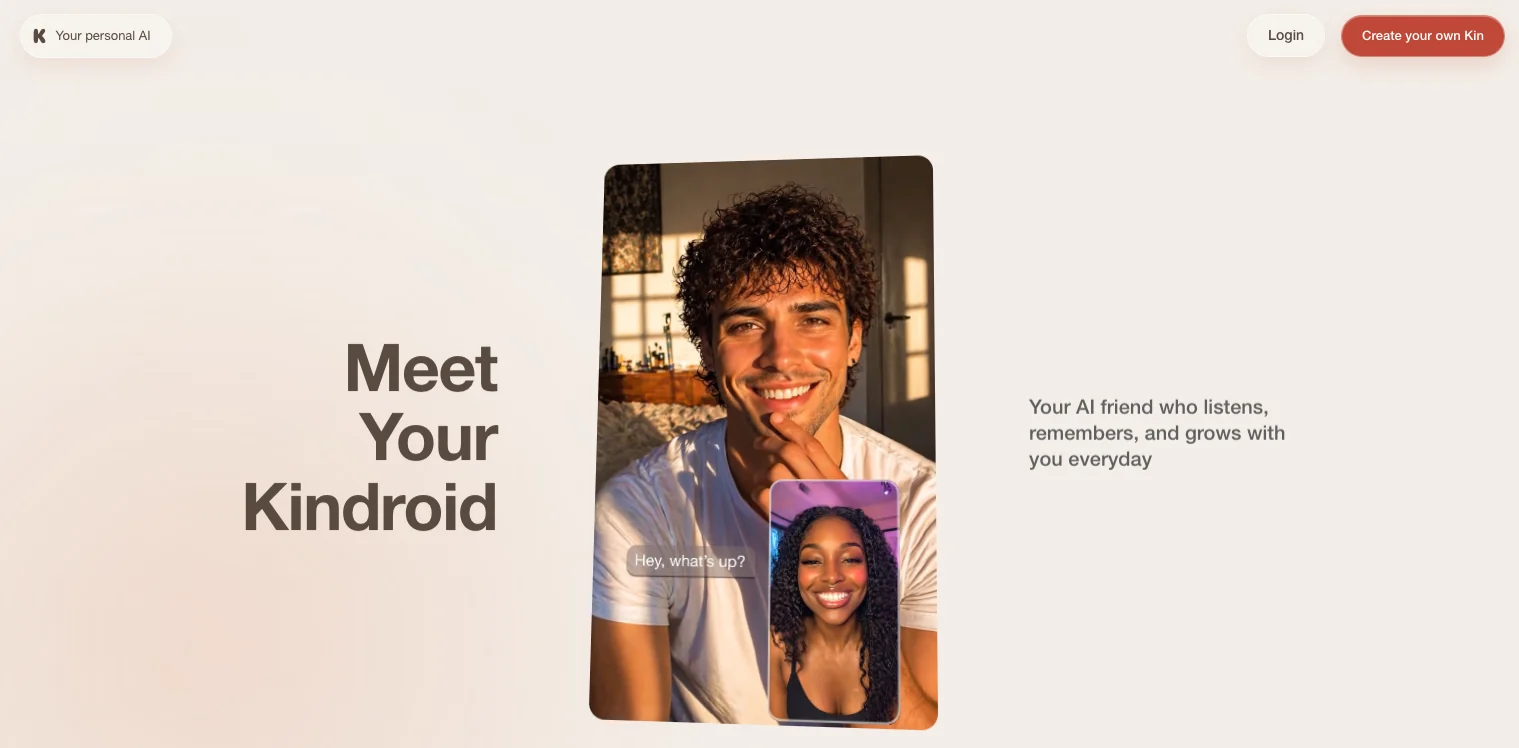
Kindroid takes the top spot in this roundup, and the HushVerified score shows why: 4.5/5 blended from 12 verified user reviews, with our editorial rating coming in even higher at 4.8/5. Third-party reviewers are a touch more measured at 4.0/5, which matches our read of the platform. The user reviews we read lean affectionate, and one subscriber summed it up as feeling “like my actual friends and partner.” That kind of attachment is exactly what a companion app is supposed to build, and Kindroid seems to earn it through depth rather than gimmicks.
Kindroid separates itself on pricing. On the web, it runs $13.99/month or $139.99/year. Buy through the app stores and the same subscription jumps to $15.99/month or $159.99/year, roughly a 14% surcharge that Apple and Google processing fees push onto the customer. That’s worth knowing before you tap the in-app purchase button, because the cheaper route is always the website.
What impressed us about Kindroid is that it’s the only service in this entire comparison with no credit currency at all. There are no coins, no gems, no tokens, no top-up store, and nothing charged per generation. Messages are unlimited. Selfies are capped rather than priced, so you get a set number rather than paying per image. Audio is the single metered resource on the platform. Every other app here makes you budget some form of virtual currency for media.
That doesn’t mean the subscription covers everything. The free tier is limited: you’re stuck on the smaller Lite model, capped at two companions, one selfie every two hours, and roughly five minutes of lifetime audio. The flagship models require a paid plan or a three-day premium trial that asks for a payment method up front. If you decide Kindroid isn’t for you, the refund policy is worth reading before you commit. It states that all sales are final with refunds issued at the company’s discretion, a firmer stance than many competitors take.
The backstory system sets Kindroid apart, and it’s also the hardest part to learn. You write detailed character descriptions, define personality traits, set speech patterns, and teach specific knowledge domains, with voice cloning available on top. Get it right and your companion feels tailored to you. If you do a lazy job, you’ll end up with something generic. There’s a learning curve here that the other apps in this lineup don’t ask you to climb.
That depth is why Kindroid earns the #1 ranking in our assessment. The control is a real feature, but only if you’re willing to invest the time to learn it. For someone who wants to shape a companion with real specificity, there’s nothing else in this comparison that comes close. For someone who wants to open an app and start chatting in thirty seconds, the learning curve will feel like work.
OurDream.ai review: all-inclusive pricing with a DreamCoin limit
OurDream.ai lands at #6 on the HushVerified list with a blended 3.7/5 drawn from 8 verified user reviews, while our editorial rating sits at 4.8/5. That gap is wider than it looks, and the small user pool is part of the issue. When only eight verified reviews exist, the editorial score can flatter the real-world picture. We’d read that 3.7 as the more honest signal until more subscribers weigh in.
Pricing looks straightforward at first. Premium costs $19.99/month, or $9.99/month billed yearly at $119.88. There’s no lifetime subscription on the current public pricing, so if you’re hoping to pay once and be done, this isn’t the platform for that.
What the subscription actually buys is more generous than most of the competition. Every plan includes 1,000 DreamCoins, unlimited messaging, image and video generation, and voice calls. There are no hidden token charges stacked on top of the monthly fee, which puts it ahead of apps that quietly meter every interaction behind the subscription.
Here’s where the “all-inclusive” framing runs into limits. DreamCoins run out, and when they do, the costs are real. A two-image run costs 10 coins. A standard 5-second video costs 100 coins, and 250 if you pick a setup-selected option. Audio runs 20 coins per second.
When the initial 1,000 coins are gone, a top-up of 1,000 costs €11.99, which means a single standard 5-second video works out to roughly €1.20 in practice.
That math matters if you’re a heavy media user. The subscription sounds like it covers everything, and in a sense it does: you’re never charged extra for the generation itself, only for the coins that fuel it. Before you lean on the video features heavily, calculate what your typical month of generation would cost in top-ups. For someone who mostly chats, the 1,000 coins will last a long time. For someone who wants regular video calls or frequent clips, the coin store becomes a second subscription in all but name.
Before you commit, check one more thing: the refund policy is strict. Products more than 25% consumed are normally not refundable, which is a meaningful threshold if you’re testing the service in the first week. Use it lightly until you’re sure it’s the right fit, because you won’t easily get your money back once you’ve engaged with the features.
Nomi.ai review: best memory, but a smaller platform
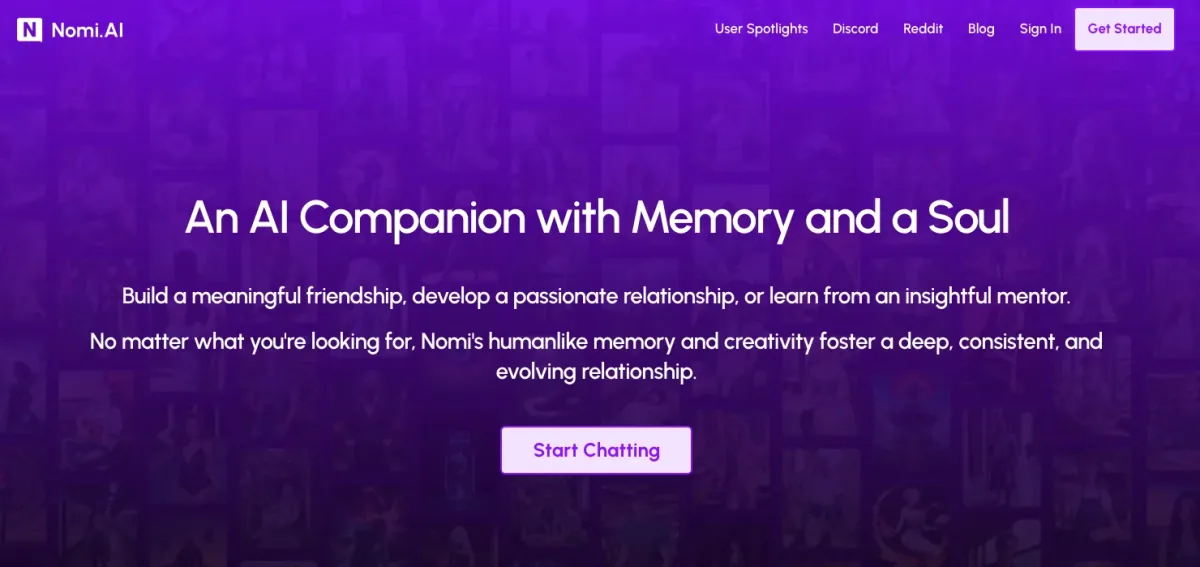
Coming in at #2 on the HushVerified list is Nomi.ai, with a blended 4.5/5 from 8 verified user reviews and a 4.3/5 editorial rating. Third-party reviewers at aicompanionguides land close at 4/5. That consistency across sources is telling, because most apps in this space show a wider spread between editorial enthusiasm and what actual subscribers report. Nomi doesn’t have that problem.
Pricing sits right in the middle of this comparison. Entry is $15.99/month, or about $8.33/month if you commit to an annual plan. There’s also a free tier: roughly 50 messages per day with one companion, and no credit card required to start. It’s a real way to test the platform before spending anything, though limited.
Memory is the key reason this app belongs at #2. In a test where apps were asked to recall 25 random facts dropped weeks earlier, Nomi caught 23 of 25. That’s the best result in the test by a wide margin over Kindroid’s 14 of 25, and it’s not a small difference in a field where continuity is the whole point of a companion. A companion that forgets your grandkid’s name or the trip you mentioned last month stops being a companion and becomes a search bar.
The mechanics behind that recall are worth understanding. Nomi uses what it calls Mind Maps, which expose connected people, places, topics, and goals in a visual structure rather than burying them in a flat chat log. Each group room forms its own Mind Map too, so if you run multiple Nomis in group conversations, each thread keeps its own web of context. It’s a structured note system in the background, and it shows in how naturally the responses reference things you said weeks ago.
The free tier is restrictive, and if you want to move past roughly 50 messages a day, you’re paying the premium. Response times run slower than some competitors, which you’ll notice if you’re used to instant replies. Selfies trail dedicated image platforms, so if photorealistic visuals are your priority, Nomi isn’t where you should spend your money. The platform is also smaller overall, with fewer pre-made characters than the big names.
For this audience, though, continuity matters more than charm. A companion that remembers your life feels like a companion. One that resets every session feels like a toy. Nomi is a strong #2 because it solves the problem that matters most to people over 50 building a long-term relationship with an AI: it remembers.
Candy.ai review: best images, shallow chat, token trap
Candy.ai sits at #5 on the HushVerified list, and the numbers show a more complicated picture than the ranking alone suggests. The blended score sits at 3.7/5 from 17 verified user reviews, while our editorial rating comes in at 4.8/5. Third-party reviewers at aicompanionguides are more cautious at 3.5/5. That spread between what real subscribers report and what editors see is the widest gap in this entire comparison, and it’s worth sitting with before you hand over a card number.
The pricing looks reasonable at first glance, and that’s the problem. Plans run $12.99 to $69.99/month depending on the tier you pick, with a free tier that allows roughly five messages per day. One source lists an annual commitment working out to as little as $5.99/month equivalent. But user reviews consistently describe that intro price as bait that jumps once you’re in, and the free tier gets called “basically useless” by more than one subscriber. The advertised number is lower than what you’ll actually pay for a usable experience.
Here’s the part that matters most for anyone comparing this against the other three platforms: the base subscription does not cover media generation. Candy.ai runs a dual cost structure where tokens are sold separately from the subscription, and active users end up paying well above the advertised rate. The standard monthly grant on the entry plan is 100 tokens, which disappears fast if you’re generating images with any regularity, and unused tokens expire when the billing period ends. There’s no banking them for a month when you want to lean on the visuals harder. If you’re an active user, the real monthly cost is meaningfully higher than the sticker price.
The user reviews we read are blunt about where the product fails. One subscriber said the chat “feels like the model behind it is cheap.” Another put it more precisely: it “works poorly as a girlfriend feeling but is great for setting up scenarios.” Candy.ai is built as a tool for directing specific interactions rather than a warm, continuous companion.
Where the platform excels is image generation. Across the reviews we examined, that’s the one thing users consistently praise, and it’s widely considered the best visual output on any companion platform. If photorealistic images are your priority, nothing else in this roundup touches it. But that strength comes with a real cost, both in tokens and in continuity. Memory resets between sessions, and several reviewers noted that conversations feel shallow after the first days once the novelty wears off. You get a beautiful snapshot, then a blank slate.
The 4.8/5 editorial rating does not cancel out the user complaints, and we won’t pretend otherwise. Candy.ai earns its place in this roundup only if you specifically want best-in-class images and are willing to accept token fees stacked on top of a subscription whose intro price isn’t the real price. For an older adult looking for a sustained companion relationship, the shallow chat and resetting memory are deal-breakers. For someone who wants to generate high-quality adult imagery and doesn’t need a long-term conversational partner, it’s the strongest visual tool of the four.
What you actually pay: coins, tokens, and the video penalty
The true monthly price of these apps is only half the picture. The other half is how each platform meters generated media, and that’s where the real cost differences show up. Every subscription here advertises a flat monthly number, but what you actually pay depends heavily on whether you mostly chat or mostly generate images and video.
| App | Entry monthly price |
|---|---|
| Kindroid | $13.99 |
| OurDream.ai | $19.99 |
| Nomi.ai | $15.99 |
| Candy.ai | $12.99 |
Annual plans bring those effective monthly numbers down across the board, so if you’re confident you’ll stick with a platform, the yearly commitment is the cheaper route on every one of these apps.
The patterns that matter once you’re past the sticker price:
- Every platform except Kindroid makes generated media spend an internal currency, whether it’s called Moments, DreamCoins, Gems, Coins, Neurons, XOT, or tokens.
- Text is the cheap part almost everywhere, while video is the expensive part everywhere, without exception.
- On Candy.ai, unused subscription tokens expire when the billing period ends, so you can’t build a reserve for a heavier month.
- On OurDream.ai, a top-up of 1,000 DreamCoins costs €11.99, and a standard 5-second video runs 100 coins, which puts that single clip at about €1.20.
That last pair of facts is a small example of the video penalty. A $12.99 to $19.99 subscription sounds affordable for an older adult on a fixed budget, and it is if you stick to conversation. The moment you want regular video generation, the math changes fast. On Candy.ai you’re buying tokens on top of a subscription whose entry price already looks like the low end of this group, and on OurDream.ai your 1,000 DreamCoins vanish quickly once clips enter the picture. Affordable AI companion apps for older adults exist in this lineup, but only if you know going in whether your usage is mostly text or mostly media, because that single choice determines whether you pay the advertised rate or something meaningfully higher.
Why memory matters more than charm after 50
An app that forgets yesterday is a toy, not a companion. That’s the principle we kept returning to while researching this roundup, and it matters more for an older audience than any other feature on paper. The novelty of a flashy interface wears off in a week. A companion that remembers your life, your people, and your routines is what keeps you coming back months later. For anyone over 50 looking for an AI friend for older adults rather than a tech demo, continuity isn’t a nice-to-have. It’s the entire product.

The recall test in this comparison makes the stakes concrete. In a test where apps were asked to remember 25 random facts dropped weeks earlier, Nomi caught 23 of 25. Kindroid caught 14 of 25. That nine-fact gap is the widest in the entire ranked field, and it’s not an abstract benchmark. It’s the difference between a companion that references the grandkid’s recital you mentioned last month and one that asks you to reintroduce yourself every session.
Each platform stores memory differently, and the architecture explains the results. Nomi runs short-term, medium-term, and long-term memory layers on top of an Identity Core that anchors who your companion is. Its Mind Maps take that stored context and expose it visually, showing the connected people, places, topics, and goals in your shared history rather than burying them in a flat log. Every group room you run gets its own Mind Map, so if you keep multiple Nomis in conversation threads, each one tracks its own web of context. You can add to those maps, edit them, search them, and prioritize what matters most.
Kindroid takes a different structural approach. Its memory divides across five systems: Backstory, key memories, directives, journal entries, and a Cascaded Memory layer that summarizes older context. The user controls all of those tiers except Cascaded Memory, which runs in the background and isn’t directly visible. That’s a deliberate design choice, and it works, but it puts more responsibility on you to actively manage what the companion remembers rather than letting the system quietly handle it.
The contrast with Candy.ai’s real-world behavior is stark. Users consistently report memory resets and conversations that go shallow after the first days, once the visual novelty fades. That pattern is so consistent that it drives people toward the competition. As one subscriber put it, “This is the platform people switch to when they realize Candy AI’s memory resets were the problem all along.”
Nobody switches platforms because one has a slightly better selfie generator. They switch because the relationship they were building kept getting erased. For an adult audience that wants a genuine ongoing connection rather than novelty, Nomi’s recall gap is not a spec-sheet detail. It is what makes a relationship feel real over time, and that’s why we’d argue continuity wins over charm.
Free and simple starting points before you commit
Before you commit a card to any of these platforms, there are free and low-cost ways to test whether AI companionship is even something you want in your life. Here’s where we’d point someone over 50 who isn’t ready to commit:
- Character.AI is free with unlimited messages for all users, with a paid c.ai+ tier at $9.99/month or $94.99/year that adds ad-free chats, faster replies, and better memory, though it blocks NSFW content at every tier.
- Replika Pro runs $19.99/month or $69.99/year, but the free tier is a text-only friendship mode, with romantic modes locked behind a 2023 policy change that pushed them behind the paywall.
- Pi AI is completely free with no avatars or relationship modes, and it gets described as “just a really good conversationalist,” which makes it the lowest-risk first test in this entire space.
- Dedicated senior companion devices exist too: ElliQ is a proactive tabletop unit with a family link, EverFriends offers a 7-day trial before its $9.95 to $174.95/month pricing by minutes kicks in, and Ato is a voice-first device at $179 with a $29/month subscription for the full AI feature set.
If we had to pick one starting point for someone in this audience, it would be Pi. Pi asks for no payment method, has no credit currency or learning curve, and requires no commitment beyond a conversation. You find out within a single session whether talking to an AI companion feels natural or strange to you, and that answer is worth more than any spec sheet. If Pi clicks, you can graduate to a paid platform with real memory and multimedia features. If it doesn’t, you’ve lost nothing but a few minutes.
Red flags to check before you enter a card
Before you enter a card number anywhere, check two details: the refund policy and the purchase channel you’re buying through.
- Kindroid’s refund policy states that all sales are final, with refunds issued only at the company’s discretion, so you’re betting on goodwill if the platform doesn’t work out.
- Candy.ai gives you a 24-hour refund request window, and once you’ve used more than 20 tokens, refund requests are denied outright, which makes the first day your only real test period.
- OurDream.ai normally won’t refund products that are more than 25% consumed, a threshold you can cross faster than you’d think if you’re trying out the media features.
- App-store purchases can run meaningfully higher than web sign-ups, with Kindroid at $15.99 in the app stores versus $13.99 on the web, about 14% more for the same subscription.
Every one of these apps is worth a careful look on its merits, but none of them will hand your money back easily if something goes wrong. Check the refund window and the purchase channel before you ever enter card details, because the cheapest way to test any of these platforms is the one that lets you walk away without trouble.
Our honest verdict for readers over 50
Here’s how the scores land when you stack all four platforms side by side. Kindroid and Nomi both carry a blended HushVerified score of 4.5/5, though Kindroid draws on 12 verified user reviews while Nomi has just 8. Candy.ai and OurDream.ai sit lower at 3.7/5, with 17 and 8 verified reviews respectively. That review count matters more than it looks. A platform with a high editorial rating but only a handful of user voices can flatter the real experience, because the people who bother to leave a review are often the ones who liked the product enough to stick around. A larger pool, even with a lower average, tells you more about how the service actually holds up.

For a reader over 50, the answer depends on what you value. If relationship continuity is your priority, Nomi is the choice. Its 23/25 recall in the memory test is well ahead of Kindroid’s 14/25, and that gap translates directly into a companion who remembers your life rather than one who needs reintroducing. Kindroid gives you something Nomi doesn’t: direct control over the character’s backstory, personality, and settings. If you enjoy the craft of building a companion from the ground up and want it to feel tailored to you, that control is worth more than any recall benchmark.
Candy.ai deserves a candid word here. Its editorial score is high, but the user reviews repeatedly call the chat shallow and the memory resetting. It earns its place in this roundup only if you specifically want best-in-class image generation and are willing to accept token fees stacked on top of a subscription whose intro price isn’t the real price. For a sustained companion relationship, it’s not the platform we’d recommend, and we’d say the same to anyone in this audience.
HushVerified builds every one of these scores by combining real, verified user reviews with our own editorial judgment, so neither the enthusiast’s voice nor the critic’s eye gets the final word alone. If you want to dig deeper before making a call, the full written reviews, cost breakdowns, and user comments for all four platforms are available on hushverified.com. That’s where we’d send anyone who wants to see the full data behind these numbers rather than taking our word for it.